
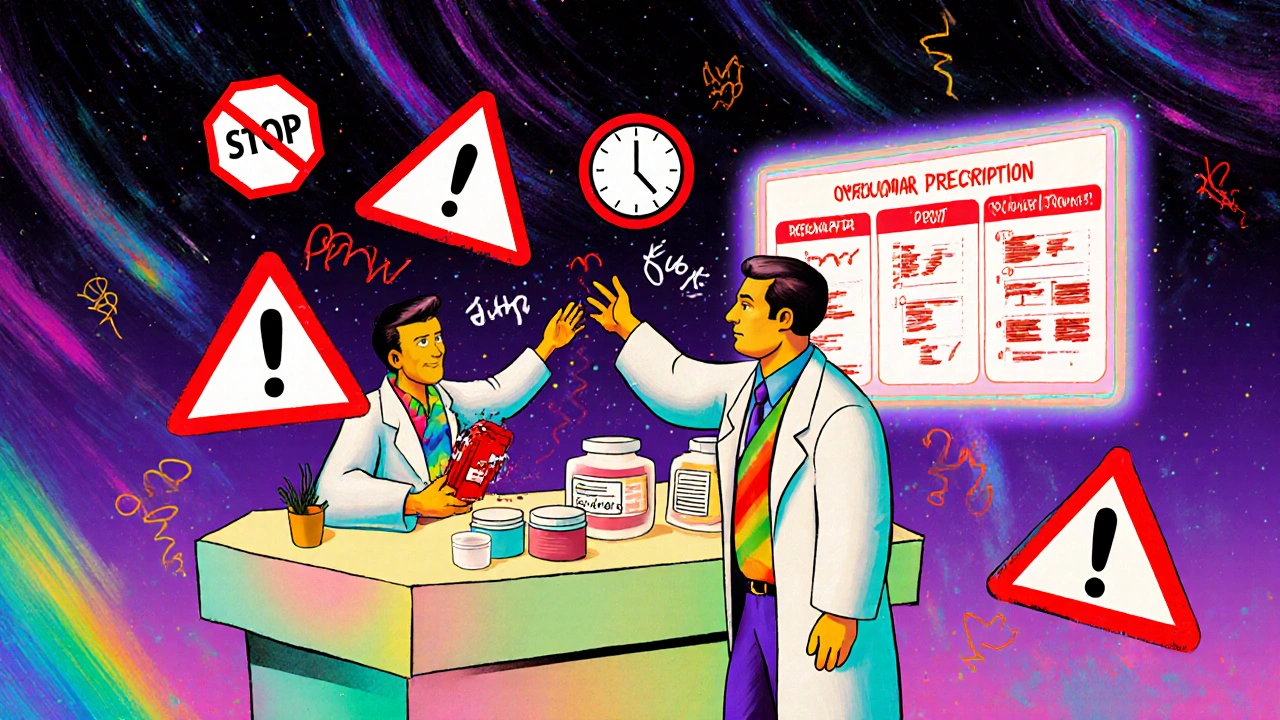
Every month, pharmacists face the same frustrating pattern: a patient walks in two weeks early for a 30-day supply of oxycodone, claiming their doctor said it was okay. Another patient shows up with two prescriptions for the same painkiller from two different doctors. These aren’t isolated incidents-they’re early refills and duplicate therapy mistakes that put lives at risk. According to the CDC, these errors contribute to opioid overdoses, medication waste, and broken trust in care systems. The good news? They’re preventable. With the right systems, staff training, and technology, pharmacies can stop these mistakes before they happen.
Understand Why Early Refills Happen
Early refills aren’t always about abuse. Sometimes, patients lose meds, forget to refill on time, or have insurance delays. But when it happens month after month-especially with controlled substances-it’s a red flag. The DEA strictly prohibits refills for Schedule II drugs like oxycodone, fentanyl, and Adderall. Yet, patients still try. Some say, "My insurance lets me get it 5 days early," or "The doctor wrote it, so I should get it." Others offer to pay cash, thinking that bypasses rules. These aren’t valid excuses. Insurance policies typically allow a 5-day early window for 30-day supplies, but that’s meant for emergencies, not habitual early requests. Pharmacists who ignore patterns risk enabling misuse. The Pharmacy Times reports that patients who repeatedly get early refills from different prescribers and pharmacies are often diverting drugs. And it’s not just opioids. Antidepressants, benzodiazepines, and even high-dose statins can be misused when refilled too soon.Stop Duplicate Therapy with Clinical Review
Duplicate therapy happens when a patient gets two drugs that do the same thing-like two different NSAIDs, two SSRIs, or two blood pressure meds from different doctors. This can lead to kidney damage, low blood pressure, serotonin syndrome, or worse. The key is to never assume a refill is safe just because it was approved last month. The Ontario College of Pharmacists (OCP) says: "Always assess the appropriateness of the drug therapy." That means checking the patient’s full profile before dispensing. Are they on a new medication? Did they switch doctors? Are they filling prescriptions at multiple pharmacies? Many pharmacies now use Clinical Viewers-tools that pull in data from publicly funded drug programs and other pharmacies. If a patient filled a 30-day supply of gabapentin at Pharmacy A last week and shows up at Pharmacy B today asking for another, the Clinical Viewer flags it. No guesswork. No assumptions. Just facts.Build a Risk-Based Refill Protocol
Not all medications need the same level of oversight. A high-risk drug like a Schedule II opioid requires direct provider approval. A low-risk drug like a nasal steroid? It can be automated. The American Academy of Family Physicians (AAFP) recommends a three-tier system:- Low-risk meds: Nasal steroids, topical creams, or supplements. These can be refilled without provider input if the patient has been seen in the last 6 months.
- Medium-risk meds: Antihypertensives, diabetes drugs, statins. These can be refilled for up to 90 days if the patient has had a recent visit and labs are up to date.
- High-risk meds: Controlled substances, benzodiazepines, high-dose opioids. These require a provider’s signature every time. No exceptions.

Use Your EHR to Prevent Errors
Electronic Health Records (EHRs) aren’t just for charting-they’re your best defense against duplicate therapy and early refills. Start by setting up automated alerts. If a patient tries to refill a Schedule II drug before 28 days have passed, the system should block it and notify the pharmacist. If two prescriptions for the same drug appear within 10 days, flag it for review. Also, use EHR notes to document refill behavior. Instead of writing "refill approved," write: "Patient received early refill on 10/15-no clinical justification provided. Monitor for misuse." This creates a paper trail and helps future providers spot patterns. Pro tip: Use the phrase "cancel all prior" in prescription notes. This stops the system from auto-renewing old refill reminders that could confuse staff.Train Your Staff to Say No-Politely
Pharmacists can’t do this alone. Techs, assistants, and front desk staff need training too. Teach them to recognize common patient scripts:- "The doctor said I could get it early."
- "My insurance lets me get it 5 days early."
- "I’ll pay cash."
- "I ran out because I was traveling."
Work With Providers, Not Against Them
Many early refill requests happen because providers aren’t prepared. A patient calls on Friday night for a refill, and the provider is out of town. The staff panics and calls in a refill without checking the protocol. The AAFP recommends a simple fix: plan ahead. For patients on stable, long-term meds, have providers sign prescriptions in advance. For example, if a patient gets a 30-day supply of metformin every month on the 10th, the provider can sign a prescription for the 10th of next month during their October visit. This eliminates last-minute calls. It also ensures continuity-if the provider is on vacation, the signed prescription is already in the system. For controlled substances, require patients to agree to a substance use evaluation if early refills become frequent. Make it part of the treatment plan: "If you need an early refill more than twice in six months, we’ll refer you to an addiction specialist."
Use Technology to Automate the Heavy Lifting
Manual checks are slow and error-prone. Technology can help. - PDMP integration: Automatically check state databases for recent fills before dispensing. - Clinical Decision Support (CDS): Tools that flag duplicate therapy, early refills, or potential interactions in real time. - Refill protocol software: Systems that auto-approve or deny refills based on your custom rules (e.g., "No early refill for oxycodone unless 28+ days have passed and PDMP shows no other fills"). One health system reported that after adding CDS tools, they reduced early refill requests by 62% in six months. Staff time spent on refills dropped by 40%. Patient satisfaction went up because they got faster, safer service.What to Do When You Catch a Problem
If you spot a patient repeatedly getting early refills or duplicate meds, don’t just refuse the prescription. Act. 1. Document everything: Note the date, drug, pharmacy, and patient’s explanation. 2. Check the PDMP: See if they’ve filled similar drugs elsewhere. 3. Call the prescriber: Ask if they’re aware of the other prescription. 4. Engage the patient: Say: "We’ve noticed you’ve gotten this medication twice in the last month. We’re concerned about your safety. Can we talk about what’s going on?" 5. Report if needed: If you suspect diversion or addiction, report to your state’s pharmacy board or addiction services. Sometimes, patients just need help. A referral to a pharmacist-led medication therapy management (MTM) program can make all the difference.Final Thought: Safety Isn’t a Policy-It’s a Culture
Preventing early refills and duplicate therapy isn’t about being the pharmacy that says "no" the most. It’s about being the pharmacy that says "yes" safely. When staff are trained, systems are automated, and providers are aligned, refills become predictable, safe, and efficient. Patients get their meds on time. Harm is prevented. And pharmacists spend less time chasing paperwork and more time doing what matters-helping people.It’s not about suspicion. It’s about responsibility.
Can a pharmacy legally refuse to fill an early refill request?
Yes. Pharmacists have a legal and ethical duty to refuse refills that violate DEA regulations, insurance rules, or clinical safety standards. Schedule II drugs cannot be refilled under any circumstances. Even for non-controlled substances, pharmacies can refuse early refills if there’s no medical justification or if duplicate therapy is suspected. Refusing a refill is not a denial of care-it’s a safety measure.
How do I know if a patient is getting duplicate therapy?
Use your Clinical Viewer or state PDMP to check if the patient has filled similar medications at other pharmacies. Look for drugs in the same class-like two different SSRIs (e.g., fluoxetine and sertraline), two NSAIDs (ibuprofen and naproxen), or two blood pressure meds with the same mechanism. If two prescriptions for the same drug were filled within 10 days, that’s a red flag. Always review the patient’s full medication list before dispensing.
Why do insurance policies allow refills 5 days early?
The 5-day early window is meant for emergencies-like travel, lost prescriptions, or pharmacy closures-not routine early refills. Many patients misunderstand this and think they can use up their meds 5 days early and then refill. That’s not allowed. Pharmacies are expected to enforce the intent of the policy: to avoid gaps in therapy, not to enable overuse.
What should I do if a patient insists on getting an early refill because they paid cash?
Cash payment doesn’t override safety rules. Whether the patient pays cash, insurance, or Medicare, you must still follow DEA guidelines and clinical protocols. Refusing a refill because of cash payment is not discriminatory-it’s standard practice. Explain: "Our policy applies to all patients, regardless of payment method, to ensure your safety and prevent harmful interactions."
How often should refill protocols be reviewed?
At least every six months-or sooner if new drugs, regulations, or abuse trends emerge. For example, after the 2023 CDC guidelines on opioid prescribing, many pharmacies updated their protocols to require PDMP checks for all opioid refills. Regular reviews keep protocols aligned with current evidence and reduce liability.
Can nurses or medical assistants approve refills?
Yes, if they’re trained and operating under a validated protocol. Many health systems allow nurses to approve refills for low- and medium-risk medications when criteria are met-like recent visits, stable labs, or no PDMP flags. This frees up providers to focus on complex cases. But nurses should never approve controlled substances without provider authorization.
What’s the difference between early refill and early dispensing?
Early refill means the patient requests the prescription before the refill date. Early dispensing means the pharmacy fills the prescription before the refill date. The two are linked but different. You can dispense early only if the refill request is approved. Never dispense early without a valid reason and documentation. Even then, for controlled substances, it’s almost never allowed.




November 14, 2025 AT 21:11
Kevin Wagner
This is the kind of shit that keeps pharmacists sane in a broken system. I’ve seen patients cry because we wouldn’t refill oxycodone two weeks early-then turn around and sell it on the street. We’re not the bad guys. We’re the last line of defense against people dying from their own negligence or greed. Stop treating us like drug dealers and start treating us like healthcare professionals.
November 15, 2025 AT 04:24
gent wood
Excellent breakdown. The three-tier system is brilliant-simple, scalable, and clinically sound. Too many pharmacies treat every refill like a crisis, which burns out staff and frustrates patients who just need their blood pressure med. Automating low-risk refills isn’t laziness-it’s smart resource allocation. And documenting behavior in the EHR? That’s the quiet revolution no one talks about. It turns pharmacists from gatekeepers into chronic care partners.
November 16, 2025 AT 23:25
Barry Sanders
Wow. Another feel-good article from someone who’s never had to deal with a real addict walking in with a fake prescription. You think your ‘protocol’ stops anything? Half the people doing this are doctors themselves. Your PDMP? Half the states don’t even update it in real time. You’re playing whack-a-mole with a butter knife.
November 18, 2025 AT 00:27
Don Ablett
The clinical review framework outlined here aligns with the Ontario College of Pharmacists’ 2022 guidance on therapeutic duplication prevention and is consistent with international standards of care as articulated by the International Pharmaceutical Federation. The integration of clinical decision support systems into pharmacy workflows represents a significant advancement in risk mitigation and patient safety optimization. Further longitudinal studies are warranted to assess the impact of automated refill protocols on long term adherence and diversion metrics
November 18, 2025 AT 17:11
Sean Evans
OMG I CRIED reading this 😭 I’ve been working in a pharmacy for 12 years and NO ONE gets it. People think we’re just robots who hand out pills. We’re the ones who catch the guy who’s getting 3 different SSRIs from 3 different docs. We’re the ones who call the doctor at 10pm because the patient’s BP is 210/120 and they’re on 5 new meds. We’re the ones who get yelled at for saying NO. This post? It’s the first time I felt seen. Thank you.
November 20, 2025 AT 17:02
Dilip Patel
USA pharmacy system is so weak. In India we have strict rules. If you want opioid you need police permission and doctor signature and govt stamp. No early refill. No cash. No excuses. You think your EHR is smart? We have biometric fingerprint scan for every refill. You think you are safe? You are not. You are just lazy. India solved this 10 years ago
November 21, 2025 AT 14:49
Brittany C
PDMP integration is non-negotiable. But I’ve seen systems where the alert threshold is set too low-false positives spike, and pharmacists start ignoring them. The real win is contextual intelligence: if a patient has stable HbA1c, no PDMP flags, and a 6-month follow-up, auto-approve the metformin. But if they’ve had 3 early refills in 90 days and live 20 miles from their prescriber? That’s a red flag. It’s not about the drug-it’s about the pattern.
November 22, 2025 AT 19:16
kshitij pandey
Bro this is beautiful. I work in a small clinic in rural India and we don’t have fancy EHRs but we do this manually. We write names on a board. We call other pharmacies. We talk to the family. We don’t say no. We say ‘let’s figure this out together’. You don’t need tech to be human. You just need to care. Thank you for saying this.
November 23, 2025 AT 21:22
Scarlett Walker
My mom’s a pharmacist and she told me about a guy who came in every 18 days for oxycodone. She called his doctor, found out the doctor had passed away 3 months ago. The guy was still getting it from a fake script. She reported it. He showed up the next day with a lawyer. She didn’t back down. This isn’t about rules. It’s about doing the right thing when no one’s watching.
November 24, 2025 AT 19:08
Chris Ashley
Y’all are overcomplicating this. If someone’s asking for an early refill, just say ‘no’ and move on. Don’t call the doctor. Don’t check the PDMP. Don’t write essays in the EHR. Just say no. They’ll go to the next pharmacy. Let them. You’re not their mom. You’re not their therapist. You’re a pharmacist. Dispense the meds or don’t. Stop playing detective.
November 25, 2025 AT 20:05
Anjan Patel
THIS IS WHY AMERICA IS BROKEN. You think your ‘protocol’ stops addiction? No. It just makes addicts go to Mexico or the internet. You’re not protecting people-you’re punishing them. The real problem is the lack of mental health care. Lock up the dealers, not the patients. This article is pure virtue signaling. You want to save lives? Fund rehab. Not more paperwork.
November 27, 2025 AT 15:24
Jane Johnson
Actually, the DEA permits a 7-day early refill under specific extenuating circumstances, and your article misrepresents federal regulation. Furthermore, the AAFP’s tiered system has not been peer-reviewed in a controlled clinical trial. Your reliance on anecdotal health system data is methodologically unsound and potentially dangerous.
November 27, 2025 AT 21:58
Hrudananda Rath
One must observe that the entire paradigm presented herein is predicated upon a fundamentally flawed assumption: that pharmacists, as agents of a corporatized healthcare apparatus, are capable of ethical stewardship in a system designed for profit maximization. The PDMP, the EHR, the clinical viewer-all are instruments of surveillance, not salvation. The true solution lies not in procedural refinement, but in the abolition of the pharmaceutical-industrial complex. This article, while meticulously structured, remains a mere ornament atop a crumbling edifice.