

When you have sleep apnea, your airway keeps closing while you sleep-sometimes dozens of times an hour. It’s not just about snoring. It’s about your body struggling to breathe, your oxygen levels dropping, and your brain jolting you awake just enough to keep you alive-but not enough for real rest. If you’re carrying extra weight, especially around your neck and midsection, that problem gets worse. And the machine most people use to treat it-CPAP-doesn’t just work the same for everyone. BMI plays a direct, measurable role in how much pressure your CPAP machine needs to keep your airway open.
How BMI Changes Your CPAP Pressure
CPAP machines deliver a steady stream of air through a mask to hold your airway open while you sleep. The pressure setting, measured in cm H₂O, isn’t arbitrary. It’s tailored to your body. For every one-point increase in your BMI, you typically need about 0.5 cm H₂O more pressure to get the same effect. That might sound small, but it adds up fast.
Take someone with a BMI of 30. They might need 10 cm H₂O. Someone with a BMI of 40? That’s 15 cm H₂O-or even higher. Higher pressure means more force pushing air into your nose and throat. It can feel uncomfortable. It can leak. It can make the mask feel like a vice. That’s why people with higher BMIs often struggle with CPAP adherence. A 2022 survey of 1,200 CPAP users found that 68% of those with BMI over 35 reported fit and comfort issues. It’s not just about the machine-it’s about the body it’s trying to fix.
Weight Loss Can Cut Your CPAP Pressure-Sometimes Even Eliminate It
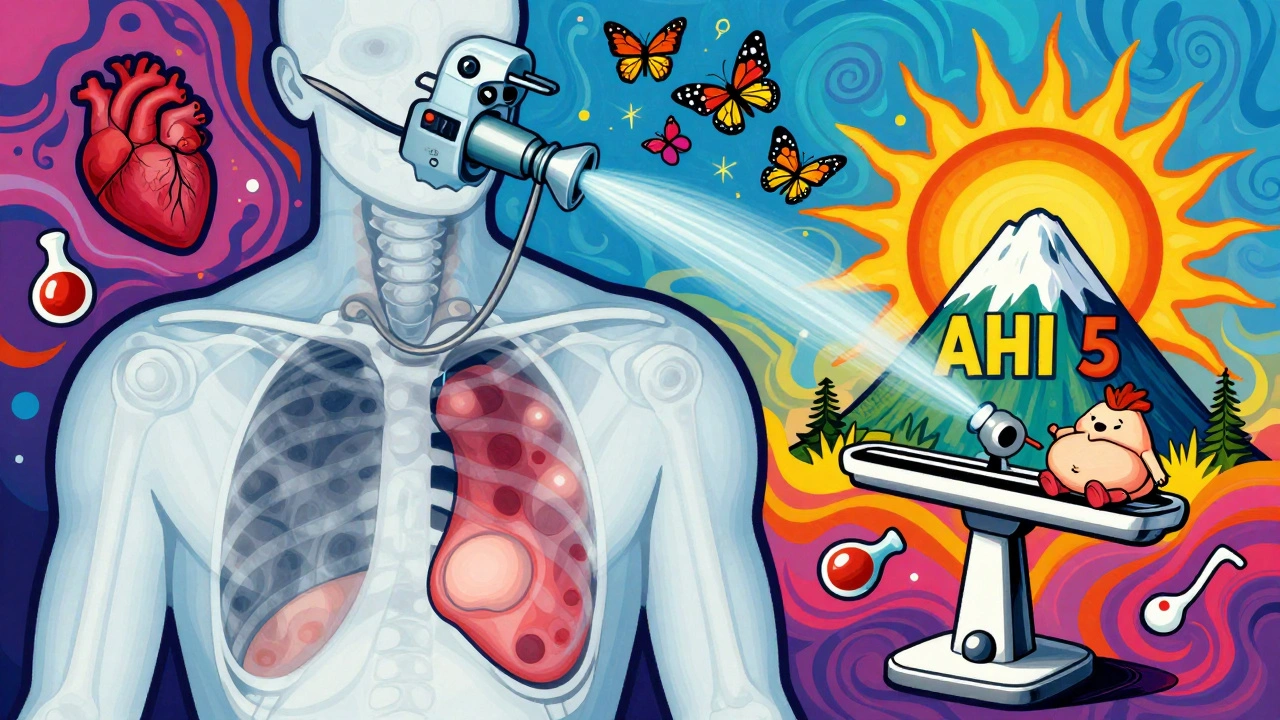
Here’s the good news: losing weight doesn’t just help your overall health. It can directly reduce your sleep apnea severity. A 2022 study of 434 veterans showed that for every one-point drop in BMI, the number of breathing pauses per hour (called the AHI) dropped by 6.2%. That’s not a guess. That’s a hard number from real polysomnography data.
What does that look like in real life? For a man who’s 5’10” and weighs 220 pounds (BMI 31), losing 20 pounds brings his BMI down to 28. That’s a 3-point drop. Based on the study, his AHI could drop by nearly 20%. If his AHI was 30 (severe), it might fall to 24 (moderate). For some, especially those with mild to moderate apnea, that drop can be enough to stop needing CPAP entirely.
Real-world stories back this up. One Reddit user, u/SleepWarrior42, lost 45 pounds-from BMI 38 to 31. His AHI went from 32 to 9. His CPAP pressure dropped from 14 cm H₂O to 9. He now only uses it when sleeping on his back. That’s not rare. A 2022 American Sleep Association survey found that 31% of mild sleep apnea patients who lost significant weight stopped using CPAP altogether.
Why Losing Weight Helps-It’s Not Just About the Neck
Most people think fat around the neck squeezes the airway. That’s true-but it’s only part of the story. Fat in your chest and belly pushes up on your diaphragm. That reduces your lung volume. Less lung volume means less upward pull on your airway, making it more likely to collapse. Fat also changes how your body controls breathing. Studies show people with obesity have lower levels of adiponectin, a hormone that helps regulate breathing patterns.
And here’s something most don’t realize: losing even 5-10% of your body weight can make a huge difference. That’s 15-30 pounds for someone who weighs 200. You don’t need to become skinny. You just need to move the needle enough to reduce fat deposits around your upper airway. That’s where the biggest improvements happen.
The Paradox: CPAP Can Make You Gain Weight
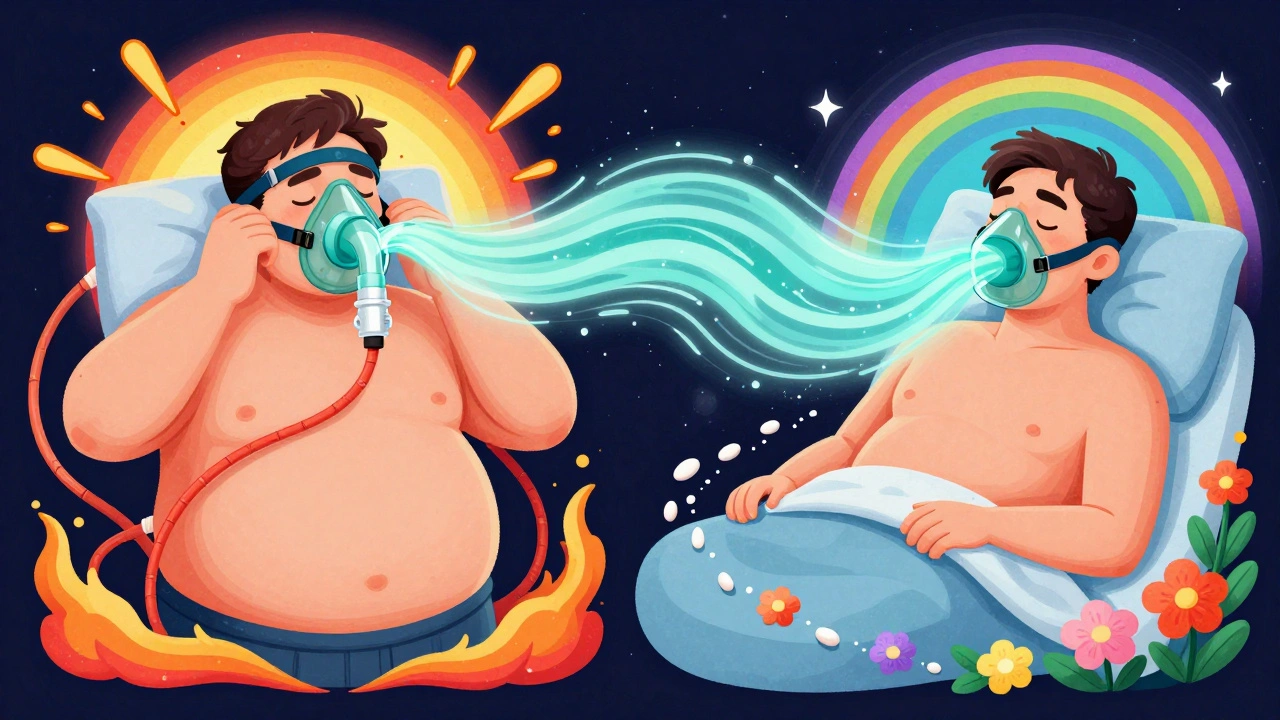
Here’s the twist. While CPAP fixes your breathing, it can sometimes make weight loss harder. Multiple studies have shown that after starting CPAP, some people gain weight-on average, about 2.6 pounds over six months. Why?
When you’re untreated, your body is in survival mode. Your stress hormones are high. Your metabolism is sluggish. You’re too tired to move. But once CPAP kicks in and you start sleeping well, your body relaxes. Your ghrelin (hunger hormone) drops less than expected. Your leptin (fullness hormone) doesn’t rise as much as it should. You feel better… so you eat more. One study found CPAP users reported eating 287 extra calories a day.
And it’s not just appetite. Your basal metabolic rate-the number of calories you burn at rest-can drop by 5.3% after starting CPAP, according to a 2016 study. That’s like losing the ability to burn 100 calories a day just by existing. If you don’t adjust your diet, the scale creeps up.
But here’s the key: this weight gain mostly happens in people who use CPAP less than 5 hours a night. Consistent users-those hitting 7+ hours-don’t see the same effect. The body isn’t gaining weight because of CPAP. It’s gaining weight because it’s finally getting rest… and not changing its habits.
CPAP Isn’t the Only Tool-Weight Loss Is the Real Game-Changer
CPAP is a life-saver. But it’s a bandage. Weight loss is the cure. The American Academy of Sleep Medicine now recommends that every person diagnosed with sleep apnea get a weight management plan. That means working with a dietitian, a sleep specialist, and sometimes an obesity medicine doctor.
And it works. A 2021 trial showed that patients who got coordinated care-CPAP plus diet and exercise counseling-lost 42% more weight than those who just got standard advice. That’s not a little better. That’s game-changing.
For people with severe obesity (BMI over 40), even CPAP can struggle. Success rates drop from 89% in normal-weight patients to 63% in those with Class III obesity. These patients often need higher-pressure machines, special masks, or even additional devices like mandibular advancement splints. Some turn to bariatric surgery. Studies show 78% of patients who get gastric bypass see their sleep apnea resolve completely within a year.
What You Can Do Right Now
If you’re on CPAP and your BMI is above 25, here’s what to do:
- Get your AHI checked. Know your baseline.
- Set a realistic goal: lose 5-10% of your body weight. That’s enough to see real changes.
- Track your CPAP use. Aim for 7+ hours a night. Consistency matters more than perfection.
- Work with your doctor to adjust your CPAP pressure after you lose weight. Don’t wait for symptoms to return. Get a follow-up sleep study.
- Don’t blame CPAP if the scale moves up. Look at your eating habits. You’re sleeping better-now make sure you’re eating better too.
One of the most powerful things you can do is link your CPAP data with your weight tracking. New machines like the Philips DreamStation 3 and ResMed AirSense 11 now track weight changes and auto-adjust pressure. That’s the future-and it’s here.
It’s Not About Being Thin. It’s About Breathing Better.
You don’t need to hit a magic number on the scale. You don’t need to look like a fitness influencer. You just need to move your BMI down enough to give your airway more room. That’s it. For many, that means losing 15-25 pounds. For others, it’s 40. But every pound lost reduces the pressure your body needs to stay alive while you sleep.
And when you do? You’ll sleep deeper. You’ll wake up less. You’ll have more energy. You’ll move more. You’ll eat better. The cycle flips. CPAP helps you start. Weight loss helps you finish.
Can losing weight eliminate the need for CPAP?
Yes, especially for people with mild to moderate obstructive sleep apnea. Losing 10% of your body weight can reduce your AHI by 50% or more. In some cases, especially if your BMI drops below 25 and your AHI falls under 5, your doctor may recommend stopping CPAP after a follow-up sleep study confirms improvement.
Why does my CPAP pressure keep changing?
Your CPAP pressure is set based on your body’s needs at the time of your sleep study. If you gain or lose weight, your airway changes. A 5-pound weight loss can lower your required pressure by 0.5 cm H₂O. If you’ve lost weight and still feel like your machine is too strong, ask your doctor for a pressure re-titration study.
Does CPAP help you lose weight?
CPAP doesn’t directly cause weight loss, but it removes a major barrier to it. By improving sleep, it helps regulate hunger hormones, boosts energy for exercise, and improves insulin sensitivity. Studies show CPAP users who stick with it and make lifestyle changes lose more weight than those who don’t use it.
What BMI is too high for CPAP to work?
There’s no BMI cutoff where CPAP stops working-but effectiveness drops as BMI rises. At BMI 40+, success rates fall to 63%, compared to 89% in normal-weight patients. Higher pressures are needed, and side effects like mask leaks and discomfort increase. Many patients at this level benefit from combining CPAP with other treatments like oral appliances or weight-loss surgery.
How much weight should I aim to lose to see results?
Aim for 5-10% of your current body weight. For a 200-pound person, that’s 10-20 pounds. That’s enough to reduce your AHI by 30-50% in most cases. You don’t need to lose 50 pounds to make a difference. Even small, consistent losses improve your breathing, energy, and CPAP comfort.
What Comes Next?
If you’re on CPAP and your BMI is above 25, your next step isn’t just to keep using the machine. It’s to start a plan. Talk to your sleep doctor about a weight management strategy. Ask if your insurance covers a dietitian or an obesity medicine specialist. Check if your CPAP machine tracks your weight and adjusts pressure automatically. Track your sleep and your food. See how they connect.
The science is clear: your weight and your breathing are linked. Fix one, and you help the other. CPAP keeps you alive at night. Weight loss lets you live better during the day.






December 1, 2025 AT 03:12
Erin Nemo
Been on CPAP for 3 years. Lost 18 lbs last year. Pressure dropped from 16 to 11. Life changed. No more 3pm naps. No more brain fog. Just… alive.
December 2, 2025 AT 03:46
Debbie Naquin
Interesting how the body’s biomechanics and neuroendocrine feedback loops interact here. The adiponectin dysregulation in obesity directly modulates central respiratory drive-so weight loss isn’t just mechanical, it’s neurophysiological. CPAP is a stopgap. The real intervention is restoring metabolic homeostasis.
December 2, 2025 AT 12:52
Bonnie Youn
You got this!! Even 10 pounds makes a difference. I lost 22 and my AHI went from 41 to 6. I used to hate my mask-now I sleep like a baby. You’re not broken, you’re just waiting for the right shift.
December 4, 2025 AT 05:12
James Allen
So let me get this straight-your body’s failing because you’re fat, and the machine that keeps you alive is somehow the problem? Maybe if you didn’t eat like a garbage disposal you wouldn’t need it. I mean, I’ve seen 300-pound guys on 22 cm H2O crying because their face hurts. You think the machine’s the villain? Nah. It’s the fryer.
December 5, 2025 AT 09:48
ariel nicholas
Interesting… but where’s the data on the placebo effect of CPAP? You assume weight loss is the cure-but what if the improvement is just because people *believe* they’re healthier after starting CPAP? And who funded these studies? The CPAP manufacturers? The weight-loss industry? The narrative is convenient… too convenient.
December 6, 2025 AT 13:27
amit kuamr
US healthcare system is broken. Insurance pays for CPAP but not dietitians. You lose weight you save them money. But they still won't pay for real help. Only machines. Always machines. Why? Profit. Simple.
December 7, 2025 AT 02:11
Rachel Stanton
For anyone reading this and feeling overwhelmed-start small. One week, swap soda for water. One week, walk after dinner. Don’t focus on the scale. Focus on how you feel when you wake up. That’s your real metric. Progress isn’t linear, but every step counts. You’re not failing-you’re learning.
December 8, 2025 AT 16:18
Amber-Lynn Quinata
I know someone who gained 15 lbs on CPAP and now she’s depressed and hates her life. She says she’s ‘too tired to cook healthy’ but she’s watching TikTok for 4 hours a night. It’s not the machine-it’s her choices. And if you’re not willing to change, stop blaming the device. 😔
December 10, 2025 AT 03:15
Karandeep Singh
CPAP makes you gain weight? Nah bro. You just eat more because you sleep better. Duh. I lost 30 lbs after getting CPAP. I just stopped eating chips at 2am. Problem solved.
December 10, 2025 AT 09:08
Scotia Corley
While anecdotal evidence is compelling, the clinical literature remains inconsistent regarding the magnitude of BMI-pressure correlation. A 2023 meta-analysis in the Journal of Clinical Sleep Medicine found a weak correlation (r=0.31) with significant heterogeneity across populations. Caution is warranted before assuming linear progression.
December 10, 2025 AT 13:31
elizabeth muzichuk
My sister lost 40 lbs and stopped using CPAP. But now she’s ‘fat shaming’ everyone else who still uses it. She says ‘you just need willpower.’ Like it’s that easy. She doesn’t get it. She doesn’t understand the science. She just thinks she’s better now. 😒
December 11, 2025 AT 02:33
Lauryn Smith
If you’re reading this and you’re scared to start losing weight because you think CPAP is your only option-you’re not alone. But you’re not stuck. Talk to your doctor. Ask for help. You don’t have to do it alone. One step. One day. One meal. You’ve got this.