

When you land in Tokyo after a 14-hour flight from New York, your body still thinks it’s 3 a.m. But the sun’s up, your meeting’s in an hour, and you’re wide awake at 3 a.m. local time - again. This isn’t just exhaustion. It’s your internal clock stuck in a time warp. Jet lag isn’t something you just "get over." It’s a biological mismatch, and how you take medication can make it worse - not better.
Why Jet Lag Feels Like a Physical Breakdown
Jet lag, or desynchronosis, happens because your body’s circadian rhythm - the 24-hour internal clock that controls sleep, hormones, digestion, and alertness - can’t keep up with sudden time zone jumps. Crossing eight or more time zones? Your body might take 8 to 12 days to fully reset. And it’s not just about being tired. You might feel nauseous, forgetful, or have trouble focusing. Your stomach might rebel. Your mood dips. Studies show up to 25% of travelers crossing long distances experience "antidromic adaptation," where their body adjusts in the wrong direction - like delaying instead of advancing when they need to go forward.The Melatonin Myth: Time-Released Isn’t Better
You’ve probably seen melatonin bottles labeled "time-released" or "slow-release." The packaging suggests it lasts longer, so it must work better. That’s the trap. The science says the opposite. Melatonin is a hormone your brain naturally makes at night to signal sleep. When you take it as a supplement, you’re giving your body a timing cue - not just a sleep aid. The key is precision. Your circadian clock responds to a short, sharp signal - like a flashlight flashed in the dark - not a dim, all-night light. Time-released melatonin keeps levels elevated for 6 to 8 hours. That means it’s still in your system when your body should be waking up. If you’re flying east, you need your body to shift its rhythm earlier. But if melatonin is still floating around at 7 a.m. local time, your brain gets confused. It doesn’t know if it’s night or day. That’s why people who use time-released versions often report waking up at 3 a.m. feeling wired, or groggy all morning. A 2019 study in Sleep Medicine found that 3 mg of immediate-release melatonin taken at bedtime produced 1.8 hours of phase advance. The same dose in time-released form? Just 0.6 hours.What the Experts Say - and Why They Warn Against Time-Released
The American Academy of Sleep Medicine, Harvard Medical School, and Stanford’s sleep center all agree: avoid time-released melatonin for jet lag. Dr. Steven Lockley from Harvard puts it bluntly: "The circadian system responds to discrete melatonin signals, not sustained elevation." Time-released versions deliver melatonin during biological morning - when your body should be producing cortisol, not melatonin. That’s like trying to turn on a light switch by holding down the button for eight hours. Dr. Charles Czeisler, chief of sleep medicine at Brigham and Women’s Hospital, calls time-released melatonin "inappropriate for circadian adjustment." The European Biological Rhythms Society and the CDC’s 2024 Yellow Book both say the same thing: slow-release melatonin is not recommended for jet lag. In fact, the CDC explicitly warns it "stays in the system too long and confuses the circadian clock." Even the FDA-approved Circadin - a 2 mg prolonged-release melatonin tablet approved in Europe for insomnia in older adults - was never approved for jet lag. Why? Because the evidence for phase-shifting just isn’t there.
Immediate-Release Melatonin: The Only Proven Option
For jet lag, you need immediate-release melatonin - fast-acting, short-lived, and timed to the minute. The sweet spot? 0.5 to 3 mg. Surprisingly, 0.5 mg works just as well as 5 mg for shifting your clock, according to a 2002 meta-analysis. Higher doses (3-5 mg) might help you fall asleep faster, but they don’t improve circadian adjustment - and they increase the chance of next-day grogginess. Eastward travel (e.g., New York to Tokyo): Take 0.5-3 mg of immediate-release melatonin 30 minutes before your target bedtime at your destination. Start taking it 1-2 days before you leave, if possible. For a 9-hour time zone jump, aim for 7-8 p.m. local time at your destination. Keep taking it for 3-5 nights. Westward travel (e.g., Tokyo to New York): You’re delaying your clock. Here, melatonin isn’t usually needed. Instead, try getting morning sunlight and avoiding bright light in the evening. If you do use melatonin, take it in the morning - upon waking - for 2-3 days to help delay your rhythm.Timing Is Everything - And Most People Get It Wrong
Even with the right pill, timing is everything. A 2022 University of Surrey study found that 65% of travelers mis-timed their melatonin by two or more hours. Taking it at 10 p.m. when you should’ve taken it at 8 p.m.? You might shift your clock backward instead of forward. Apps like Timeshifter use your flight path, chronotype, and sleep history to calculate the exact time to take melatonin. Over 1.2 million travelers used it in early 2024. One Business Insider columnist flew from New York to Singapore (12-hour time difference) and reset his rhythm in 3.5 days using 1 mg of immediate-release melatonin timed with the app. He said the time-released version he accidentally took once left him disoriented for two extra days.What Else Works - And What Doesn’t
Melatonin isn’t the whole solution. Light is just as important. After taking melatonin, avoid bright light - especially blue light from phones. Get sunlight at the right time: 2,000-10,000 lux for 30-60 minutes after waking if you’re going east. If you’re going west, get bright light in the late afternoon. Prescription sleep aids like zolpidem or stimulants like modafinil can help you sleep or stay awake, but they don’t fix your clock. They just mask symptoms. You’ll still feel off for days.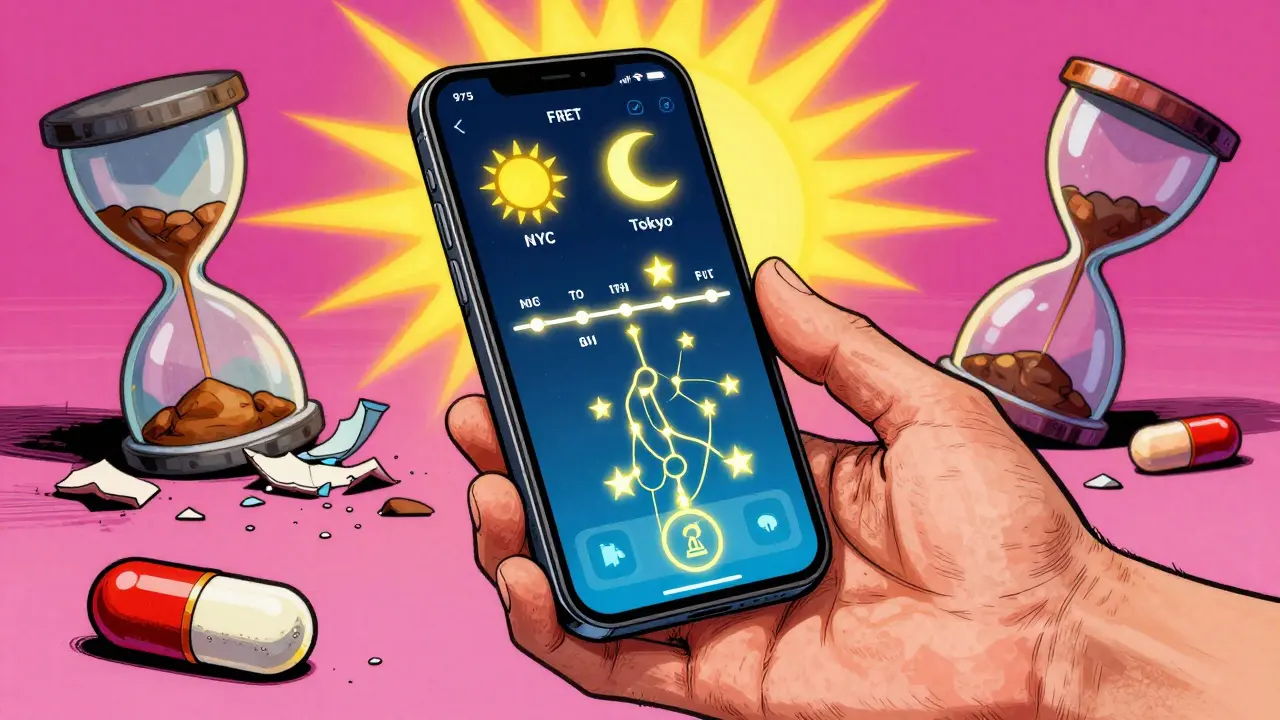
Market Reality: Time-Released Is Dying for Jet Lag
The global jet lag market hit $1.74 billion in 2023. Melatonin makes up 68% of that. But 85% of jet lag-specific melatonin sales are immediate-release. Time-released versions? They’re shrinking. Forty-two of the Fortune 100 companies now give employees immediate-release melatonin and timing guides for international travel. None recommend time-released. Amazon reviews show time-released melatonin averages 2.8 stars. Immediate-release? 4.1. Common complaints: "Woke up at 3 a.m. feeling wired," "felt groggy all day in Tokyo." The FDA doesn’t regulate melatonin as a drug - it’s a supplement. That means a bottle labeled "3 mg" might actually contain 1 mg or 14 mg. A 2023 FDA warning letter found content variability from 83% to 478% off the label. Buy from reputable brands. Check third-party testing.The Future: Personalized Sleep Timing
Scientists are now looking at genes like CRY1 to predict when someone’s body naturally produces melatonin. Early trials show some people need to take melatonin 2.5 hours earlier or later than average. The NIH is funding research to build apps that adjust timing based on your DNA. By 2030, time-released melatonin for jet lag is projected to make up less than 5% of the market. Immediate-release, paired with smart timing tools, is the clear winner.Bottom Line: Skip the Time-Released, Time It Right
If you’re flying across multiple time zones, don’t waste your money on time-released melatonin. It doesn’t work. It confuses your body. It prolongs jet lag. Use immediate-release melatonin. Take 0.5-3 mg 30 minutes before your target bedtime at your destination. Start a day or two early. Avoid light after taking it. Get sunlight at the right time. Use an app like Timeshifter if you’re unsure. Jet lag isn’t inevitable. Your body can reset - but only if you give it the right signal, at the right time.Is time-released melatonin safe for jet lag?
It’s not unsafe in the sense of being toxic, but it’s ineffective and counterproductive for jet lag. Time-released melatonin keeps your melatonin levels elevated for 6-8 hours, which confuses your circadian clock. It may cause you to wake up too early, feel groggy all day, or even delay your adjustment when you need to advance it. The CDC, American Academy of Sleep Medicine, and leading sleep researchers all advise against it for jet lag.
How much melatonin should I take for jet lag?
Start with 0.5 mg. Research shows this dose is just as effective as 5 mg for shifting your circadian rhythm. Higher doses (2-3 mg) may help you fall asleep faster but don’t improve clock adjustment. Avoid doses above 5 mg - they increase grogginess without added benefit. Always use immediate-release, not time-released.
When should I take melatonin for eastward travel?
For eastward travel (e.g., U.S. to Europe or Asia), take melatonin 30 minutes before your target bedtime at your destination. If you’re flying to Tokyo (13-hour time difference), your target bedtime might be 8 p.m. Tokyo time. Take it at that time for 3-5 nights. Start 1-2 days before departure if you can. Avoid bright light after taking it.
Can I use melatonin for westward travel?
It’s less common and less effective. For westward travel (e.g., Asia to U.S.), your body naturally wants to delay its clock. Melatonin isn’t usually needed. Instead, get bright sunlight in the late afternoon and avoid bright light in the morning. If you do use melatonin, take it in the morning - upon waking - for 2-3 days to help delay your rhythm.
Are there better alternatives to melatonin for jet lag?
Yes - light exposure is the most powerful tool. Get sunlight at the right time: morning light for eastward travel, late afternoon light for westward. Avoid blue light after dark. Prescription sleep aids like zolpidem or stimulants like modafinil can help you sleep or stay awake, but they don’t reset your internal clock. They only mask symptoms. Melatonin is the only supplement proven to shift your circadian rhythm.
Do melatonin supplements have the right dosage?
Not always. Since melatonin is sold as a supplement, the FDA doesn’t regulate its strength. A 2023 FDA warning found some products contained 83% less or 478% more than labeled. Buy from brands that provide third-party testing (look for USP, NSF, or ConsumerLab seals). Start low - 0.5 mg - and increase only if needed.





December 16, 2025 AT 08:06
Thomas Anderson
Just took 0.5mg immediate-release before bed in Tokyo and slept like a rock. No more 3 a.m. panic attacks. Time-released? Total waste. My body felt like it was stuck in a time loop.
December 16, 2025 AT 17:15
Dwayne hiers
From a chronobiology standpoint, the pharmacokinetics of prolonged-release melatonin are fundamentally incompatible with circadian phase-shifting. The hormone’s receptor saturation kinetics require a transient, pulsed signal-not sustained elevation. The 2019 Sleep Medicine study’s delta of 1.2 hours in phase advance is statistically significant and clinically meaningful. Time-released formulations induce pharmacological noise, not signal.
December 18, 2025 AT 15:43
Jonny Moran
Been flying to Asia for work for 15 years. Tried everything. Melatonin? Only works if it’s immediate-release and you take it at the *right* time-not when you think you should, but when your body’s clock says to. I use Timeshifter now. Life changed. Also, sunlight is king. No pill beats the sun.
December 20, 2025 AT 07:56
Sarthak Jain
bro i tried the time released one in dubai and woke up at 2am feeling like a zombie. i thought it was supposed to help?? then i switched to 0.5mg normal melatonin at 9pm local and boom-slept like a baby. also, why does everyone sell 5mg bottles? that’s like using a firehose to water a plant 😅
December 21, 2025 AT 23:15
Sinéad Griffin
So let me get this straight-some big pharma company is selling you fake sleep pills because they know you’re too lazy to adjust to time zones? Classic American scam. We don’t need magic pills. We need discipline. And if you can’t handle 12 hours of jet lag, maybe you shouldn’t be flying to Tokyo for a meeting.
December 23, 2025 AT 07:23
Edward Stevens
Oh wow, so the answer to jet lag is… taking a pill? Groundbreaking. I’m sure the airlines will start handing out melatonin with the pretzels next. Meanwhile, my grandma in Nebraska just drinks coffee and stares at the wall until she feels better. Maybe we should ask her.
December 24, 2025 AT 21:16
Alexis Wright
You’re all missing the bigger picture. This isn’t about melatonin. It’s about the collapse of biological sovereignty in a globalized capitalist nightmare. Your circadian rhythm is being weaponized by corporate travel schedules. Time-released melatonin? It’s not ineffective-it’s a symptom. The system doesn’t want you to reset. It wants you docile, dosed, and productive at 3 a.m. in a hotel room in Singapore. Wake up. The clock is not your friend.
December 25, 2025 AT 12:24
Wade Mercer
If you’re taking melatonin at all, you’ve already lost. Real men don’t need supplements. They just power through. I’ve crossed 14 time zones three times this year. No pills. No apps. Just grit. If you can’t handle a little sleep deprivation, maybe you’re in the wrong job.
December 27, 2025 AT 00:36
Natalie Koeber
Did you know the FDA doesn’t regulate melatonin because it’s secretly part of a 1970s CIA mind control program? They want us to believe time-released is bad so they can push the real version-the one that syncs with satellite clocks. I saw a whistleblower video. The pills have microchips. That’s why they make you feel wired. Don’t trust the labels. Buy from the guy on the corner with the blue bottles. He knows.
December 28, 2025 AT 19:59
Rulich Pretorius
There’s a deeper rhythm here beyond melatonin and time zones. The body doesn’t just adapt to clocks-it adapts to meaning. When I travel, I don’t just take melatonin-I journal, I walk barefoot on the ground, I breathe deeply at dawn. The pill helps, yes. But the real reset? That’s when you stop fighting the time and start listening to the silence between ticks. The circadian rhythm isn’t a machine. It’s a poem. And most people are reading it with a dictionary instead of a heart.
December 30, 2025 AT 02:25
Daniel Wevik
Let’s cut through the noise: immediate-release melatonin at 0.5-3mg, 30 minutes before target bedtime, eastward. No exceptions. Time-released is snake oil wrapped in a 4.2-star Amazon review. If you’re still using it, you’re not just misinformed-you’re wasting money and prolonging your own suffering. Fix your timing. Use an app. Don’t be the guy who blames jet lag when it’s just bad habits.
December 31, 2025 AT 11:46
Rich Robertson
My dad’s from India. He used to say, ‘Your body knows the time better than any clock.’ He never took melatonin. He’d sit by the window, watch the sunrise, drink warm water, and just… wait. Took him three days, but he never felt off. Maybe the answer isn’t in a bottle. Maybe it’s in stillness. We’ve forgotten how to just be with the day.
January 1, 2026 AT 12:38
Tim Bartik
Who the hell is selling time-released melatonin for jet lag? That’s like putting a diesel engine in a bicycle. It’s not just wrong-it’s an insult to biology. And the FDA letting this crap fly? Total corporate BS. I called out a brand last month-turns out their ‘3mg’ bottle had 14mg. My kid got a migraine. We’re suing. Don’t buy anything without USP. And if you’re still using time-released? Please. For the love of all that’s circadian-stop.