
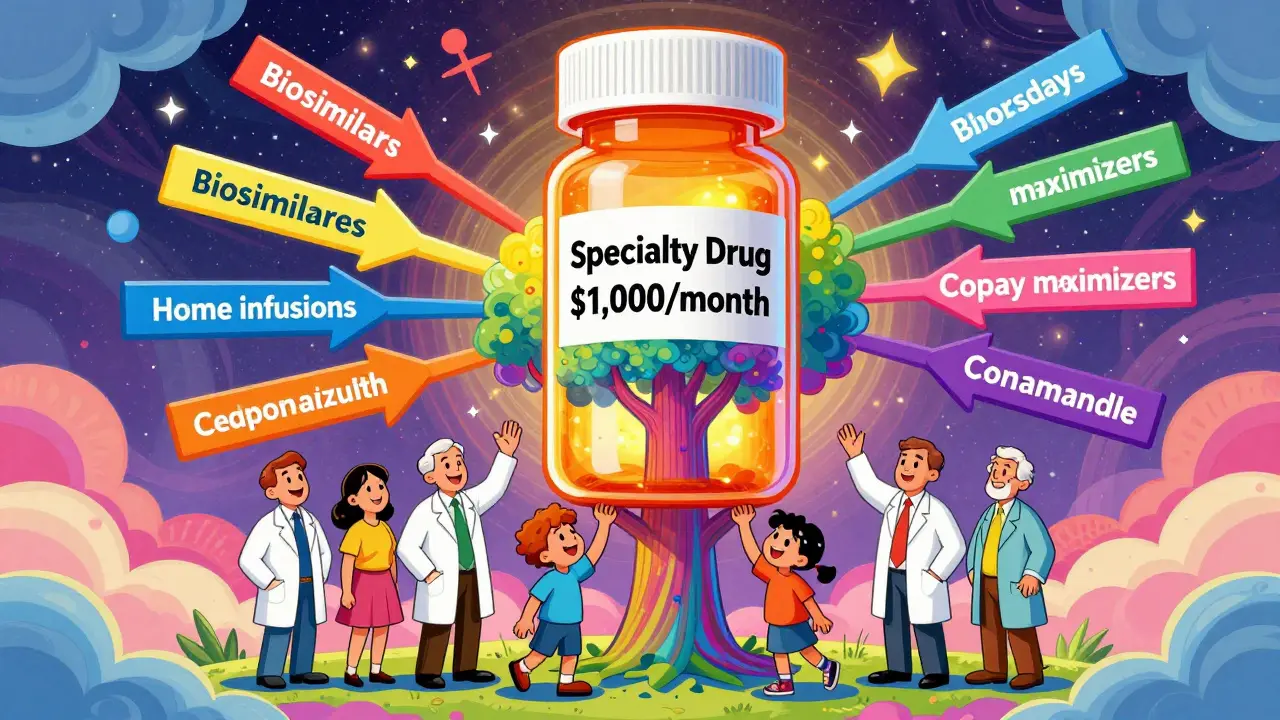
Specialty medications and injectables are changing how we treat chronic diseases-but they’re also breaking the bank. These drugs, used for conditions like cancer, rheumatoid arthritis, and multiple sclerosis, make up just 2% of all prescriptions but consume 50% of total pharmacy spending. In 2023, the U.S. spent over $200 billion on these drugs, and that number is expected to hit $350 billion by 2027. For many families and employers, the monthly cost of a single injectable can exceed $1,000. The question isn’t whether these drugs work-it’s how to make them affordable without sacrificing care.
Start with Formulary Management
One of the most effective ways to control costs is through formulary management. This means setting rules around which drugs are covered and under what conditions. Employers and insurers use prior authorization, step therapy, and quantity limits to ensure patients get the right drug at the right time-not the most expensive one. For example, Excellus BlueCross BlueShield saved $13.64 per member per month just by requiring prior authorization for GLP-1 weight loss drugs like Ozempic and Wegovy. These drugs aren’t inherently bad-they help people lose weight and reduce diabetes risk-but they’re often prescribed without checking if other, cheaper options were tried first. Step therapy requires patients to try a lower-cost alternative before moving to a specialty drug. If the cheaper drug works, you save hundreds per month. The key is balance. Too many barriers can delay care. Too few, and costs spiral. Successful programs use clinical pharmacists to review requests, not automated bots. They also track outcomes: if a patient starts on a cheaper drug and still gets better, that’s a win.Narrow Your Pharmacy Network
Not all pharmacies are created equal when it comes to specialty drugs. Most patients assume they can pick any pharmacy, but that’s not always the case-and it doesn’t have to be. By limiting coverage to a small group of specialty pharmacies, employers can negotiate lower prices. CarelonRx found that narrow networks cut costs by 10-15%. Why? Because these pharmacies specialize in handling complex drugs. They offer home delivery, nurse support, adherence tracking, and real-time monitoring. They’re also more willing to give rebates because they know they’ll get volume. A case study from the Children’s Hospital Association showed a $1.3 billion drug spend over three years saved 10% just by switching to a preferred CVS specialty pharmacy network. Patients didn’t notice the change. They still got their meds on time, with extra support. And satisfaction scores went up because the pharmacy staff knew their drugs inside and out. The downside? Some patients resist switching. About 22% of employers reported a spike in customer service calls during the transition. That’s why clear communication matters. Tell patients why the change is happening. Show them the new pharmacy’s support services. Make it easy to transfer prescriptions.Switch to Biosimilars When You Can
Biosimilars are the closest thing to a miracle in drug pricing. They’re not generics-they’re highly similar versions of complex biologic drugs made from living cells. But they cost about half as much. The FDA has approved 42 biosimilars as of late 2023. Yet adoption remains under 30% for most conditions. Why? Prescribers are hesitant. Patients worry they won’t work as well. But the data doesn’t lie. A 2014 ASHP study found hospitals that switched to biosimilars for rheumatoid arthritis and Crohn’s disease saved 20-30% with no drop in effectiveness. Quantum Health reported that switching just one biologic drug to its biosimilar equivalent saved $180 billion industry-wide over five years. The biggest barrier? Education. Many doctors still think biosimilars are “inferior.” But they’re not. They’re approved using the same rigorous standards as the original. The FDA requires them to show no clinically meaningful differences. Start by targeting high-cost biologics like Humira, Enbrel, and Remicade. These have multiple biosimilars on the market. Ask your pharmacy benefit manager for a list of available biosimilars and their savings. Then, work with your prescribing doctors to update protocols.Move Injections Out of Hospitals
If your drug requires an injection or infusion, it’s likely being given in a hospital outpatient department. That’s expensive. A single infusion in a hospital can cost $2,000-$5,000. The same drug, given in a doctor’s office or even at home, might cost $800-$1,200. Quantum Health analyzed 220 specialty drugs and found that 91% of patients receiving infusions in hospitals didn’t need to be there. The treatment was just as safe-and often more comfortable-in a clinic or home setting. Shifting those patients cut costs by 48%. This isn’t just about saving money. It’s about improving care. Patients hate sitting in hospital waiting rooms for hours. They’d rather get their infusion in a quiet office or even in their own bed. To make this work, you need three things: a clear clinical guideline for which drugs can be given outside the hospital, provider buy-in, and a payment system that rewards lower-cost settings. Prime Therapeutics recommends setting fair, competitive fees across all sites of care. That way, clinics and home health providers aren’t penalized for being cheaper.
Use Financial Assistance Programs Wisely
Many drug manufacturers offer copay assistance programs. These help patients pay their share. But here’s the catch: some of these programs don’t count toward your deductible or out-of-pocket maximum. That means you’re still paying more later. Enter copay maximizers. These are programs offered by some insurers that redirect manufacturer assistance to cover your deductible instead of just your copay. The result? You pay $0 out of pocket today-and your deductible is still being met. That saves you money later if you need more care. CarelonRx found that these programs let patients get specialty drugs with $0 cost-sharing while reducing employer costs by 5-8%. It’s a win-win. But not all programs are created equal. Check your plan’s rules. Ask your pharmacy benefit manager if they offer maximizers. If they don’t, push for it. It’s one of the easiest fixes with the biggest impact.Push for Value-Based Contracts
What if you only paid for a drug if it worked? That’s the idea behind value-based contracting. Instead of paying a fixed price per bottle, you agree to pay more if the drug delivers great results-and less-or nothing-if it doesn’t. For example, a cancer drug might be tied to tumor shrinkage or survival rates. If the patient doesn’t respond, the manufacturer refunds part of the cost. Prime Therapeutics saw a 45% increase in these types of contracts in 2023. Companies like Merck and Roche are starting to offer them. But they’re still rare because they require data sharing, outcome tracking, and legal agreements. Start small. Pick one high-cost drug with clear measurable outcomes-like a multiple sclerosis drug that reduces relapses. Negotiate a contract where the price drops if the patient has more than two relapses in a year. Track results. If it works, expand it.What Doesn’t Work
Not every cost-cutting idea is smart. Capping out-of-pocket costs sounds good, but it doesn’t reduce total spending-it just shifts it. If your plan caps your monthly cost at $100, the insurer still pays the rest. The drug company still gets paid the full price. Same with blanket bans. If you block all new specialty drugs, you’re not saving money-you’re risking patient health. The goal isn’t to deny care. It’s to make sure care is appropriate and cost-effective. Also, don’t rely on patient cost-sharing alone. Dr. Troyen Brennan of CVS Health warned that making patients pay more often leads to non-adherence. People skip doses. They stop refills. That leads to hospitalizations-which cost far more than the drug.
Implementation Checklist
If you’re an employer, insurer, or even a patient advocating for change, here’s what to do next:- Review your top 10 most expensive specialty drugs. Find out if biosimilars exist.
- Check if your plan uses a narrow pharmacy network. If not, ask why.
- Ask your PBM for prior authorization data on your top drugs. Are they being overused?
- Find out if your plan offers copay maximizers. If not, request them.
- Ask your doctor: “Is this drug necessary in a hospital setting, or can it be given elsewhere?”
- Push for value-based contracts on one high-cost drug this year.
Real Results, Real Savings
One employer with 5,000 employees switched to a narrow specialty pharmacy network, started using biosimilars for all eligible patients, and moved 80% of infusions out of hospitals. In 18 months, they cut specialty drug spending by 32%. That’s $1.2 million saved annually. Another group implemented formulary controls and copay maximizers for GLP-1 drugs. They saved $13.64 per member per month-$682,000 a year for a 4,000-member plan. These aren’t theoretical numbers. They’re happening right now. And they don’t require massive budgets. Just smart decisions.What’s Coming Next
By 2026, experts predict that shifting specialty drugs from medical benefit to pharmacy benefit will cut costs by 60-70% for most drugs. Why? Pharmacy benefits have better pricing controls and rebate structures. The Inflation Reduction Act is starting to force Medicare to negotiate drug prices. That pressure is spilling into the private market. More manufacturers will offer discounts to stay competitive. Biosimilar adoption will accelerate. The FDA’s Project BioSet is speeding up approvals. By 2027, we could see 20+ new biosimilars each year. The future isn’t about lowering prices by force. It’s about aligning incentives-so everyone wins: patients get the drugs they need, providers deliver better care, and payers stop overpaying.Are biosimilars as safe as the original biologic drugs?
Yes. The FDA requires biosimilars to show no clinically meaningful differences in safety, purity, and potency compared to the original drug. They go through the same rigorous testing as new drugs. Over 40 biosimilars have been approved in the U.S., and millions of patients have used them with no increased risk. Studies show they work just as well for conditions like rheumatoid arthritis, Crohn’s disease, and cancer.
Can I switch to a cheaper drug on my own?
You can ask your doctor, but you can’t always switch without approval. Many specialty drugs require prior authorization. Even if a cheaper alternative exists, your plan may not cover it unless your doctor submits documentation showing you’ve tried other options first. Always talk to your provider before changing medications-never stop or switch on your own.
Why do some specialty drugs cost so much more than others?
Specialty drugs are complex to make, often require special storage, and are used for rare or chronic conditions with small patient populations. Companies set high prices to recoup R&D costs and generate profit. Unlike traditional drugs, they often have little competition. For example, a new cancer drug might be the only one approved for a specific genetic mutation-giving the maker a monopoly. That’s why formulary controls and biosimilars are so important.
Does using a specialty pharmacy mean I lose my choice of pharmacy?
You lose choice in the sense that only certain pharmacies are covered at lower cost. But most specialty pharmacies offer home delivery, 24/7 nurse support, and automatic refills-often better service than your local pharmacy. If you’re switched to a new pharmacy, you’ll get a letter explaining the change and how to transfer your prescription. Most patients find the support helpful, even if they’re initially frustrated.
What should I do if my insurance denies coverage for a specialty drug?
First, ask your doctor to submit an appeal with clinical documentation showing why the drug is medically necessary. Many denials are overturned with proper paperwork. Second, check if the manufacturer offers a patient assistance program. Many provide free or discounted drugs to those who qualify based on income. Third, contact your employer’s HR department-they may have a special exception process. Don’t give up. Appeals work more often than people think.





January 4, 2026 AT 16:51
Uzoamaka Nwankpa
My sister’s on a biologic for RA and pays $1,200/month out of pocket. They told her to switch to a biosimilar. She cried for three days because she’s scared it won’t work. No one talks about the emotional toll of these decisions-just spreadsheets and savings.
It’s not just about cost. It’s about trust. You’re told this drug keeps you alive, then suddenly someone decides it’s ‘too expensive’ and you’re handed a new vial with a different name. That’s trauma wrapped in a formulary.
I get the math. But you can’t reduce human suffering to a line item.
They saved $13.64 per member? What about the person who had to wait six weeks for prior auth and ended up in the ER? That cost more than the drug ever did.
January 4, 2026 AT 23:39
Chris Cantey
The entire system is a Rube Goldberg machine designed to extract wealth from the sick while pretending to optimize care.
Formulary management? That’s just rationing with a PowerPoint.
Narrow networks? More like corporate cartels with exclusive deals and rebates no one sees.
Biosimilars? Sure, they’re ‘clinically equivalent’-until you’re the one who gets the 3% who have a bad reaction and your doctor shrugs and says, ‘It’s FDA-approved.’
Value-based contracts sound noble until you realize they’re only offered when the drug already has market dominance. It’s not innovation-it’s rent-seeking with better PR.
And don’t get me started on copay maximizers. That’s not helping patients-that’s just moving the debt from one pocket to another while the manufacturer pockets the full list price.
The real solution? National price controls. But that’s not in the checklist, is it? Because this isn’t about health. It’s about profit.
Everything here is a Band-Aid on a severed artery.
We’re not fixing a broken system. We’re just making the bleeding less visible.
January 6, 2026 AT 16:57
Abhishek Mondal
While the article presents a superficially pragmatic framework for cost containment, it fundamentally misdiagnoses the pathology: the issue is not misallocation, but structural monopolism-patent evergreening, regulatory capture, and the commodification of biological life itself.
Furthermore, the reliance on ‘biosimilars’ as a panacea ignores the epistemological gap between ‘no clinically meaningful difference’ and actual therapeutic equivalence in heterogeneous populations-especially those with polypharmacy or comorbid autoimmune conditions.
Moreover, the assumption that home infusions are universally preferable presumes access to sterile environments, trained caregivers, and uninterrupted utilities-privileges not universally distributed, even within the U.S.
And let us not forget: the ‘savings’ cited are contingent upon administrative overhead-prior auth clerks, PBM negotiators, compliance officers-all of whom extract their own rent.
The checklist? A managerial fantasy. Real reform requires dismantling the biopharma-industrial complex-not optimizing its margins.
Also: why is ‘step therapy’ never applied to opioids? Ah. There’s the rub.
January 7, 2026 AT 13:19
Oluwapelumi Yakubu
Man, this whole thing hits different when you’re from Nigeria and you’ve seen people die because they couldn’t get insulin, let alone a $1,000-a-month injectable.
Here in the U.S., we’re arguing over whether to save $13 a month per person while people still skip doses because they can’t afford the copay-even with ‘maximizers.’
Meanwhile, in Lagos, my cousin’s mom with MS gets her drug once every three months because that’s all the family can scrape together.
So yeah, narrow networks and biosimilars? Cool. But why are we acting like this is the pinnacle of healthcare justice?
It’s not. It’s just less bad.
And honestly? If a drug company can charge $70,000 a year for something that costs $200 to make, we’ve lost our damn minds.
Let’s stop pretending we’re being smart. We’re just rearranging deck chairs on the Titanic.
Also-can we just make all these drugs generic already? Like… please?
Someone’s making bank. And it ain’t us.
January 9, 2026 AT 11:12
Terri Gladden
I switched my husband to a biosimilar and he had a seizure.
They said it was 'coincidental'.
Now he’s on a different one and his liver enzymes are through the roof.
I’m not ‘resisting change’-I’m surviving it.
They told me the pharmacy would help.
The nurse called me twice and then ghosted.
And now my employer says ‘we saved $800/month’.
What do they think I’m saving? My sanity?
It’s not a spreadsheet. It’s my husband.
And I’m done pretending this system cares.
January 9, 2026 AT 15:22
Jennifer Glass
I appreciate the practical steps here, especially the checklist. As someone managing a chronic condition, I’ve seen all sides-the denials, the delays, the confusion.
What’s missing is patient voice in the design of these programs. The ‘narrow network’ sounds great until you realize your trusted pharmacist isn’t in it. The ‘biosimilar’ sounds safe until your doctor hasn’t been trained to explain it.
One thing I’d add: transparency. If a plan switches pharmacies or forces a biosimilar, they should provide a side-by-side comparison of the drugs-not just a brochure.
Also, why don’t we track patient-reported outcomes as rigorously as cost savings? If someone feels worse on a biosimilar-even if labs look fine-that matters.
And yes, home infusions are better… if you have a quiet room, a reliable internet connection, and someone to help you if you faint.
These strategies work. But only if they’re designed with humans, not just algorithms.
Let’s not mistake efficiency for empathy.
January 10, 2026 AT 18:35
Joseph Snow
This entire piece is a corporate propaganda pamphlet disguised as public policy.
Who benefits from ‘narrow networks’? The PBM. Who benefits from ‘copay maximizers’? The drug manufacturer. Who benefits from ‘value-based contracts’? The lawyers who draft them.
Patients? They’re the ones who get caught in the crossfire of bureaucratic gymnastics.
And don’t tell me about ‘savings’-the $1.2 million saved by that employer? That’s not charity. That’s profit redistribution from sick people to shareholders.
Meanwhile, the FDA approves biosimilars faster than ever-but the original drug’s patent expires in 2028, and the manufacturer just released a ‘new and improved’ version with a slightly different molecular tweak to reset the clock.
This isn’t reform. It’s camouflage.
Real cost control? Ban direct-to-consumer ads. Break up the PBM monopolies. Force price disclosure. Let Medicare negotiate for everyone.
But that would hurt profits.
So instead, we get this.
It’s not a solution.
It’s a distraction.
January 12, 2026 AT 18:08
melissa cucic
Thank you for this thorough, well-structured overview-it’s rare to see such a balanced take on a topic this complex.
I especially appreciate the emphasis on outcomes over cost alone; too often, cost-cutting measures are implemented without regard for long-term clinical impact, which ultimately increases total healthcare spending through avoidable hospitalizations.
One additional consideration: the role of pharmacists in formulary decisions. Clinical pharmacists, not automated systems, should be the frontline reviewers for prior authorization requests. Their nuanced understanding of drug interactions, patient adherence patterns, and comorbidities is irreplaceable.
Also, the point about home infusions being underutilized due to payment disincentives is critical. If we truly want to shift care to lower-cost settings, we must align reimbursement structures accordingly-not just mandate the change.
And finally, while I agree with the push for biosimilars, I’d urge caution: patient education must be proactive, not reactive. Many patients fear biosimilars because they’ve never been given clear, non-technical explanations of FDA standards.
Empathy + evidence = sustainable change.
This checklist should be mandatory reading for every PBM executive, HR director, and clinical leader.