
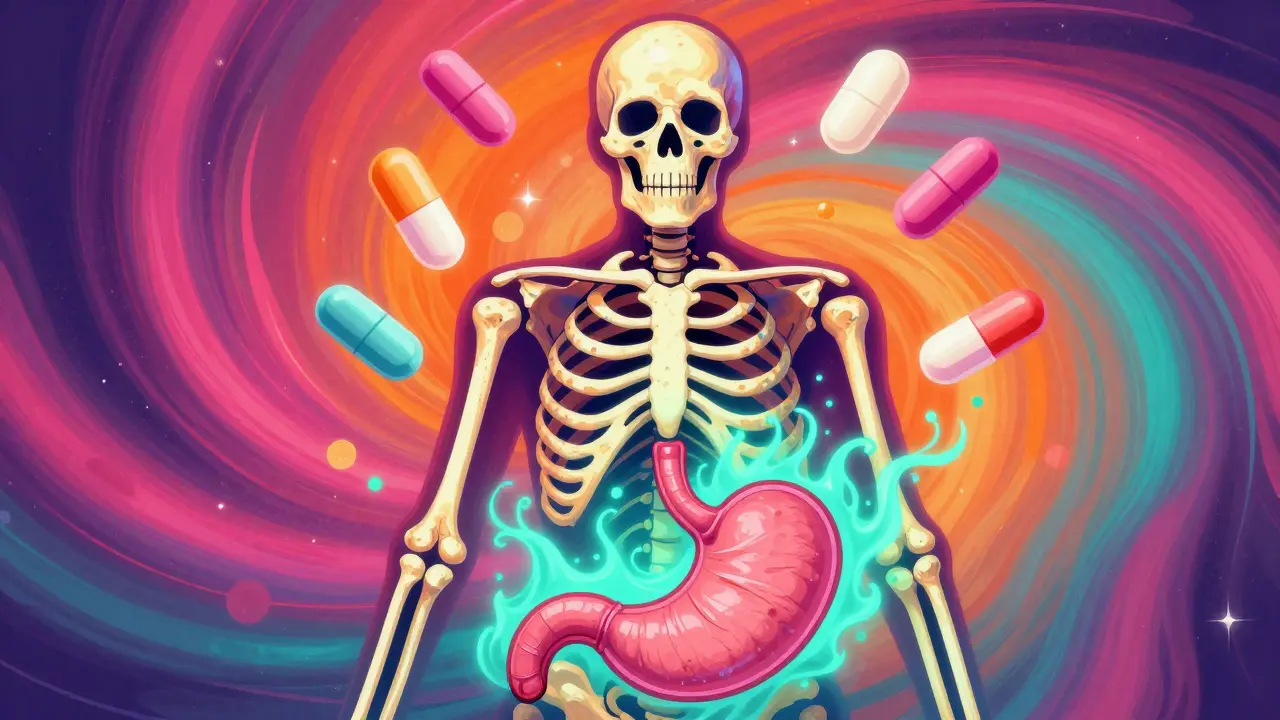
PPI Fracture Risk Assessment Tool
This tool estimates your relative fracture risk based on your PPI usage patterns and other factors. Data based on studies showing increased fracture risk with long-term PPI use
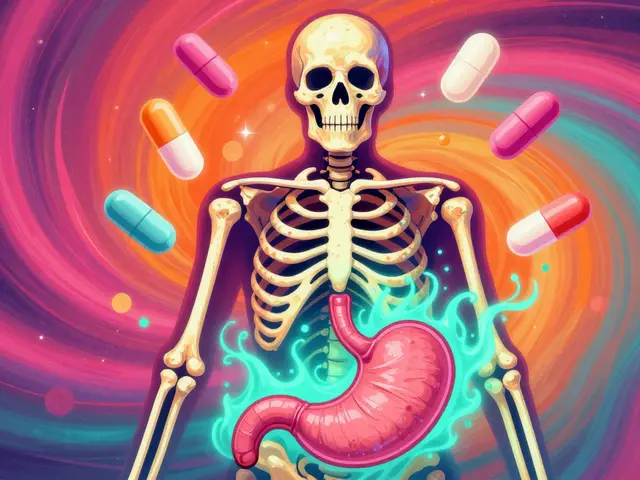
Every year, millions of Americans take proton pump inhibitors (PPIs) to manage heartburn, acid reflux, or ulcers. These drugs-like omeprazole, esomeprazole, and lansoprazole-are powerful, effective, and often sold over the counter. But behind their popularity lies a quiet, growing concern: PPIs and osteoporosis. Could something meant to calm your stomach be quietly weakening your bones?
How PPIs Work (and Why That Might Hurt Your Bones)
PPIs work by shutting down the acid pumps in your stomach lining. Less acid means less heartburn. Simple, right? But your stomach acid isn’t just there to digest food-it’s also your body’s first step in absorbing key minerals, especially calcium. When you take a PPI for weeks or months, your stomach becomes less acidic. And that’s where things get tricky.
Most calcium supplements, like calcium carbonate, need stomach acid to break down and get absorbed. Without enough acid, your body struggles to pull calcium from the supplement into your bloodstream. Over time, your bones start to lose calcium because they’re not getting enough to rebuild themselves. That’s not a sudden crash-it’s a slow leak. And over years, that leak can add up.
The Evidence: Real Numbers, Real Risk
The data doesn’t sugarcoat it. Multiple large studies have shown a clear pattern:
- A 2019 meta-analysis in the Journal of Bone and Mineral Research found that long-term PPI users had a modest but real increase in hip, spine, and wrist fractures.
- One study tracked people who took PPIs for seven or more years and found their hip fracture risk jumped to 4.55 times higher than non-users.
- Even at lower doses, the risk climbs: low-dose users saw a 17% increase, while high-dose users saw up to a 30% higher risk of upper femur fractures.
- Postmenopausal women on long-term PPIs had a 35% higher chance of hip fracture, according to a 2019 study.
It’s not just about how long you take them-it’s about how much. Higher doses = higher risk. And it’s not just older adults. A 2020 study of over 110,000 children found a 22% higher risk of lower-limb fractures in kids aged 6-12 on PPIs.
Is It Just PPIs? What About H2 Blockers?
Not all acid reducers are the same. H2 blockers like famotidine (Pepcid) and ranitidine (Zantac) work differently. They don’t shut down acid production completely-just dial it down. And guess what? Studies show they don’t carry the same fracture risk.
One major study compared over 50,000 PPI users to 50,000 H2 blocker users. The PPI group had a 27% higher risk of hip fracture. That’s not a small difference. It’s a signal that the problem isn’t just less acid-it’s how much acid you’re losing.
And here’s the kicker: the FDA reviewed seven studies in 2010. Six showed increased fracture risk with PPIs. One didn’t. The difference? The study that didn’t find a link didn’t account for other risk factors like age, steroid use, or prior fractures. That’s why experts say: it’s not the PPI alone. It’s the PPI plus other risks.
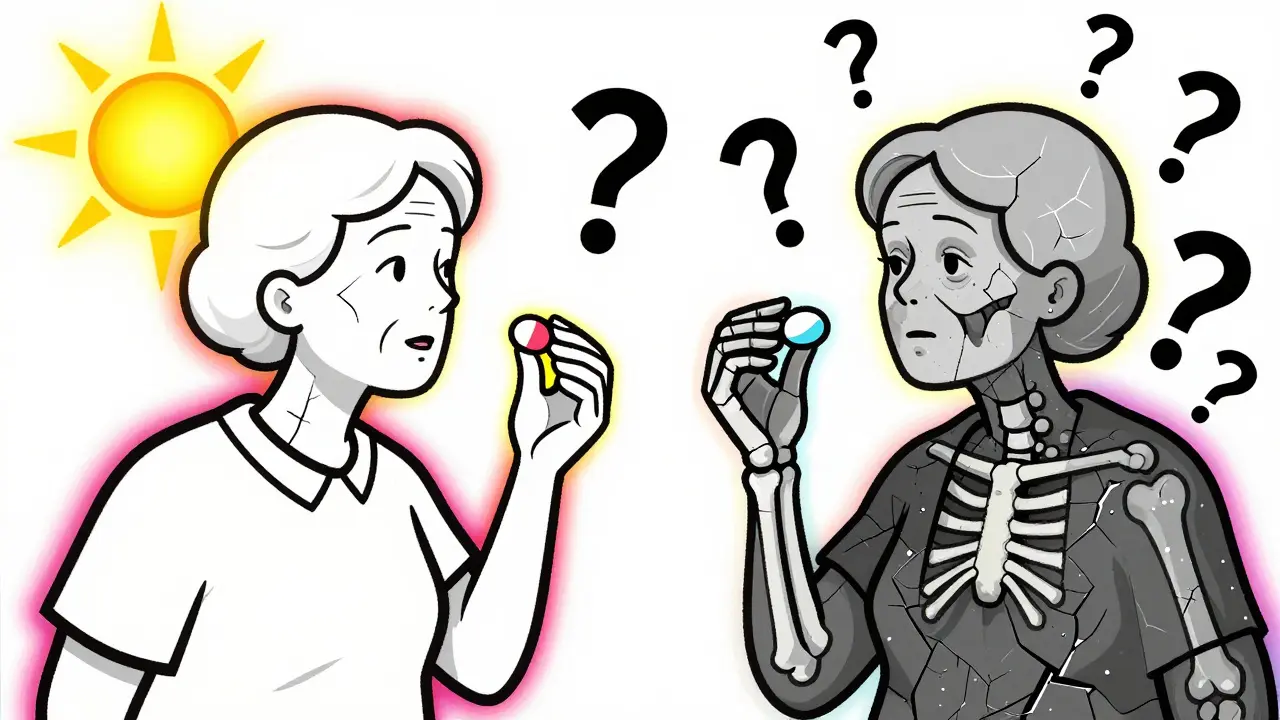
Who’s Most at Risk?
If you’re wondering whether you should be worried, ask yourself these questions:
- Are you over 65?
- Are you a postmenopausal woman?
- Do you have a history of fractures?
- Do you take steroids or have low body weight (under 125 lbs)?
- Have you been on PPIs for more than a year?
If you answered yes to any of these, your risk is higher. That doesn’t mean you have to stop your medication. But it does mean you need to be proactive.
What Can You Do? Practical Steps
Here’s what the experts recommend if you’re on long-term PPIs:
- Use the lowest dose possible. Many people stay on high doses long after they don’t need them. Talk to your doctor about stepping down.
- Try intermittent dosing. Instead of daily, try taking it every other day or only when symptoms flare up.
- Switch to calcium citrate. Unlike calcium carbonate, citrate doesn’t need stomach acid to absorb. It’s the better choice if you’re on PPIs.
- Get enough vitamin D. Your body needs vitamin D to use calcium. Aim for at least 800 IU daily-more if you’re over 70 or have low sun exposure.
- Get a bone density test. If you’re over 65, female, or have other risk factors, ask your doctor about a DEXA scan. It’s quick, painless, and tells you if your bones are thinning.
The American Geriatrics Society says PPIs should be avoided in older adults unless absolutely necessary. The Endocrine Society says if you’re on PPIs for more than 8 weeks and have other risk factors, get tested. These aren’t vague suggestions-they’re guidelines based on hard data.
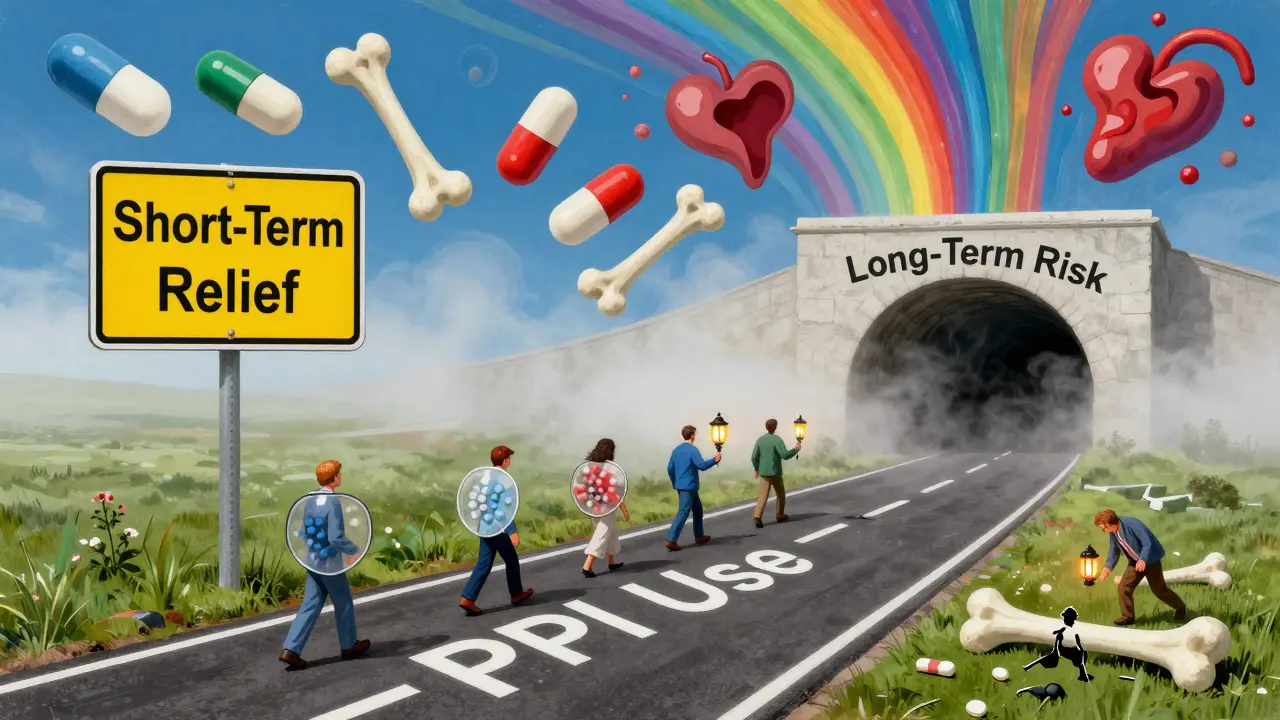
What About the Benefits?
Let’s be clear: PPIs save lives. For someone with severe GERD, a bleeding ulcer, or Zollinger-Ellison syndrome, the benefits far outweigh the risks. The problem isn’t PPIs themselves-it’s overuse. Studies show that 60-70% of PPI prescriptions are for conditions that don’t require long-term treatment.
Many people take them for years because they started for a short-term issue and never stopped. That’s why the FDA added a fracture warning to labels in 2011. That’s why prescribing rates dropped 19% between 2015 and 2021. Awareness is working.
The Bigger Picture: It’s Not Just About Calcium
Some researchers think there’s more going on than just calcium absorption. PPIs may also trigger excess gastrin (a hormone that controls acid), which could mess with bone-building cells. Others point to histamine changes that might speed up bone breakdown. But here’s the catch: studies measuring actual calcium absorption in PPI users show mixed results. Some show a small dip. Others show no change at all.
So is it calcium? Or something else? Or both? The answer isn’t settled yet. But the fracture data is consistent enough to act on.
What’s Next?
A major NIH-funded study called PPI-BONE is tracking 15,000 people over five years. Results are expected in early 2025. That study will control for confounding factors like diet, activity, and other meds-something past studies struggled with.
Until then, the advice stays simple: don’t take PPIs longer than you need to. If you’ve been on them for years, talk to your doctor about whether you still need them. If you do, make sure you’re getting enough calcium (citrate form) and vitamin D. And if you’re at risk for osteoporosis, get your bone density checked.
There’s no need to panic. But there’s every reason to be informed.
Do all PPIs increase fracture risk equally?
No. While all PPIs work the same way, the risk appears to be tied more to dose and duration than the specific drug. Omeprazole, esomeprazole, pantoprazole, and lansoprazole all carry similar risks when used long-term at high doses. There’s no evidence that one PPI is safer than another for bone health.
Can I stop taking PPIs on my own?
Don’t stop suddenly. If you’ve been on PPIs for more than a few weeks, stopping abruptly can cause rebound acid hypersecretion-worse heartburn than before. Work with your doctor to taper off slowly. There are proven strategies, like switching to an H2 blocker first, then gradually reducing frequency.
Is it safe to take calcium supplements with PPIs?
Yes-but not all calcium supplements are equal. Calcium carbonate requires stomach acid to absorb, so it’s less effective with PPIs. Choose calcium citrate instead. It absorbs well even in low-acid environments. Take it with food for best results.
How long do I have to take PPIs before fracture risk increases?
Risk starts to rise after about one year of daily use, but the strongest link is with use longer than three to five years. Some studies show increased risk after just one year, especially in high-risk groups like older women or those on high doses. The longer you take them, the higher the risk.
Should I get a bone density scan if I’m on PPIs?
If you’re over 65, a woman, have had a prior fracture, have low body weight, or take steroids, yes. The Endocrine Society recommends a DEXA scan for anyone on long-term PPI therapy (more than 8 weeks) with one or more of these risk factors. It’s a simple, non-invasive test that can guide your next steps.


February 10, 2026 AT 03:06
Elan Ricarte
Let’s be real - PPIs are the new sugar. Everyone’s on them like they’re candy, and nobody stops to ask why. I’ve seen people on omeprazole for 12 years because their grandpa took it for ‘a little heartburn’ in ’09. You don’t need a PhD to see this is a problem. Your stomach acid isn’t the enemy - it’s your body’s first line of defense. Shut it down long enough, and your bones start turning to dust. No magic bullet here. Just biology being biology.
February 11, 2026 AT 09:09
Angie Datuin
I appreciate how clear this is. My mom’s on PPIs and I’ve been trying to get her to talk to her doctor about switching to citrate. She’s 72, had a wrist fracture last year, and still thinks ‘it’s just a pill.’
February 13, 2026 AT 04:10
Camille Hall
Thank you for laying this out so plainly. I work in primary care and see this all the time - people get prescribed PPIs for a 2-week course, then keep refilling because ‘it helps.’ We need better patient education, not just more warnings on labels. Calcium citrate + vitamin D is low-hanging fruit. Why aren’t pharmacists pushing this more?
February 14, 2026 AT 06:51
Ritteka Goyal
OMG this is so true!! I live in India and we dont have this problem here because we eat spicy food and our stomachs are built tough!! Like my uncle he had acid problem for 30 years but he just ate amla and neem leaves and he fine!! Why we need western drugs?? PPIs are just big pharma scam!! My cousin took it for 5 years and now she have osteoporosis!! But in india we dont even know what is DEXA scan!! We trust homeopathy and ayurveda!!
February 14, 2026 AT 18:11
Monica Warnick
I knew it. I just knew it. I’ve been saying this since 2018. My aunt went from ‘just a little heartburn’ to a hip replacement at 68. She was on Nexium for 11 years. Her doctor never mentioned bone density. Never. I cried for three days. Now I have a spreadsheet. Every pill. Every symptom. Every lab result. I’m not letting this happen again.
February 15, 2026 AT 04:28
Ashlyn Ellison
Switched to H2 blockers last year. No more burning. No more fear. Just… quiet.
February 15, 2026 AT 14:00
Jonah Mann
Wait - so calcium carbonate doesn’t work with PPIs? I’ve been taking 1200mg daily and wondering why my levels are still low… I’m switching to citrate today. Also, vitamin D - 800 IU? My supplement says 1000. Should I up it? And can you take it with iron? I’m confused. My doc just said ‘take it.’ No details. Help?
February 16, 2026 AT 20:10
Tricia O'Sullivan
Thank you for this meticulously researched and clearly articulated exposition. The clinical implications are both significant and underappreciated. I would respectfully suggest that the integration of bone health monitoring into routine gastroenterological follow-up protocols be considered a standard of care, particularly for individuals with prolonged exposure to proton pump inhibitors. The evidence base is now sufficiently robust to warrant systemic change.
February 17, 2026 AT 18:10
Tatiana Barbosa
THIS. THIS IS WHY WE NEED TO TALK ABOUT THIS. I’m 43, female, on PPIs since 2019 for GERD. I didn’t know I was at risk. Now I’m on citrate, got my DEXA scan - T-score of -1.8. Not osteoporosis yet, but pre. I’m cutting my dose in half, adding magnesium, and doing yoga. I’m not scared. I’m empowered. You can reverse this. You just have to act.
February 17, 2026 AT 21:22
Andrew Jackson
It’s not the PPIs. It’s the decline of American resilience. We’ve become a nation of pharmaceutical addicts, trading real health for chemical convenience. Our ancestors didn’t have PPIs - they had vinegar, ginger, and a spine. Now we’re crumbling under the weight of our own overmedication. This is not medicine. It’s surrender.
February 18, 2026 AT 09:42
Joseph Charles Colin
For those asking about vitamin D dosing: if you’re over 70 or have low sun exposure, 1000–2000 IU/day is acceptable per Endocrine Society guidelines. Serum 25(OH)D should be maintained above 30 ng/mL. Calcium citrate absorption is not significantly affected by gastric pH - unlike carbonate, which requires an acidic milieu for dissolution. DEXA is indicated per FRAX score ≥20% for major osteoporotic fracture risk. Consider baseline testing if PPI use exceeds 12 months with concomitant risk factors.
February 18, 2026 AT 21:12
Tom Forwood
Just got my DEXA scan. T-score -2.1. I’m 58, took PPIs for 8 years. I didn’t know. Now I’m on citrate, vitamin D, and walking 10K steps daily. My wife says I’m obsessed. I say I’m alive. If you’re on these pills long-term - check your bones. It’s not dramatic. It’s just… quiet. And that’s the scariest part.