

Metformin Contrast Safety Calculator
This tool helps determine if you should stop metformin before imaging procedures based on current medical guidelines.
Based on FDA 2016 guidelines and clinical evidence from the article
Every year, millions of people with type 2 diabetes get imaging scans like CTs or angiograms. Many of them take metformin. And for decades, doctors told them to stop it before the scan. Why? Fear of lactic acidosis. But here’s the truth: that fear was way out of proportion to the real risk.
Why Was Metformin Stopped Before Contrast Scans?
Metformin is cleared by the kidneys. Contrast dye can, in rare cases, cause temporary kidney stress - called contrast-induced acute kidney injury (CI-AKI). If the kidneys slow down, metformin builds up. And when metformin piles up, it can interfere with how cells use oxygen, pushing them to burn sugar without oxygen. That process makes lactic acid. Too much lactic acid in the blood = lactic acidosis.
It sounds scary. And it is - if it happens. But it almost never does. The old rule? Stop metformin 48 hours before any contrast scan, no matter what. Even if your kidneys were perfectly fine. That was the FDA’s recommendation back in the 1990s and early 2000s. But that rule didn’t come from solid evidence. It came from caution. And caution, in this case, led to unnecessary disruption.
The Real Risk: It’s Extremely Low
Let’s put numbers to it. Studies show that metformin-associated lactic acidosis (MALA) happens in about 1 to 9 cases per 100,000 people each year. For comparison, you’re more likely to be struck by lightning. And in most of those rare cases, the patient already had multiple serious health problems - heart failure, sepsis, liver disease, or severely damaged kidneys.
Here’s the kicker: in patients with normal kidney function who get intravenous (IV) contrast, the risk of lactic acidosis from metformin is essentially zero. Multiple large studies, including one from the American College of Radiology, found no cases of MALA in over 10,000 diabetic patients who kept taking metformin during IV contrast procedures.
The real danger isn’t the contrast dye. It’s the combination of metformin plus a major health crisis - like a heart attack, severe infection, or sudden kidney failure. That’s when lactic acidosis becomes a threat. Not because of the scan. Because the body is shutting down.
What Changed in 2016? (And Why It Matters)
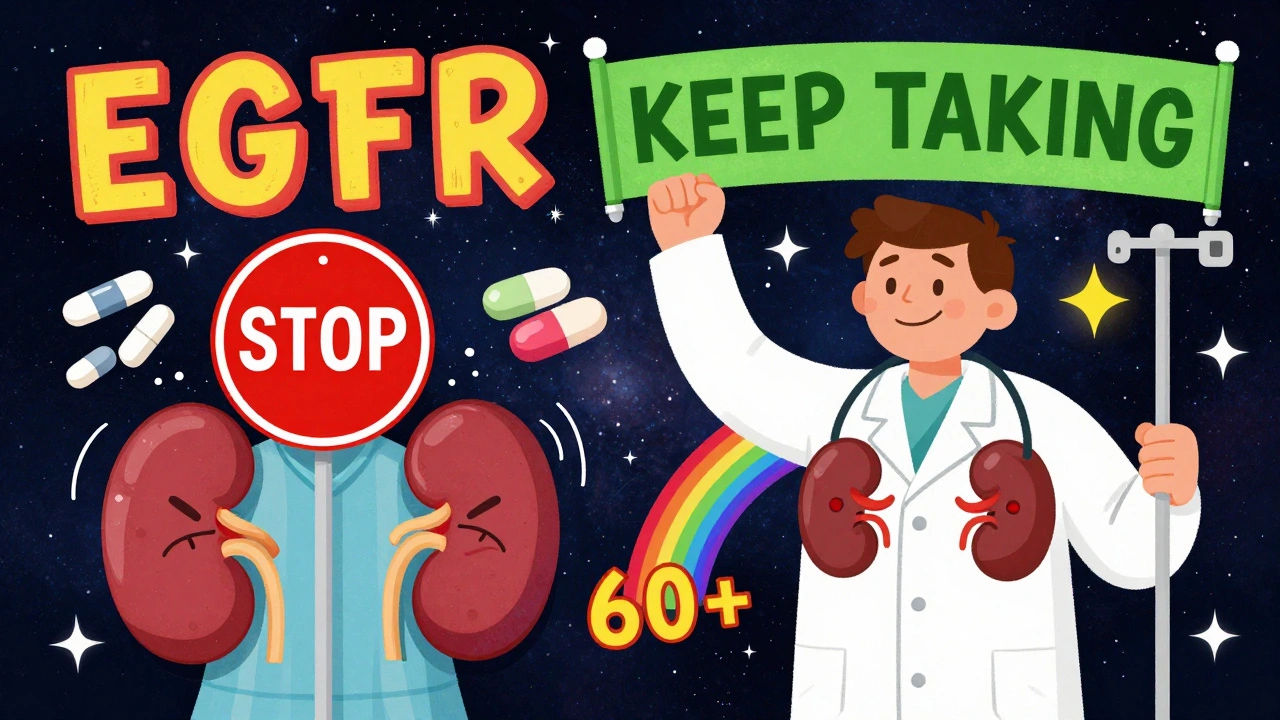
In 2016, the FDA updated its guidelines. And it was a big deal. Instead of blanket stops, they said: only stop metformin if you have moderate kidney impairment (eGFR between 30 and 60 mL/min/1.73 m²), or if you have heart failure, liver disease, alcohol use disorder, or you’re getting intraarterial contrast - like during a heart catheterization.
For IV contrast? If your eGFR is above 60 and you’re otherwise healthy? Keep taking metformin. No need to pause.
This change didn’t come out of nowhere. It was based on years of real-world data. A 2013 study in the PMC journal showed that the theoretical risk of lactic acidosis from contrast had been wildly exaggerated. Doctors were stopping metformin for scans that posed no real danger - and that left patients with high blood sugar for days. Poor control means more stress on the body, more risk of complications, and more hospital visits. The cure was worse than the disease.
Who Still Needs to Stop Metformin?
Not everyone. But some people still need to pause it - and here’s exactly who:
- Patients with eGFR between 30 and 60 mL/min/1.73 m²
- Anyone getting intraarterial contrast (cardiac cath, angioplasty, neurointerventional procedures)
- People with active heart failure, liver disease, or alcoholism
- Those with severe infection or low blood pressure
For these groups, metformin should be held on the day of the scan. It’s not restarted until 48 hours after, and only after checking kidney function again. Why? Because if the contrast dye caused kidney stress, metformin could still build up. Waiting gives the kidneys time to recover.
But if your eGFR is above 60, you’re not in heart failure, you don’t drink heavily, and you’re getting a routine CT scan with IV contrast? Keep taking your metformin. No interruption needed.
What About Dialysis Patients?
If you’re on dialysis, you’re already managing a major kidney issue. Metformin is generally avoided in advanced kidney disease - not because of contrast, but because your body can’t clear it at all. If you’re on dialysis and need contrast, your doctor will likely already have you off metformin. If you’re on peritoneal dialysis or hemodialysis, metformin can be removed during the session. No need to delay your scan.
What If Lactic Acidosis Happens?
It’s rare, but if it does - symptoms come on slowly. You might feel tired, nauseous, have abdominal pain, or breathe faster than normal. Your skin might feel cold. Blood tests will show high lactate levels and low pH.
Treatment is straightforward but urgent: stop metformin, give IV fluids, correct acidosis, and if it’s severe, start dialysis. Hemodialysis removes metformin and lactate quickly. Survival rates jump when treatment starts early. That’s why recognizing risk factors matters more than avoiding contrast scans.

Why This Matters for Diabetics
Metformin is the most common diabetes drug in the world. Over 150 million prescriptions are filled in the U.S. every year. It’s cheap, effective, and safe for most people. But when doctors tell you to stop it, you might go a week without good blood sugar control. That leads to high glucose, dehydration, and even diabetic ketoacidosis - a real emergency.
Stopping metformin for a scan that doesn’t need it isn’t safety. It’s overcaution. And it harms patients more than it helps.
The Bottom Line: A New Way Forward
Here’s what you need to do:
- Know your eGFR. Ask your doctor for your last kidney function number.
- If it’s above 60 and you’re otherwise healthy? Keep taking metformin before and after IV contrast scans.
- If it’s between 30 and 60? Stop metformin the day of the scan. Restart only after 48 hours, once your kidney function is checked again.
- If you’re getting cardiac cath or any artery-based procedure? Stop metformin regardless of kidney function.
- Don’t panic if you’re told to stop. But do ask: Why? What’s my eGFR? Is this IV or intraarterial contrast?
The science has shifted. The guidelines have shifted. It’s time your care does too. You don’t need to choose between diabetes control and imaging safety. With the right info, you can have both.
Can I take metformin before a CT scan with contrast?
Yes, if your kidney function is normal (eGFR above 60 mL/min/1.73 m²) and you’re getting intravenous (IV) contrast. You only need to stop metformin if your kidneys are impaired (eGFR 30-60), you have heart or liver disease, or you’re getting intraarterial contrast like during a heart catheterization.
How long should I stop metformin after contrast dye?
Wait 48 hours after the scan, then check your kidney function with a blood test. If your eGFR is stable or back to normal, you can restart metformin. Don’t restart without checking - even if you feel fine.
Does contrast dye damage kidneys?
Contrast dye can cause temporary kidney stress in about 1-2% of people, mostly those with existing kidney disease, diabetes, or dehydration. But for healthy kidneys, the risk is very low. Drinking water before and after the scan helps reduce this risk.
Is lactic acidosis common with metformin and contrast?
No. It’s extremely rare - fewer than 10 cases per 100,000 patient-years. Most cases happen in people with multiple serious health problems, not from contrast alone. The fear of lactic acidosis has been exaggerated for decades.
Should I stop metformin before an MRI with contrast?
No. MRI contrast (gadolinium) doesn’t affect kidney function the same way as iodinated contrast used in CT scans. There’s no link between gadolinium and metformin-related lactic acidosis. You can keep taking metformin for MRI scans regardless of kidney function.
Can I drink alcohol while taking metformin and getting contrast?
Avoid alcohol for at least 48 hours before and after contrast. Alcohol increases lactic acid production and stresses the liver and kidneys - both of which raise the risk of lactic acidosis when combined with metformin. Even if your kidneys are fine, alcohol adds unnecessary risk.
What’s Next?
The future of metformin use is personal. Researchers are starting to look at genetic factors that might make some people more prone to lactic acidosis. But for now, the best tool is simple: know your numbers. Know your eGFR. Know your health history. And ask your doctor: Is this scan really risky for me?
You’re not just a patient with diabetes. You’re someone who needs care - not fear. The evidence is clear. You don’t have to choose between your health and your imaging. With the right knowledge, you can have both.






December 10, 2025 AT 22:09
David Palmer
So you're telling me I don't need to stop my metformin before a CT? My doctor's been making me skip it for years. Now I feel like a lab rat.
December 11, 2025 AT 16:03
Michaux Hyatt
This is such a relief. I've been on metformin for 12 years and every time I needed a scan, I'd be stuck with blood sugar spikes for days. I'm glad the guidelines finally caught up with the science. Seriously, if your kidneys are fine, just keep taking it. No need to panic.
December 13, 2025 AT 11:30
Aileen Ferris
so u mean the fda just changed their mind? lol. what if they change it again next year? i'm not takin any chances. i'll keep skipin my meds like always. #bettersafethansorry
December 14, 2025 AT 12:30
Nikki Smellie
Wait. This is all a pharmaceutical scam. They want you to keep taking metformin so they can sell you more drugs. The contrast dye is actually a tracking agent. They're monitoring your glucose levels through your kidneys. The FDA doesn't care about you. They care about profits. I've read 17 papers on this. You're being manipulated.
December 15, 2025 AT 11:17
Jack Appleby
Let’s be clear: the 2016 FDA revision was not merely a guideline update-it was a paradigmatic recalibration of clinical risk assessment, grounded in robust meta-analytic evidence from the American College of Radiology’s prospective cohort studies. The prior dogma was not just outdated-it was statistically indefensible. To continue halting metformin in eGFR >60 patients is not caution; it’s iatrogenic negligence dressed in ritual.
December 17, 2025 AT 10:19
Queenie Chan
I love how this post breaks it down like a detective story-my kidneys are fine, my contrast is IV, so I’m just gonna keep popping my metformin like it’s candy. But… what about the people who don’t know their eGFR? Do they just guess? I mean, I had to beg my doctor for my last number. Shouldn’t this be automatic? Like, why aren’t labs just flagging it on every blood report? And what about rural folks who don’t have easy access to follow-up tests? Is this really equitable care?
December 19, 2025 AT 00:29
Stephanie Maillet
It’s fascinating… isn’t it?… how fear, not science… has dictated medical practice for decades… and how slowly… so slowly… truth creeps in… like dawn through fog… We treat patients like risks to be managed… not people to be trusted… and yet… here we are… learning… again… to listen… to data… to each other…
December 20, 2025 AT 23:22
Raj Rsvpraj
HAHAHAHAHAHA! You Americans think you invented medicine? In India, we've been giving metformin with contrast for 20 years without a single case! Your doctors are still stuck in the 1990s because they're too lazy to read journals. We don't need your guidelines-we have real-world results. Your system is broken.
December 21, 2025 AT 04:35
Frank Nouwens
Well written. Clear, concise, and backed by data. I’ve been a nurse for 18 years and I’ve seen patients suffer from uncontrolled hyperglycemia after unnecessary metformin holds. This is the kind of update that makes a real difference in outcomes. Thank you for taking the time to lay it out so well.
December 22, 2025 AT 04:52
Kaitlynn nail
Metformin = peace. Stopping it = chaos. Contrast = just water with color. We’re overcomplicating simple things.
December 23, 2025 AT 17:41
Rebecca Dong
THIS IS A TRAP. I just read a blog that says the contrast dye is laced with lithium to mess with your thyroid. And metformin? It’s not just for diabetes-it’s a government mood stabilizer. They don’t want you to stop it because then you’d wake up and realize you’re being controlled. I know someone who got a CT and then started dreaming in binary. You think that’s a coincidence?!
December 24, 2025 AT 02:57
Michelle Edwards
Thank you for writing this. I’ve been so anxious about my next scan, and now I feel like I can breathe again. I’m going to print this out and give it to my doctor. I deserve to manage my diabetes without unnecessary fear. You’re right-we don’t have to choose. We can have both.
December 25, 2025 AT 15:55
Sarah Clifford
my doctor told me to stop metformin and now i'm having crazy sugar crashes. like... why did i listen? i'm never trusting a doctor again. i'm just gonna drink coffee and hope for the best.