
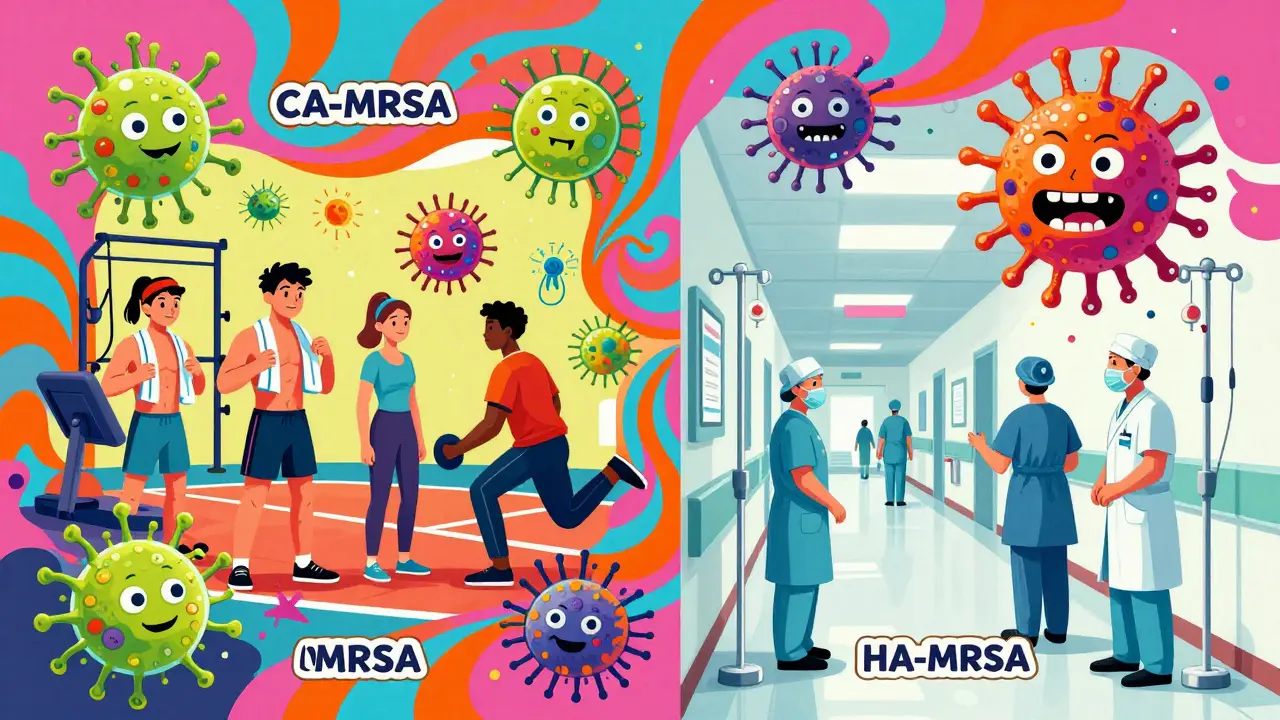
MRSA isn’t just a hospital problem anymore. Ten years ago, if you heard someone had MRSA, you assumed they’d been in a hospital or nursing home. Today, healthy people with no recent medical visits are getting it-after a workout, from a shared towel, even from a locker room bench. And the reverse is true too: hospital strains are showing up in homes, schools, and prisons. The old divide between community and hospital MRSA is fading fast, and that changes everything about how we treat and stop it.
What Exactly Is MRSA?
MRSA stands for methicillin-resistant Staphylococcus aureus. It’s a type of staph bacteria that doesn’t respond to common antibiotics like penicillin, amoxicillin, or methicillin. Staph bacteria live harmlessly on skin or in the nose for most people. But when they get into a cut, scrape, or surgical wound, they can cause serious infections. MRSA is dangerous because it resists the first-line drugs doctors usually reach for.
There are two main types: one that spreads in hospitals (HA-MRSA) and one that spreads in the community (CA-MRSA). They’re not just different in where they’re found-they’re genetically different, behave differently, and need different treatments.
CA-MRSA: The Strain That Came Home
Community-associated MRSA, or CA-MRSA, started showing up in the late 1990s. It hit people who’d never been in a hospital: athletes, kids in daycare, military recruits, people in prisons, and those who use injectable drugs. The most common strain in the U.S. is called USA300. It makes up about 70% of all CA-MRSA cases.
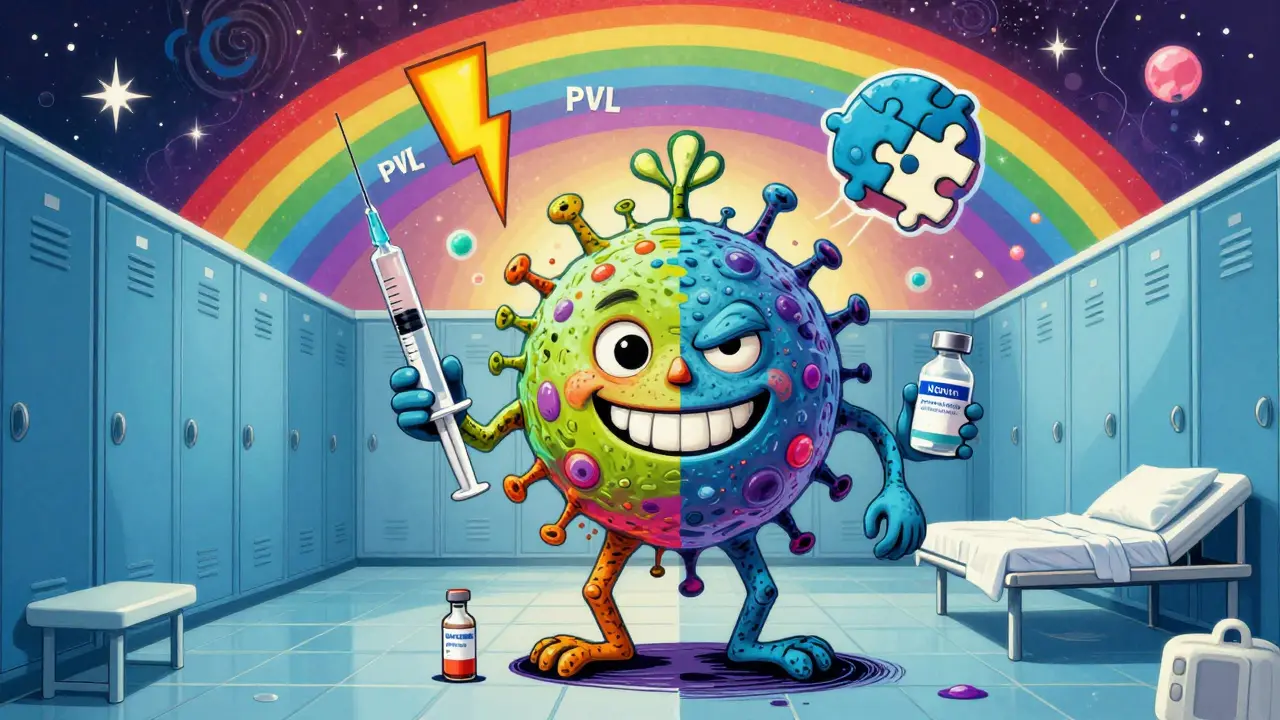
What makes USA300 so aggressive? It carries a toxin called Panton-Valentine leukocidin (PVL). This toxin kills white blood cells, which lets the infection spread fast through skin and soft tissue. That’s why CA-MRSA often starts as a painful boil or abscess-sometimes mistaken for a spider bite. It can also lead to life-threatening pneumonia, especially after the flu.
CA-MRSA doesn’t carry heavy antibiotic resistance genes. Instead, it has a small genetic package called SCCmec type IV or V. That means it’s usually still sensitive to drugs like clindamycin (96% of cases), trimethoprim-sulfamethoxazole (92%), and tetracyclines (89%). Many times, just draining the abscess is enough to clear the infection without antibiotics.
But it spreads easily. Skin-to-skin contact is the main route. Shared gear-towels, razors, gym equipment, uniforms-makes transmission simple. Crowded places raise the risk: military barracks have 12 times the rate, prisons have nearly 15 times, and homeless shelters have almost 9 times the infection rate compared to the general public.
HA-MRSA: The Hospital Workhorse
Hospital-associated MRSA has been around since the 1960s, right after methicillin was introduced. It’s the strain that thrives in places with lots of antibiotics, IV lines, catheters, and surgeries. People with weakened immune systems, long hospital stays, or recent surgeries are most at risk.
HA-MRSA carries bigger genetic packages-SCCmec types I, II, or III. These carry resistance to more antibiotics. Up to 98% of HA-MRSA strains resist erythromycin. Two-thirds resist clindamycin. Over 90% resist fluoroquinolones like ciprofloxacin. That means doctors can’t rely on simple oral meds. They often need stronger IV antibiotics like vancomycin, daptomycin, or linezolid.
HA-MRSA infections are more likely to be deep and serious: bloodstream infections, pneumonia from ventilators, or surgical site infections. Patients stay in the hospital much longer-on average 21 days compared to under 3 days for CA-MRSA. That’s partly because the infections are more complex, but also because the patients are often already sick with other conditions.
The Blurring Line: How Strains Are Crossing Over
Here’s the twist: the lines between hospital and community MRSA are dissolving. A 2017 Canadian study found that nearly 28% of MRSA infections picked up in hospitals were actually caused by community strains. And 27.5% of community infections were caused by hospital strains.
How? People move between settings. A patient gets discharged from the hospital carrying HA-MRSA on their skin. They go home and infect family members. A community member with CA-MRSA gets admitted after a bad skin infection-and brings the strain into the hospital. Medical staff can carry both types on their hands or scrubs.
Even more troubling, hybrid strains are appearing. Some now have the high virulence of CA-MRSA (like PVL toxin) combined with the multi-drug resistance of HA-MRSA. These are harder to treat and harder to track. The CDC’s old definition of CA-MRSA-based on whether someone had a hospital stay in the past year-is becoming useless. Many patients with CA-MRSA have had recent medical care. Many with HA-MRSA have never been hospitalized.
Treatment: One Size Doesn’t Fit All
Don’t assume all MRSA needs the same treatment. For CA-MRSA, if it’s just a skin abscess, draining it is often the most effective step. Antibiotics aren’t always needed. If they are, clindamycin, Bactrim (trimethoprim-sulfamethoxazole), or doxycycline are usually effective.
For HA-MRSA, you need stronger drugs. Vancomycin is still the go-to IV option. Daptomycin works for bloodstream infections. Linezolid is useful for pneumonia. But resistance to these is growing. Doctors now test the strain’s sensitivity before choosing antibiotics-something they didn’t always do in the past.
Here’s the catch: if you’re in the hospital with a skin infection, and you’ve recently been in the community, your doctor might have to treat you as if you have CA-MRSA-even if you’re in a hospital setting. That means avoiding antibiotics that won’t work, like clindamycin if you’re infected with a hybrid strain.

Stopping the Spread: What Actually Works
Handwashing still matters. But it’s not enough. MRSA can live on surfaces for days. In hospitals, strict isolation, contact precautions, and environmental cleaning reduce spread. In the community, it’s about behavior.
For athletes: shower immediately after practice. Don’t share towels, razors, or clothing. Cover cuts with clean bandages. Wipe down gym equipment before and after use.
For families: if someone has a draining boil, keep it covered. Wash their clothes and bedding in hot water. Avoid touching the wound. Don’t share personal items.
For prisons and shelters: routine screening, access to hygiene supplies, and education reduce transmission. Injecting drug users need clean needle access and wound care support-this isn’t just about addiction, it’s about stopping a public health crisis.
One big mistake: using antibiotics unnecessarily. Taking amoxicillin for a cold doesn’t help-and it helps MRSA grow. Antibiotic overuse in the community fuels resistance. In hospitals, it creates the perfect environment for HA-MRSA to thrive.
What’s Next? Surveillance Has to Change
Experts now say we need to stop thinking of MRSA as two separate problems. We need one system that tracks MRSA across the whole chain-from homes to ERs to ICUs. Genetic testing is becoming more common in labs. Knowing whether a strain is USA300 or ST239 helps predict how it will behave and what drugs will work.
Some hospitals now screen all incoming patients for MRSA, especially those with recent community exposure. Others are testing for PVL toxin to identify aggressive strains early. These aren’t perfect, but they’re steps in the right direction.
The biggest threat? A strain that combines the worst of both worlds: easy to spread like CA-MRSA, and resistant to nearly every drug like HA-MRSA. That strain already exists in small numbers. If it becomes dominant, we could face a return to the pre-antibiotic era for staph infections.
Right now, we’re not fighting two types of MRSA. We’re fighting one evolving threat that moves between our homes and our hospitals. The answer isn’t better drugs alone. It’s better awareness, smarter testing, and stopping the spread before it starts.
Can you get MRSA from a toilet seat?
Yes, but it’s unlikely. MRSA can survive on surfaces like toilet seats, towels, or gym equipment for days. But you usually need a break in the skin-like a cut or scrape-for it to cause an infection. The biggest risk comes from direct skin-to-skin contact or sharing personal items, not just touching a surface.
Is MRSA airborne?
No, MRSA is not typically spread through the air. It spreads through direct contact with infected skin or contaminated objects. The exception is CA-MRSA pneumonia, which can occur after a viral infection like the flu. In those cases, the bacteria may be coughed into the air, but this is rare and not the main way it spreads.
Can you carry MRSA without being sick?
Absolutely. About 1.3% of people in the U.S. carry MRSA on their skin or in their nose without any symptoms. These people are called carriers. They can spread it to others without knowing it. Carriers are more common in high-risk groups like healthcare workers, prison inmates, or people with frequent skin injuries.
Does MRSA go away on its own?
Sometimes, especially with small skin abscesses caused by CA-MRSA. Draining the pus can clear the infection without antibiotics. But if the infection spreads-redness increases, fever develops, or it doesn’t improve in a few days-you need medical care. Left untreated, MRSA can turn deadly.
Are natural remedies like honey or tea tree oil effective for MRSA?
Some studies show honey (especially medical-grade Manuka honey) and tea tree oil can kill MRSA in lab settings. But there’s no strong evidence they work reliably on human infections. They shouldn’t replace medical treatment. If you have a suspected MRSA infection, see a doctor. Natural remedies might help as a supplement, not a substitute.
Can you get MRSA from your pet?
Yes, but it’s rare. Pets like dogs and cats can carry MRSA, especially if they’ve been in hospitals or around sick people. If you have a skin infection and your pet has a wound or is licking you frequently, it’s possible to pass it back and forth. Good hygiene-washing hands after petting, keeping pet wounds covered-reduces this risk.
How long does MRSA stay contagious?
MRSA can stay on your skin or in your nose for months or even years without causing symptoms. Even after an infection clears, you might still carry the bacteria. Treatment reduces the amount of bacteria, but doesn’t always eliminate it. Ongoing hygiene and avoiding skin-to-skin contact with others is key to preventing spread.




January 29, 2026 AT 21:24
rajaneesh s rajan
So let me get this straight-we’re basically living in a bacterial soap opera where MRSA is the villain who keeps changing costumes? One day it’s the gym rat with a pimple, next day it’s the ICU monster with a PhD in antibiotic evasion. Wild.
January 30, 2026 AT 04:58
Ryan Pagan
Actually, this is way more nuanced than people realize. The real game-changer is that CA-MRSA’s SCCmec IV/V isn’t just ‘lightweight’-it’s evolutionarily optimized. Less genetic baggage means faster replication, better skin colonization, and less energy wasted on resistance genes that aren’t needed outside hospitals. That’s why it spreads like wildfire in locker rooms but dies off in sterile ICUs. The hybrid strains? That’s evolution on steroids. We’re not just fighting bacteria-we’re fighting a living algorithm.
January 30, 2026 AT 09:46
Keith Oliver
Bro, I work in a hospital and we screen everyone now. Half the time the ‘community’ strain comes from someone who got an MRI last month. The whole HA/CA distinction is a relic. We just call it ‘MRSA’ and treat based on the toxin profile, not the hospital chart. Stop overcomplicating it.
January 31, 2026 AT 23:58
DHARMAN CHELLANI
Typical. Doctors overcomplicate everything. Just wash your hands. Done. No need for genetic testing or PVL this or SCCmec that. You want to live? Don’t touch gross stuff. Simple.
February 2, 2026 AT 20:46
Andy Steenberge
I’ve seen this play out in my community health clinic. We had a kid come in with a boil that looked like a spider bite-turned out his dad had just been discharged from the hospital after knee surgery. The strain matched the hospital’s MRSA registry. Meanwhile, our local gym had three cases of USA300 in a month. The lines aren’t blurring-they’ve dissolved. We need public health messaging that doesn’t treat hospitals and homes like separate planets.
And yes, carriers are the silent engines of transmission. I had a nurse who didn’t know she was colonized for 18 months. She gave it to three patients before we caught it. Screening isn’t paranoia-it’s prevention.
Antibiotics for a cold? That’s like pouring gasoline on a fire. We’ve normalized overprescribing so much that people think it’s normal to pop pills for a sniffle. Meanwhile, MRSA laughs.
Manuka honey? Cute. But if your abscess is the size of a golf ball, no amount of honey is gonna save you. Drain it. Get the culture. Don’t gamble with your life.
And pets? Yeah, they can carry it. My dog licked my son’s infected cut. We tested both. Dog was positive. We treated him with chlorhexidine baths. No big deal. But people freak out like it’s a horror movie. It’s biology. Not magic.
Bottom line: MRSA isn’t going away. But if we stop treating it like two different enemies and start treating it like one smart, adaptable foe-we might actually win some battles.
February 3, 2026 AT 16:32
Robin Keith
...and yet, in the grand tapestry of human hubris, we imagine ourselves as the masters of biology-when in truth, we are but fleeting vessels in the eternal dance of microbial adaptation... MRSA doesn’t hate us... it simply *is*... and in its silent, resilient proliferation, it holds up a mirror to our arrogance: we built antibiotics as gods... only to become their most obedient servants... and now, the bacteria, ever patient, ever wise, have rewritten the rules... not with malice... but with the cold, indifferent grace of evolution itself... we thought we controlled life... but life? Life has always controlled us...
February 4, 2026 AT 01:56
kabir das
But what if… what if… MRSA is a government bioweapon?? I mean, think about it-why else would they push antibiotics so hard in hospitals AND in livestock?? It’s a trap!! They want us dependent on drugs that don’t work!! And the PVL toxin?? That’s not natural-that’s lab-engineered to target white blood cells!! They’re testing it on prisons and gyms!! I read a paper once-
Wait, did you know the CDC changed the definition in 2017 because they couldn’t cover up the truth??
Someone’s silencing the truth!!
February 4, 2026 AT 09:10
Alex Flores Gomez
Yeah ok but like, who even cares? It’s just staph. I had one once, popped it with a needle, drank some tequila, done. Also, ‘SCCmec’? Sounds like a brand of yoga mats. Can we just call it ‘super staph’ and move on?
February 5, 2026 AT 07:37
Paul Adler
This is one of the clearest, most balanced explanations of MRSA I’ve read in years. Thank you for highlighting the behavioral side-hygiene in gyms, prisons, and homes is just as critical as hospital protocols. Too often, public health efforts focus only on clinical settings, ignoring the social ecosystems where transmission actually happens. We need community-led education, not just top-down mandates.
February 6, 2026 AT 08:57
Andy Steenberge
Agreed. And I’d add that we need to stop stigmatizing carriers. People who carry MRSA aren’t dirty-they’re just unlucky. We should treat them like they’re part of the solution, not the problem. Offer free nasal swabs at community centers. Give out antiseptic wipes at gyms. Make prevention easy, not a chore.