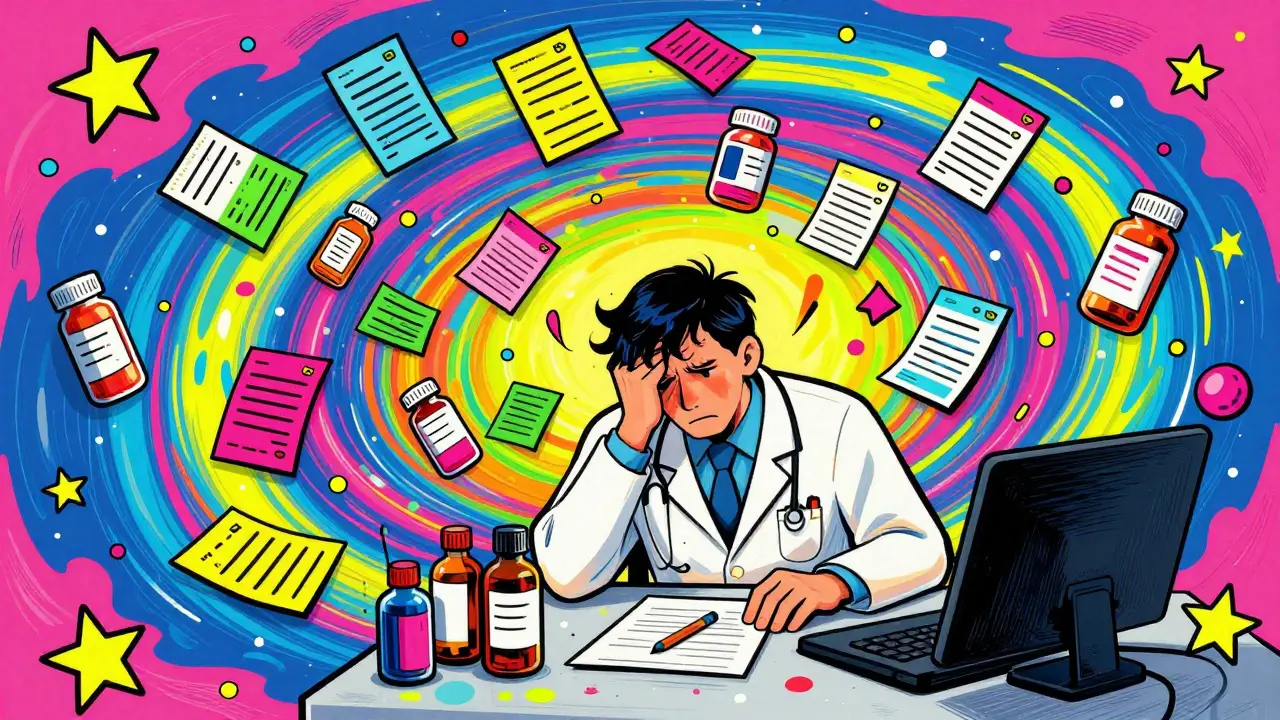
Getting a patient's prescription filled shouldn't feel like a full-time administrative job. Yet, for many clinicians, the battle with insurance companies over prior authorization is a daily reality. While we usually associate these hurdles with expensive brand-name drugs, providers are increasingly finding that even basic generic medications are being flagged. Whether it's a quantity limit on a common statin or a restriction on a specific generic manufacturer, these barriers can delay care and frustrate patients.
| Focus Area | Strategy for Success | Expected Impact |
|---|---|---|
| Submission Method | Shift from fax to electronic portals (e.g., CoverMyMeds) | 35-50% faster processing |
| Documentation | Use standardized templates for medical necessity | 32% faster approval times |
| Timing | Submit early; generics typically approve in 1-3 days | Reduced patient wait times |
Why Insurance Companies Flag Generic Drugs
It seems counterintuitive-why would a payer block a cheaper generic option? In reality, Prior Authorization is a utilization management strategy used by payers to control costs and ensure appropriate drug use. Even with generics, payers use these tools to prevent what they see as inappropriate spending.
Most generic flags fall into three buckets. First, there are therapeutic interchange restrictions. This happens when a Pharmacy Benefit Manager (or PBM) is a third-party administrator of pharmacy benefits that manages the drug formulary for health plans) prefers one specific generic over another. Second, you'll hit quantity limits-like requesting a 90-day supply when the plan only allows 30. Finally, duration limits are common for drugs like proton pump inhibitors, which may be capped at eight weeks unless you can prove a chronic condition.
The Technical Path to Approval
Securing approval isn't just about asking for the drug; it's about proving medical necessity. Payers aren't looking for a general recommendation; they want a data-driven argument. To get a generic approved, your documentation needs to be concrete. This means including chart notes, recent lab results, or diagnostic imaging like MRIs and radiographs.
If you're requesting a specific generic because the preferred one caused an adverse reaction, you can't just say "the patient didn't like it." You need to document the specific reaction or the therapeutic failure. For example, if a patient with Barrett's esophagus needs a higher dose of omeprazole, submitting an endoscopy report showing intestinal metaplasia provides the clinical evidence a reviewer needs to hit "approve."
The method of delivery matters. While some offices still rely on the fax machine, the industry has shifted toward electronic submission. Using portals like CoverMyMeds or Surescripts isn't just a convenience-it's a necessity for speed. Data shows that electronic systems can cut processing times nearly in half compared to paper-based methods.

Comparing Approval Timelines by Payer
Not all insurance plans operate on the same clock. If you're managing a diverse patient panel, you'll notice that the turnaround time varies wildly based on the payer type. Commercial insurers are often the most stringent, while government programs have specific legal mandates for their timelines.
| Payer Type | Standard Request | Urgent Request | PA Requirement Rate |
|---|---|---|---|
| Commercial Insurance | 5-10 Business Days | 24-72 Hours | ~93% |
| Medicare Part D | 3-7 Business Days | 24 Hours | ~89% |
| Medicaid (FFS) | Up to 14 Days | 24 Hours | ~67% |
Pro Strategies to Reduce Administrative Burden
Physicians are spending an average of 16 hours a week on this paperwork-time that should be spent with patients. To claw that time back, the most efficient practices stop treating every PA as a unique event and start treating them as a process. Establishing a dedicated prior authorization team is the most effective way to handle the volume.
Experienced medical assistants can often handle up to 78% of routine requests if they have the right tools. One of those tools is the standardized documentation template. Instead of writing a new letter for every patient, create a template for common scenarios-such as "failure of preferred generic" or "chronic need for PPI." When the clinical data is presented in the format the payer expects, approvals happen faster.
Another pro tip is to maintain payer-specific checklists. Since different insurers have different requirements, knowing exactly what a specific PBM needs for a generic switch prevents the dreaded "request for more information," which can push your approval timeline from three days to two weeks.

The Future of Generic Approvals: AI and Automation
The landscape is shifting. We're seeing a rise in "auto-approve" pathways. Some PBMs now automatically approve generic requests if the quantity is within the standard limit and the patient has a history of a paid claim for that drug. This removes the human reviewer from the loop entirely.
Looking ahead, AI-assisted review systems are expected to handle a huge portion of these decisions. By 2026, experts predict that 75% of generic PA decisions will be AI-driven, potentially bringing the average wait time down to under 24 hours. While this sounds great, it also means that if your documentation doesn't hit the specific "keywords" or data points the AI is trained to find, you'll get an automated denial.
Why is prior authorization required for generics if they are cheaper?
Payers use prior authorization for generics to manage "therapeutic interchange." This means they prefer one specific generic manufacturer or formulation over another to maximize their negotiated discounts. They also use it to enforce quantity and duration limits to prevent long-term misuse of medications that are only intended for short-term use.
What is the fastest way to get a generic medication approved?
The fastest route is using an electronic prior authorization (ePA) portal like CoverMyMeds or Surescripts rather than faxing. Additionally, providing all required clinical documentation (lab results, chart notes) in the first submission avoids a "request for information" delay. Generic approvals typically take 1-3 business days when submitted electronically with complete data.
What should I do if a generic PA is denied due to "failure to try preferred alternative"?
You must provide documented evidence of why the preferred alternative is contraindicated or has failed. This could include a history of adverse drug reactions, a documented allergy, or specific clinical guidelines (like ADA guidelines for diabetes meds) that justify skipping the preferred generic. A simple note saying the patient is "intolerant" is often not enough; specific symptoms and dates of occurrence are required.
How do quantity limits affect the PA process?
Quantity limits are set by the insurer to control the amount of medication dispensed over a specific period. If you prescribe a dose that exceeds this limit, the pharmacy will trigger a PA requirement. To secure approval, you must document why the patient requires a higher-than-average dose based on their specific clinical condition.
Are there legal mandates for how quickly a PA must be processed?
Yes, especially for government programs. CMS mandates that Medicaid urgent requests be processed within 24 hours and standard requests within 14 calendar days. For Medicare Advantage, new rules require 90% of urgent requests to be handled within 24 hours and standard requests within 72 hours.
Next Steps for Your Practice
If you're still relying on manual faxes, your first step should be auditing your submission workflow. Move as many requests as possible to ePA portals. Next, review your top ten most-prescribed generics and create "clinical evidence cheat sheets" for your staff. These sheets should list the exact labs or notes required by the most common payers in your region.
For those facing frequent denials, consider a periodic review of the PBM formularies for your most common patients. Knowing which generic manufacturer is "preferred" before you write the script can save you hours of paperwork and ensure your patients get their medication without a trip back to the pharmacy.