
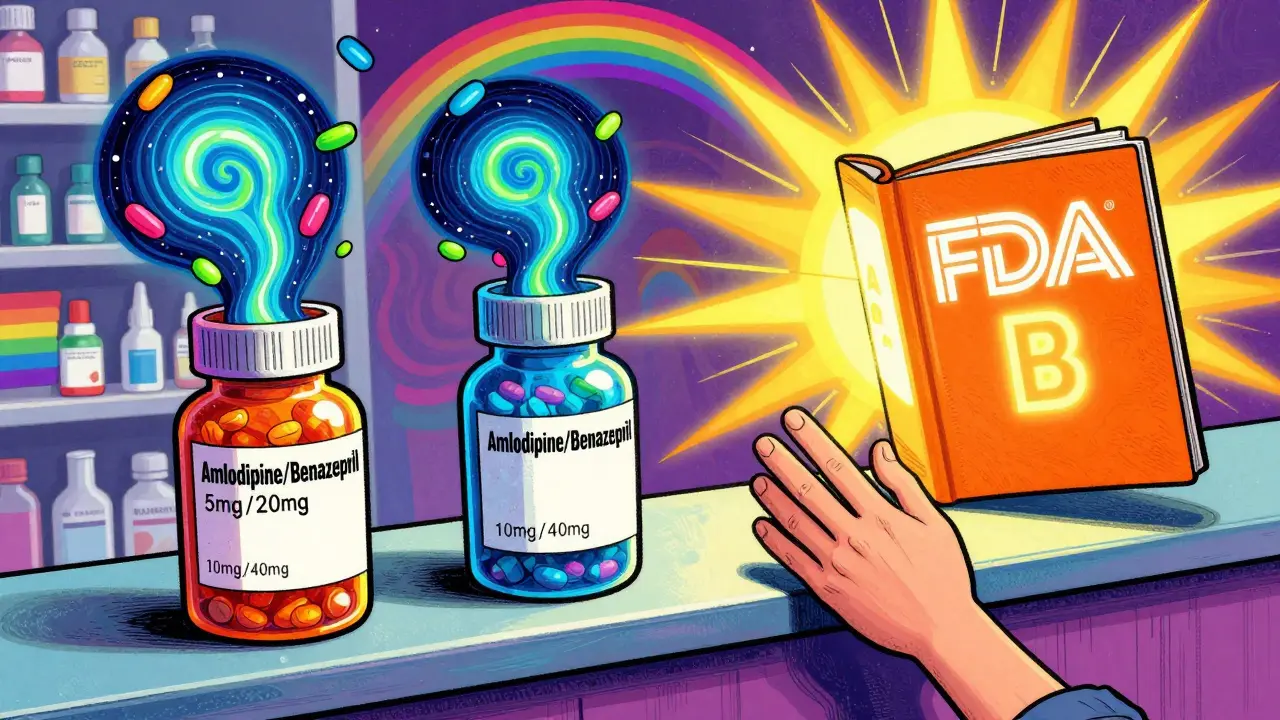
When you take two medications together-like a blood pressure pill and a cholesterol drug-it’s not just about adding up the doses. The real challenge comes when your pharmacy switches one of those pills to a different brand or generic version. You might not notice the change, but your body might. That’s because therapeutic equivalence isn’t just about the same active ingredients. It’s about whether those ingredients work the same way in your body, especially when they’re combined.
What Does Therapeutic Equivalence Really Mean?
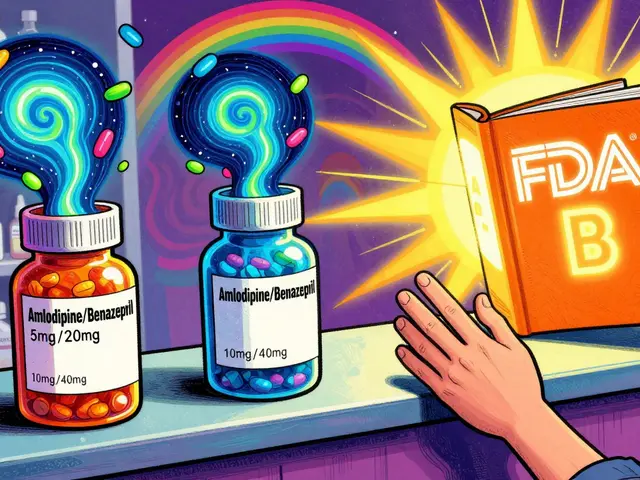
Therapeutic equivalence means two drug products can be swapped without changing how well they work or how safe they are. The FDA calls this the "A" rating in the Orange Book, a public list of approved drugs. If a generic version of your combination pill has an "A" rating, it’s supposed to act just like the brand-name version. But here’s the catch: that only applies if both products have the exact same active ingredients, the same strength, the same form (pill, patch, injection), and the same way they’re taken (by mouth, injected, etc.).That sounds simple-until you start mixing combinations. Take amlodipine/benazepril, a common combo for high blood pressure. One manufacturer makes it as a 5mg/20mg tablet. Another makes the same combo but in 10mg/40mg. Both have "A" ratings. But if you switch from one to the other without adjusting the dose, you could end up taking twice as much of one drug. That’s not therapeutic equivalence-it’s a dosing error.
Why Dose Differences in Combinations Are Tricky
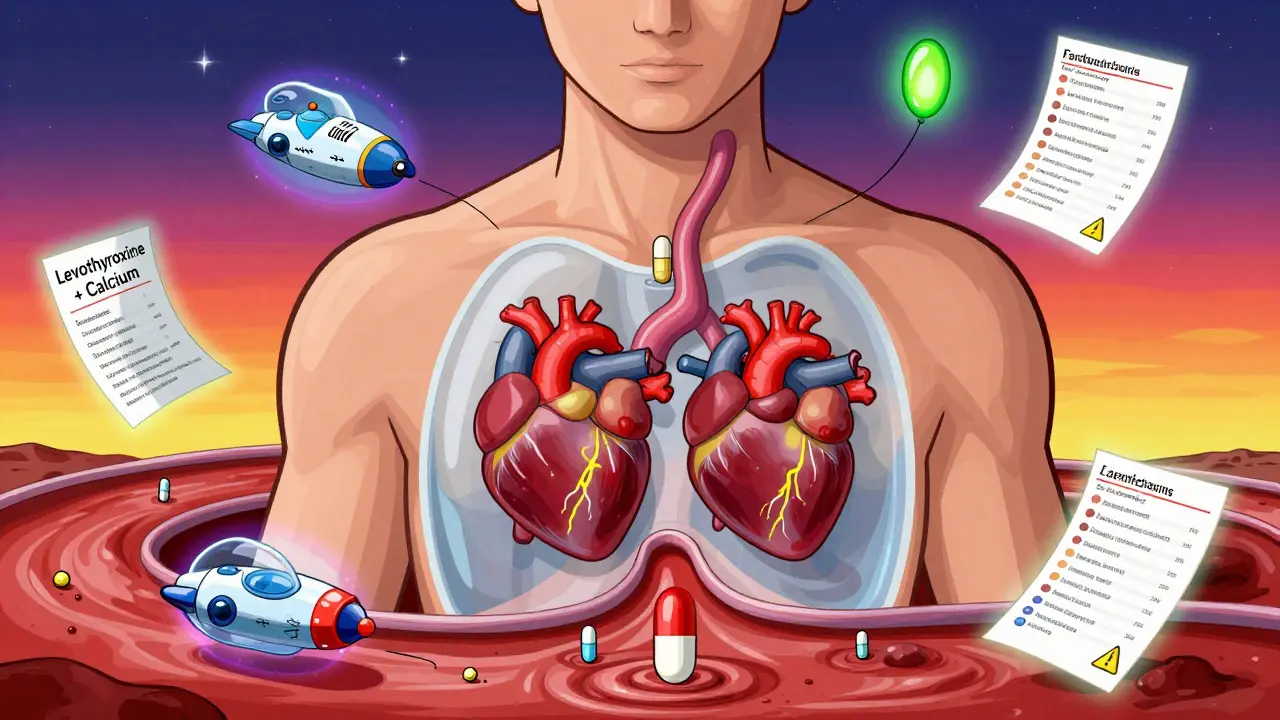
Combination drugs aren’t just two pills rolled into one. Sometimes, the ingredients work better together than they do alone. That’s called synergy. For example, tramadol and acetaminophen together give stronger pain relief than either one alone. But that means you can’t just swap them based on total milligrams. You need to know how each component behaves in the body, and how they interact.Some combinations have what’s called a narrow therapeutic index (NTI). That means the difference between a good dose and a dangerous one is tiny. Drugs like warfarin, levothyroxine, and phenytoin fall into this category. When they’re part of a combo-say, levothyroxine with a calcium supplement-the margin for error shrinks even more. A 2018 study found that 12% of patients had problems after switching between different generic versions of levothyroxine, even though both met FDA bioequivalence standards. Their thyroid levels went out of range. Their heart rates changed. Some needed emergency visits.
Even small differences in inactive ingredients-like the filler or coating-can matter. One generic version of rivaroxaban uses croscarmellose sodium as a disintegrant. Another uses sodium starch glycolate. That might not sound like much, but in a combo product, it can change how fast the drug gets absorbed. And if one component absorbs slower than expected, the whole balance shifts.
How the FDA Rates Combination Products
The FDA doesn’t treat all combination products the same. If a company applies under an Abbreviated New Drug Application (ANDA), and the product matches the brand-name drug exactly, it usually gets an "A" rating. But if they use a 505(b)(2) pathway-meaning they made a change to the original formula, like a new dose or different inactive ingredient-they might get an "A" or a "B." A "B" rating means there’s a question about whether it’s truly equivalent.For example, the brand-name Advair Diskus (fluticasone/salmeterol) had a generic version approved with a 97% therapeutic equivalence rating. It cost 40% less. But that’s rare. Most combination generics don’t get tested as thoroughly as single-drug generics. And if the combo includes a drug with complex pharmacokinetics-like many psychiatric meds-the chances of getting a solid "A" rating drop to around 72%.
What Happens in Real Life?
Pharmacists aren’t guessing. They use the Orange Book. But even with the right code, mistakes happen. A pharmacist on Reddit shared that in just six months, they made three dosing errors switching between different strengths of amlodipine/benazepril. One patient ended up with dangerously low blood pressure. Another got too much of the diuretic component and became dehydrated.On Allnurses, a nurse practitioner described a patient on Vytorin (ezetimibe/simvastatin) who switched to a generic. Their LDL cholesterol jumped 15%. The patient didn’t feel different. The numbers didn’t show a problem until the next lab test. That’s the silent danger: no symptoms, but the drug isn’t working as well.
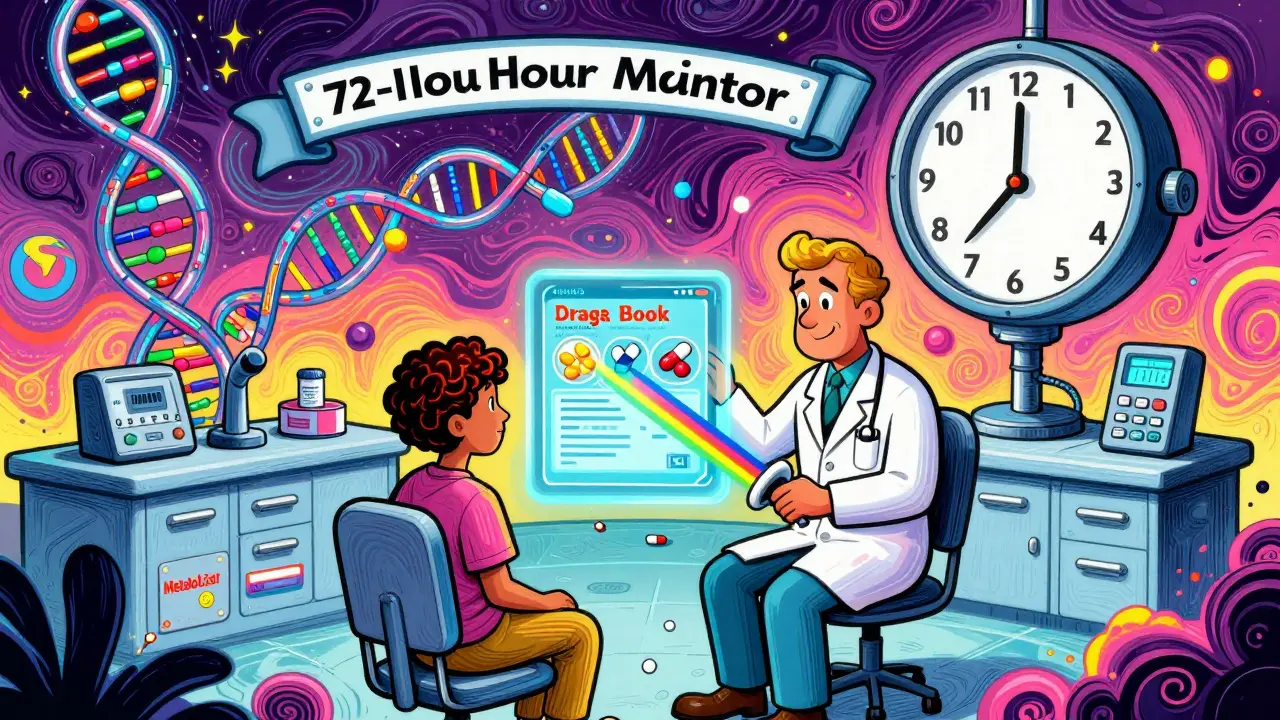
Meanwhile, hospitals that have strict protocols see better results. One system saved $1.2 million a year by switching to generic proton pump inhibitor combos-without a single adverse event. How? They trained staff. They used barcode scanning. They monitored patients for 72 hours after any switch.
How to Manage Dose Equivalents Safely
There’s no magic formula, but there are clear steps to reduce risk:- Check the TE code in the FDA’s Orange Book. Don’t assume "same name = same dose." Look up the exact combination and strength.
- Confirm active ingredient amounts. If the combo has two drugs, make sure both are at the same dose in the new product. Don’t rely on the brand name alone.
- Watch for NTI drugs. If one component is warfarin, levothyroxine, or phenytoin, treat the whole combo like a high-risk product. Don’t switch without monitoring.
- Use barcode scanning. It’s not just for inventory-it’s a safety net. Scanning ensures the right drug, right dose, right patient.
- Monitor for 72 hours after any switch. Check labs, vital signs, symptoms. Even if the TE code says "A," real-world biology isn’t always predictable.
Some health systems now use standardized conversion tables for combo products. Others have built alerts into their electronic prescribing systems. If a prescriber tries to substitute a combo with a different strength, the system flags it. That’s the future-and it’s already working.
The Bigger Picture: Where This Is Headed
The FDA is working on new tools to predict when a generic combo might not work the same. They’re using machine learning to compare formulation differences and flag potential problems. Early tests are 89% accurate. That’s promising.But the real shift is coming from personalized medicine. By 2030, the NIH expects 30% of therapeutic equivalence decisions to include genetic data. Why? Because two people can take the same combo, and one metabolizes the drug fast while the other holds onto it. That changes what "equivalent" even means.
Right now, we treat therapeutic equivalence like a checkbox. But it’s not. It’s a dynamic balance. And when you’re combining drugs, that balance gets fragile.
What You Can Do
If you’re a patient: Ask your pharmacist, "Is this the exact same dose as before?" Don’t just say, "It’s the same pill." Show them the label. Compare the numbers.If you’re a provider: Don’t assume generics are interchangeable in combos. Double-check the Orange Book. If you’re switching a patient on an NTI combo, schedule a follow-up in a week. Check labs. Ask how they feel.
Therapeutic equivalence isn’t about saving money. It’s about making sure the money you save doesn’t cost someone their health.
Can I swap any generic combination drug for the brand-name version?
Not always. Only if the generic has an "A" rating in the FDA’s Orange Book and matches the brand in active ingredients, strength, dosage form, and route of administration. Even then, dose differences between manufacturers can cause problems-especially in combination products. Always verify the exact milligram amounts of each component.
Why do some generic combination drugs cause side effects even if they’re "therapeutically equivalent"?
Because "therapeutic equivalence" only guarantees the same active ingredients at the same strength. It doesn’t control for inactive ingredients, manufacturing processes, or how the drug is absorbed in the body. For example, one generic might use a different filler that slows absorption, causing the drug levels to peak later or lower than expected. This can be especially risky with narrow therapeutic index drugs like warfarin or levothyroxine.
Are combination drugs with NTI components always risky to switch?
Yes, they require extra caution. The FDA requires tighter bioequivalence standards (90-111% instead of 80-125%) for NTI drugs, but even that isn’t foolproof. Studies show patients on NTI combo drugs can experience changes in lab values or symptoms after switching-even with "A" ratings. Always monitor closely after any substitution and consider keeping the patient on the same manufacturer if possible.
How do I know if my combination drug is a 505(b)(2) product?
You can’t always tell just by looking at the label. But if the generic version has a different strength, inactive ingredient, or delivery method than the original brand, it’s likely a 505(b)(2) application. These products may have an "A" or "B" rating. Check the FDA’s Orange Book for the TE code. If it’s "B," there’s an unresolved bioequivalence issue.
What should I do if I notice a change in how my combination drug works after a switch?
Contact your prescriber immediately. Don’t assume it’s "all in your head." Document any symptoms-like dizziness, fatigue, unusual heart rate, or changes in lab results. Bring the new pill bottle and the old one to your appointment. Your provider can check the Orange Book, compare active ingredient amounts, and decide whether to switch back or adjust the dose.
Is there a list of combination drugs that are commonly mis-substituted?
Yes. Common ones include amlodipine/benazepril, ezetimibe/simvastatin, levodopa/carbidopa, and metformin/glipizide. These are often prescribed in multiple strengths, and manufacturers vary in how they combine them. The Institute for Safe Medication Practices (ISMP) publishes annual lists of high-risk combination products. Ask your pharmacist for their current list.


January 18, 2026 AT 01:01
Joni O
I switched my amlodipine/benazepril generic last month and felt like a zombie for three days. My BP dropped so low I had to sit down just to brush my teeth. Turns out the new one was 10/40 instead of 5/20. Pharmacy didn't catch it. Don't trust the label-check the numbers. 🙏
January 19, 2026 AT 03:16
Ryan Otto
Let me be clear: the FDA’s "A" rating is a corporate fiction. The agency is captured by Big Pharma and allows generics with wildly different dissolution profiles to pass as equivalent. The fact that you can swap a 5/20 for a 10/40 and call it "therapeutic equivalence" is not just negligent-it’s criminal. This is how people die quietly while CEOs get bonuses.
January 20, 2026 AT 06:20
Max Sinclair
Really appreciate this breakdown. I’ve been a pharmacist for 18 years and this is exactly why I always double-check the mg amounts-even if the brand name is the same. One time I caught a switch from valsartan/hydrochlorothiazide 160/12.5 to 160/25. Patient was fine, but their potassium was crashing. Small change, huge consequence. Always verify. 🙌
January 20, 2026 AT 08:50
Praseetha Pn
YOU THINK THIS IS BAD? WAIT TILL YOU HEAR ABOUT THE PHARMACIES THAT USE THE SAME BOTTLE LABELS FOR DIFFERENT DRUGS-AND THE ALGORITHMS THAT AUTO-SUBSTITUTE BASED ON PRICE, NOT SAFETY. I WORKED AT A BIG CHAIN AND SAW A MAN GET 100MG OF METFORMIN INSTEAD OF 500MG BECAUSE THE SYSTEM PICKED THE CHEAPEST ONE. HE HAD A SEIZURE. THE PHARMACIST SAID "IT WASN'T MY JOB TO QUESTION THE SOFTWARE." THEY FIRED HER. THEN THEY HIRED A NEW ONE. SAME SYSTEM. SAME MISTAKES. THE SYSTEM IS BROKEN. WE'RE ALL GUINEA PIGS.
January 20, 2026 AT 15:18
Andrew McLarren
While the concerns raised are valid, it is imperative to recognize that the FDA’s bioequivalence standards, though imperfect, remain the most rigorous in the world. The majority of generic combination products perform equivalently in clinical practice. The instances of harm are statistically rare and often stem from human error in dispensing, not formulation variance. Systemic solutions-such as barcode verification and electronic alerts-are far more effective than public alarmism.
January 21, 2026 AT 03:33
Andrew Short
Anyone who takes generics without demanding the exact same manufacturer is asking for trouble. You think your doctor cares? They get paid by the system. Your pharmacist? They’re paid by volume. Your insurance? They want the cheapest pill, no matter if it makes you sick. You’re not a patient-you’re a cost center. Wake up. Your life is being auctioned off to the lowest bidder.
January 21, 2026 AT 04:21
christian Espinola
So let me get this straight-you’re telling me we can’t trust a pill just because it says "generic"? Newsflash: every single drug in your cabinet is made in a factory overseas with ingredients that might’ve been shipped through three countries. The FDA doesn’t inspect most of them. This isn’t about therapeutic equivalence-it’s about trust. And we don’t have any.
January 21, 2026 AT 19:46
Chuck Dickson
Hey everyone-just wanted to say I’ve been using the same generic combo for 3 years now, switched manufacturers twice, and never had an issue. But I also check my labs every 3 months and talk to my doc before anything changes. It’s not about fear-it’s about being smart. If you’re on an NTI drug, don’t just roll the dice. Monitor. Ask questions. Stay involved. You’ve got more power than you think.
January 23, 2026 AT 12:49
kenneth pillet
Been a nurse for 12 years. Saw a patient go into torsades after a generic switch on amiodarone/another combo. Lab was fine. EKG wasn't. We caught it in time. Always check the rhythm. Always.
January 24, 2026 AT 23:14
Wendy Claughton
I just want to say… thank you for writing this. 💙 I’ve been terrified to switch my levothyroxine combo since my TSH went wild last year. I didn’t know it was a thing. Now I print the Orange Book page and bring it to every appointment. I feel less alone. Also, I cried reading this. Not because I’m sad-because someone finally said it out loud.
January 25, 2026 AT 02:05
Stacey Marsengill
Of course they don’t test combo generics properly. Why would they? The FDA’s budget is slashed every year while drug prices soar. It’s not incompetence-it’s intentional. They want you dependent on expensive brand names. The "A" rating is a scam. The "B" rating? That’s the truth they’re hiding. And the pharmacists? They’re told to shut up and dispense. You’re not safe. You never were.