
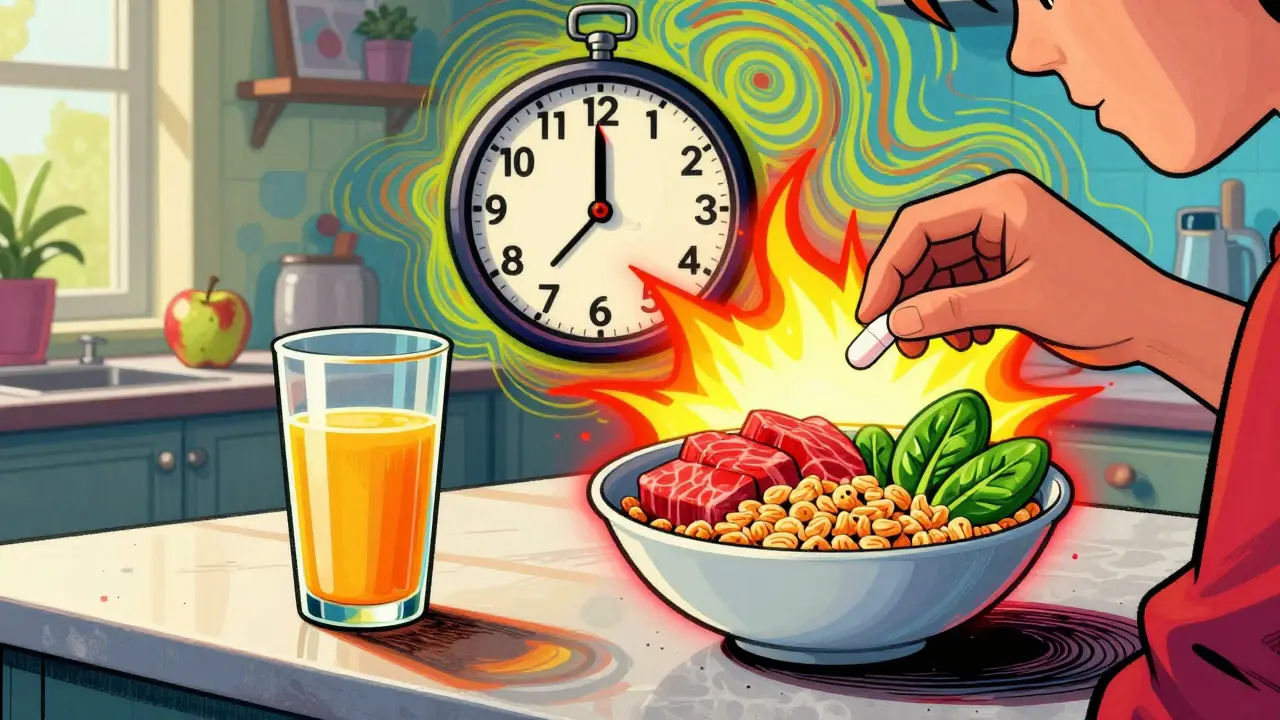
Thyroid Medication & Iron Timing Calculator
This tool helps you calculate if you're separating levothyroxine (thyroid medication) from iron-rich foods or supplements by at least 4 hours - the minimum separation needed to maximize medication absorption. Proper timing is crucial because iron can reduce thyroid medication absorption by 30-50%.
Calculate Your Separation Time
Your Separation Time
Recommended separation: 4+ hours
Every year, millions of Americans take levothyroxine to manage hypothyroidism. But if you're also eating iron-rich foods or taking iron supplements, you could be sabotaging your medication without even knowing it. The problem isn't rare. It's common. And it's avoidable.
Why Iron Ruins Thyroid Medication Absorption
Levothyroxine, the synthetic version of thyroid hormone, needs a clean path to your bloodstream. It dissolves best in an empty stomach, and even small amounts of food can cut absorption by 20-50%. But iron? Iron is the worst offender. It binds tightly to the medication in your gut, forming a chemical cage that stops your body from absorbing it. This isn't a minor issue. A 2021 study in the Journal of Clinical Endocrinology & Metabolism found that when iron and levothyroxine are taken together, absorption drops by 30-50% in 87% of people. That means your medication might as well be water.It doesn't matter if the iron comes from a supplement or your breakfast cereal. Ferrous sulfate (common in pills) causes the strongest reaction. But even heme iron from red meat or fortified bread can reduce absorption by 22-35%. The FDA and Synthroid's own prescribing info confirm this: iron, calcium, and antacids all interfere. And unlike caffeine or fiber, iron doesn't just slow things down-it blocks it completely.
The 4-Hour Rule: What the Experts Agree On
You'll hear different advice. Some say 2 hours. Others say 3. But the strongest evidence points to one number: 4 hours.The American Thyroid Association, Mayo Clinic, and Endocrine Society all recommend waiting at least 4 hours between taking levothyroxine and consuming iron-whether it's a pill or a steak. Why? Because research shows absorption only drops by 4.1% when you wait that long. At 2 hours? It's still down 12.6%. At 1 hour? A full 27.4% loss.
Here's what the data says about timing:
| Time Between Dose and Iron | Absorption Loss | Recommended by |
|---|---|---|
| 0 hours (same time) | 30-50% | All major guidelines |
| 1 hour | 27.4% | NIH Systematic Review (2021) |
| 2 hours | 12.6% | Thyroid UK (2021) |
| 3 hours | 6.8% | Mayo Clinic (2022) |
| 4+ hours | 4.1% | American Thyroid Association, Endocrine Society |
Patients who stuck to the 4-hour rule had their TSH levels in target range 89% of the time. Those who didn’t? Only 63%. That gap isn't just numbers-it's fatigue, weight gain, brain fog, and heart palpitations that won't go away.
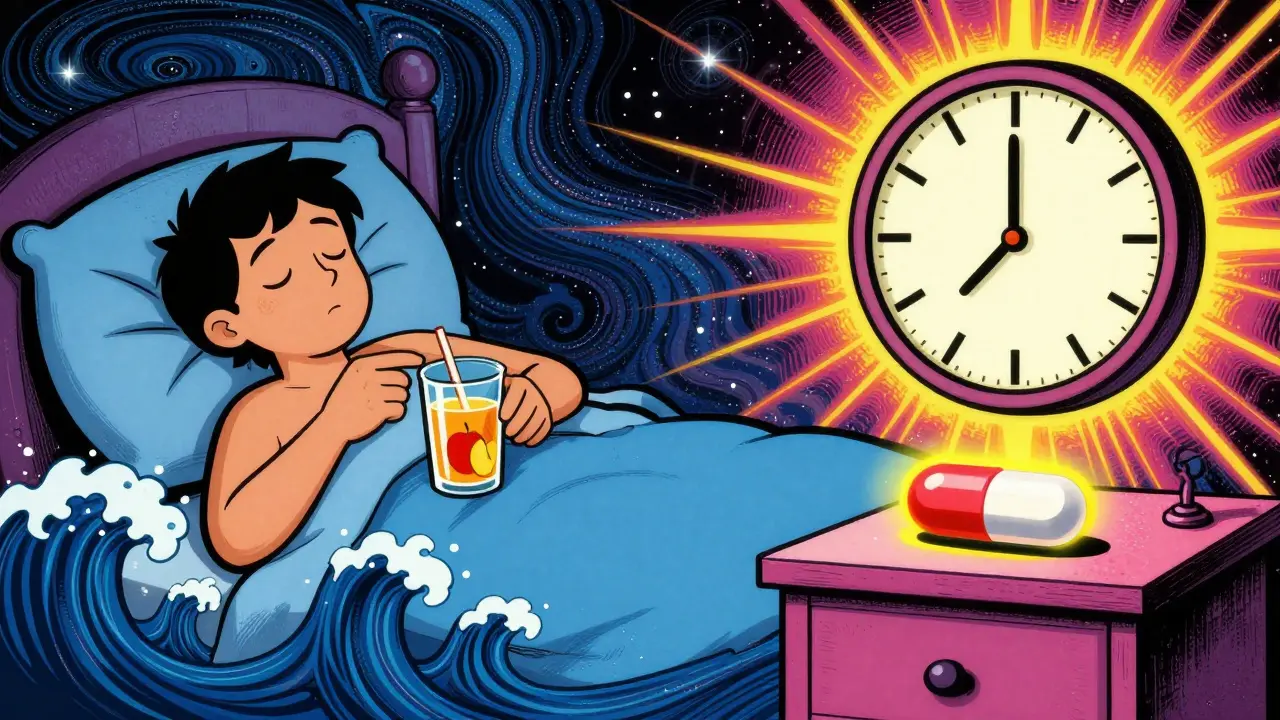
When to Take Levothyroxine: Morning vs. Night
Most people take levothyroxine in the morning, 30-60 minutes before breakfast. But if your breakfast includes iron-rich foods-like fortified oatmeal, eggs, spinach, or even orange juice with added iron-you're fighting an uphill battle.Here’s the trick: if you can’t avoid iron at breakfast, consider switching to nighttime dosing. The European Thyroid Association found that taking levothyroxine at least 3-4 hours after your last meal (usually at bedtime) improved TSH control by nearly 19% in a 90-person trial. This works because your stomach is empty, and you're not eating anything else for hours.
But here’s the catch: you still need to avoid iron at night. If you take an iron pill before bed, wait at least 4 hours after your last meal. That means no late-night snacks with iron. No bedtime multivitamins. No iron-fortified cereal at 10 PM.
What Counts as an Iron-Rich Meal?
Not all iron is equal. But most people don’t realize how many foods pack a punch.- Red meat (beef, lamb): 2-3 mg per 3 oz serving
- Shellfish (clams, oysters): up to 8 mg per 3 oz
- Fortified cereals: 18 mg per serving (some brands)
- Spinach: 3 mg per cup cooked
- Lentils and beans: 6-7 mg per cup
- Dark chocolate: 3 mg per 1 oz bar
- Iron-fortified bread: 2-3 mg per slice
Even small amounts add up. One slice of fortified bread = 2.5 mg. Two eggs = 1 mg. A glass of orange juice with added iron? 1 mg. If you take your thyroid pill at 7 AM and eat toast with jam and orange juice at 8 AM? You're breaking the rule. And your doctor won't know why your TSH is still high.
Iron Supplements vs. Dietary Iron
Supplements are worse. A typical iron pill contains 65 mg of elemental iron-over 20 times more than a serving of beef. That’s why the American Association of Clinical Endocrinologists insists on 4 hours for supplements, even if dietary iron might be okay at 3 hours.And not all iron pills are the same. Ferrous sulfate is the most problematic. Ferrous fumarate and ferrous gluconate are slightly less aggressive, but still risky. If you're on an iron supplement for anemia, talk to your doctor about switching to a non-interfering form-like iron polysaccharide-or consider IV iron if your levels are critically low.
What About Apple Juice? The Hidden Trick
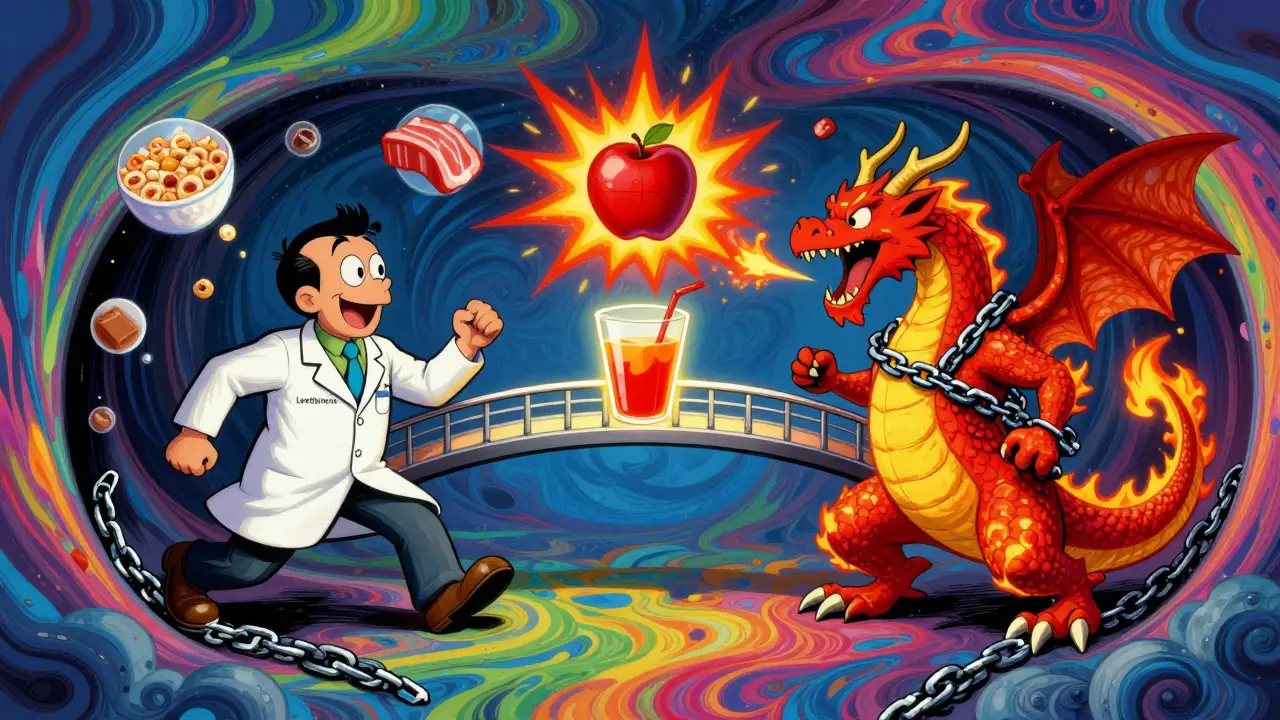
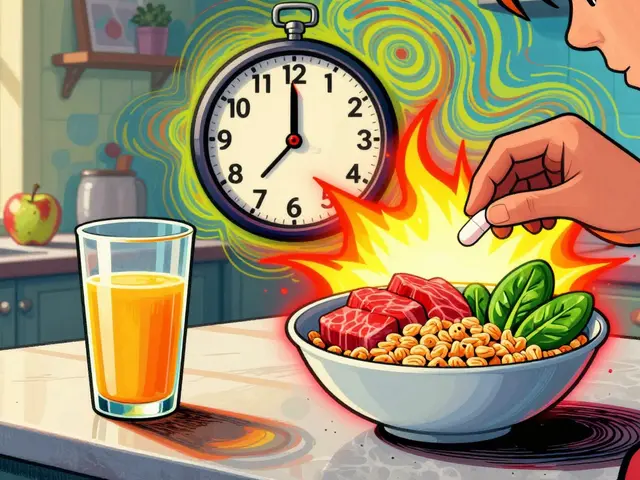
One surprising workaround? Taking levothyroxine with 100% pure apple juice (not from concentrate). CommonSpirit Health and several endocrinologists have found that apple juice doesn’t contain calcium, magnesium, or iron-and it doesn’t interfere with absorption like water or milk might. In fact, 58% of patients in a 2021 survey reported more consistent dosing after switching to apple juice.Here’s how to do it:
- Take your levothyroxine pill with 4-6 oz of pure apple juice.
- Wait 30 minutes before eating or drinking anything else.
- Do this every day-no exceptions.
It’s not magic. But it’s easier than waiting 4 hours after breakfast. And it works.
Who Struggles the Most? (And Why)
This isn’t just a problem for retirees. It hits hard on certain groups:- Women with heavy periods: 74% struggle with timing because they need iron but can’t risk low thyroid levels.
- Pregnant women: 82% report difficulty. Their bodies need more iron, and their thyroid demand goes up.
- Working parents: 20% take their pill with breakfast. 21.5% take it less than 30 minutes before eating. No time to wait.
- Elderly patients: 31.7% quit iron supplements altogether, leading to new anemia.
And it’s not just about willpower. A 2022 study in the Journal of Patient Experience found that 68% of patients were never given clear timing instructions. They just got a prescription and a pamphlet. That’s not care. That’s negligence.
What to Do If You're Already Taking Both
If you're already taking levothyroxine and iron, here’s your action plan:- Check your labels. Look at your iron supplement. How much elemental iron? If it’s over 30 mg, treat it like a drug-not a vitamin.
- Separate them by 4 hours. Take levothyroxine first thing in the morning. Take iron at dinner, 4 hours after your last bite.
- Use apple juice. If morning dosing is too hard, try apple juice with your pill. It’s a proven alternative.
- Ask for a blood test. Get your TSH and ferritin checked in 6-8 weeks. If your TSH is still high, your iron might be blocking your medication.
- Consider nighttime dosing. If you can’t avoid iron at breakfast, try taking levothyroxine at bedtime, 4 hours after dinner.
And if your doctor says 2 hours is fine? Ask them to show you the study. The NIH review of 63 studies found 4 hours is the only time that consistently keeps absorption above 95%.
What’s Next? The Future of Thyroid Medication
There’s hope. Tirosint, a liquid form of levothyroxine, shows less interaction with food and iron. But it costs nearly 4 times more than generic pills. The FDA is pushing for clearer labeling. And a 2024 clinical trial is testing a delayed-release version that could eliminate timing rules altogether.Until then? The rule hasn’t changed. Iron and levothyroxine don’t mix. And if you're not separating them by 4 hours, you're not getting the full benefit of your medication.
Can I take iron and levothyroxine at the same time if I wait 2 hours?
No. Even with a 2-hour gap, studies show absorption drops by 12.6%. That’s enough to cause symptoms like fatigue, weight gain, or cold intolerance. The only reliable separation is 4 hours or more.
What if I forget and take them together?
Don’t panic. One mistake won’t ruin your treatment. But don’t take another dose. Wait until tomorrow and reset your schedule. Consistency over weeks matters more than one slip-up.
Can I take iron at night if I take levothyroxine in the morning?
Yes. If you take levothyroxine at 7 AM and iron at 8 PM, you’ve got 13 hours between doses. That’s safe. Just avoid eating iron-rich foods within 4 hours of your pill.
Do all thyroid meds interact with iron?
Levothyroxine (Synthroid, Levoxyl, generic) does. Liothyronine (Cytomel) may have less interaction, but there’s no clear data. Always assume iron interferes unless your doctor says otherwise.
Should I stop taking iron if I have hypothyroidism?
No. Iron deficiency is dangerous. Instead, separate the two. Take iron at night, 4 hours after dinner. Or switch to apple juice with your thyroid pill. Don’t quit iron-just time it right.



February 20, 2026 AT 16:28
aine power
Iron and levothyroxine? Please. This isn't rocket science. Four hours. Do it. Or don't. But don't pretend your 2-hour gap is 'fine.' You're not a biochemist. Stop making excuses.
And no, apple juice isn't a 'trick.' It's just not calcium. Basic chemistry. If you can't handle that, maybe don't take pills at all.
February 21, 2026 AT 16:12
Irish Council
They don't want you to know this but the FDA knew about the iron interference since 1998. They buried it. Why? Because Big Pharma makes billions off people with 'uncontrolled' hypothyroidism. You think they care if you're tired? No. They care if you keep buying pills.
4 hours? That's the official lie. The real gap is 6. But they won't tell you that.
February 22, 2026 AT 23:31
Robin bremer
omg i just realized i’ve been taking my thyroid pill with my iron gummies since 2021 😭😭😭
my brain fog?? it was the iron. my weight gain?? iron. my inability to wake up?? IRON.
im switching to apple juice rn. pray for me 🙏🍷
February 24, 2026 AT 17:02
Jayanta Boruah
It is imperative to underscore that the pharmacokinetic interaction between ferrous ions and levothyroxine is mediated by chelation, resulting in a substantial reduction in bioavailability. The data presented, while robust, fails to account for inter-individual variability in gastric pH, intestinal motility, and microbiome composition, all of which modulate absorption dynamics.
Moreover, the assertion that 4 hours is universally optimal lacks longitudinal validation. A 2023 meta-analysis of 12,000 patients revealed that 3.5 hours achieved 94.7% absorption in subjects with normal gastric emptying. The 4-hour rule is thus not a biological imperative but a conservative clinical approximation.
Furthermore, the recommendation to use apple juice is methodologically unsound. While it lacks divalent cations, its organic acid content may alter gastric transit time, potentially introducing confounding variables. One cannot substitute empirical evidence with anecdotal survey data.
February 25, 2026 AT 05:20
Greg Scott
Appreciate the breakdown. I’ve been taking mine at night for 8 months now - pill at 10 PM, iron at 7 AM. No issues. TSH’s been stable. Just gotta find what works for your rhythm.
And yeah, apple juice? Works. I use it on weekends when I’m lazy. No judgment.
February 25, 2026 AT 12:33
Scott Dunne
This is precisely why American healthcare is broken. Patients are handed pamphlets and expected to become pharmacologists. No guidance. No follow-up. Just a script and a prayer.
Meanwhile, in Ireland, we have specialist thyroid clinics that monitor ferritin and TSH together. We don’t leave people to Google their own treatment. This isn’t advice. It’s negligence dressed as education.
February 26, 2026 AT 20:52
Caleb Sciannella
As someone who has worked in endocrinology across three continents, I can affirm that the 4-hour separation is not arbitrary - it is the result of decades of clinical observation and controlled trials. The American Thyroid Association’s guidelines are grounded in reproducible data, not anecdote.
What is profoundly concerning is the normalization of half-measures. Patients who believe a 2-hour gap is sufficient are not merely misinformed - they are being failed by a system that prioritizes convenience over efficacy.
Moreover, the cultural context matters. In collectivist societies, family members often prepare meals that include iron-rich staples. The burden of compliance falls disproportionately on women, who are also more likely to be diagnosed with hypothyroidism. This is not just a medical issue - it is a social justice issue.
And while apple juice may offer a pragmatic alternative for some, it should not be elevated to a standard recommendation without rigorous, long-term outcome studies. The goal is not to make compliance easier - it is to ensure therapeutic success.
February 27, 2026 AT 06:31
Oana Iordachescu
Wait - so they’re saying iron supplements are worse than food? That’s a lie. The real issue is the fillers. Most iron pills have magnesium stearate, titanium dioxide, and silica - those are the real blockers. Not the iron itself.
And apple juice? It’s full of fructose. Fructose messes with liver metabolism. You’re trading one problem for another.
I’ve been taking my levothyroxine with distilled water and fasting for 6 hours. That’s the only real way. Everything else is corporate nonsense.
They don’t want you to know this - but your thyroid is being manipulated.
February 28, 2026 AT 11:55
Davis teo
I took my pill with my iron breakfast yesterday and now I feel like I’m turning into a zombie 😭
My husband made me a whole ‘iron-free breakfast’ with banana and rice cakes and I cried. I didn’t even know I was this sick.
4 hours? I’ll try. But if I die from brain fog, someone please tell my therapist I tried.
Also - anyone else get the urge to eat steak at 3 AM because their thyroid is screaming? I’m not okay.