
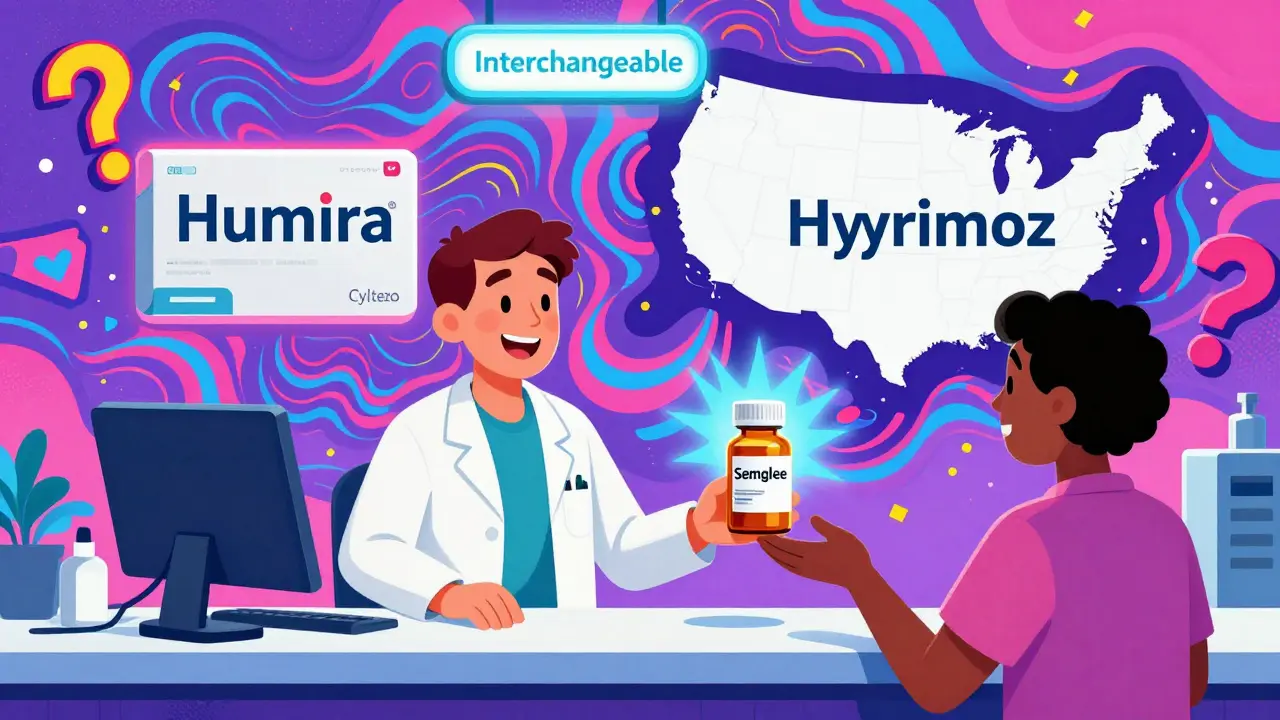
When you pick up a prescription for insulin or a biologic drug like Humira, you might not realize the pharmacy could swap it out for a cheaper version without your doctor’s knowledge. That’s because of something called interchangeability-a special FDA designation that lets pharmacists automatically replace a brand-name biologic with a biosimilar, no doctor’s approval needed. But here’s the catch: not all biosimilars are created equal. Only a small handful have this status. And even then, whether you get swapped depends on where you live.
What Makes a Biosimilar Interchangeable?
Biosimilars are not like generic pills. A generic version of, say, ibuprofen is chemically identical to the brand name. It’s the same molecule, made in a lab. Biosimilars are different. They’re made from living cells-like yeast or bacteria-and even tiny changes in the manufacturing process can affect how they work. That’s why the FDA treats them more carefully. To get approved as a biosimilar, a company must prove it’s highly similar to the original biologic in structure, function, safety, and effectiveness. But to be labeled interchangeable, they need to go further. They must prove that switching back and forth between the original and the biosimilar-multiple times-doesn’t increase risk or reduce effectiveness. That means running clinical studies where patients alternate between the two drugs, sometimes several times over months. Only then does the FDA grant interchangeability status. As of November 2023, the FDA has approved 41 biosimilars. Only 10 of them are interchangeable. The first was Semglee, an insulin glargine product approved in July 2021. The first interchangeable monoclonal antibody biosimilar, Cyltezo (for adalimumab), followed in August 2023. These aren’t "better" biosimilars. They’re just ones that passed an extra hurdle for switching.Why Does This Even Matter?
Biologics are expensive. Humira, for example, costs over $7,000 a month without insurance. Biosimilars can cut that by 15% to 30%. But if pharmacists can’t swap them automatically, many patients won’t get the cheaper option. Doctors might not know to prescribe it. Insurance might not cover it unless it’s the only option. Interchangeability removes those barriers. A 2023 study in JAMA Health Forum showed that states allowing automatic substitution saw 18.7% higher use of biosimilars for insulin. That’s not just savings-it’s access. For patients with rheumatoid arthritis, psoriasis, or Crohn’s disease, getting a biosimilar can mean sticking with treatment instead of skipping doses because of cost. But here’s the flip side: automatic substitution can backfire. One patient on the Psoriasis Foundation forum said their pharmacy switched them from Humira to Hadlima without telling them. They had a reaction-turns out they were allergic to an inactive ingredient in the biosimilar. Another patient reported saving $800 a month after switching to Hyrimoz, with no side effects. The difference? Communication.State Laws Make It a Patchwork
Even if the FDA says a biosimilar is interchangeable, your state decides whether your pharmacist can swap it. And the rules vary wildly. Forty states let pharmacists substitute interchangeable biosimilars without checking with your doctor. Arizona, for example, lets them swap freely as long as they notify you, record what was dispensed, and send a note to your prescriber within five days. California is different: substitution is only allowed if it saves you money. In Alabama, Indiana, South Carolina, and Washington, your doctor has to give explicit permission before any swap happens. Washington, D.C. and six other states require cost savings as a condition. This mess creates real headaches for pharmacies. A 2022 survey found 67% of independent pharmacists were confused about what they could and couldn’t do depending on the state. One pharmacist on Reddit wrote: "In California, I have to check if it’s lower cost. In Arizona, I don’t. My system doesn’t tell me which state I’m in. I’m just guessing."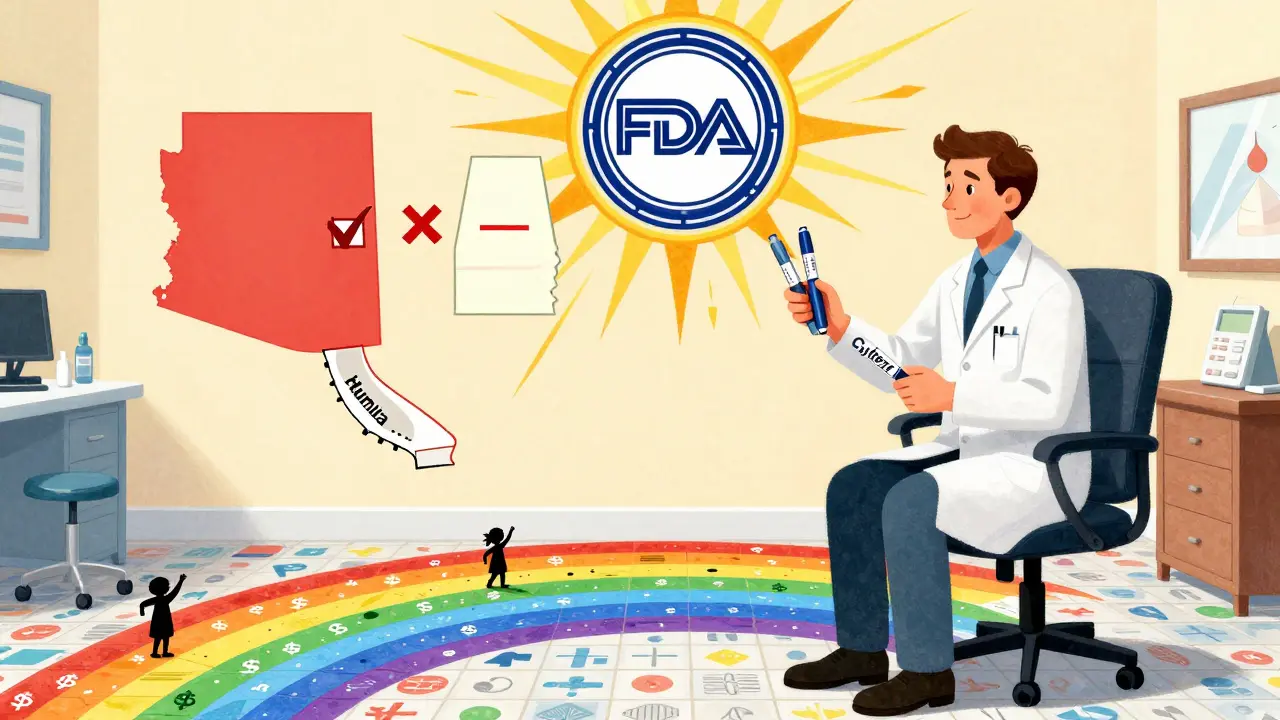
Interchangeable vs. Biosimilar: What’s the Difference?
All interchangeable biosimilars are biosimilars. But not all biosimilars are interchangeable. Think of it like this: every interchangeable biosimilar passed the same safety bar as every other biosimilar. The extra step isn’t about being safer-it’s about being switchable. The FDA is clear on this: "Interchangeables are not a higher level of biosimilar." All FDA-approved biosimilars are just as safe and effective as the original. But only the interchangeable ones have been tested for multiple switches. This matters because pharmacists sometimes think they can swap between different biosimilars of the same drug. They can’t. If you’re on Humira and your pharmacy has two interchangeable biosimilars-Cyltezo and Hyrimoz-they can’t swap you from one to the other without your doctor’s okay. Interchangeability only applies to switching from the original brand to one biosimilar, not between biosimilars.What Patients Need to Know
If you’re on a biologic, you have rights. You can ask your doctor to write "dispense as written" on your prescription. That blocks any substitution. You can also ask your pharmacist: "Is this the original brand, or a biosimilar?" They’re required to tell you. A 2022 survey by the National Psoriasis Foundation found 63% of patients were happy with their biosimilar. But 28% didn’t even know they’d been switched. That’s not okay. You deserve to know what you’re taking. If you notice new side effects after a switch-rashes, fatigue, joint pain-tell your doctor. It could be nothing. Or it could be a reaction to a different excipient (those are the inactive ingredients, like preservatives or stabilizers). Biosimilars aren’t required to use the same ones as the original. That’s a real risk.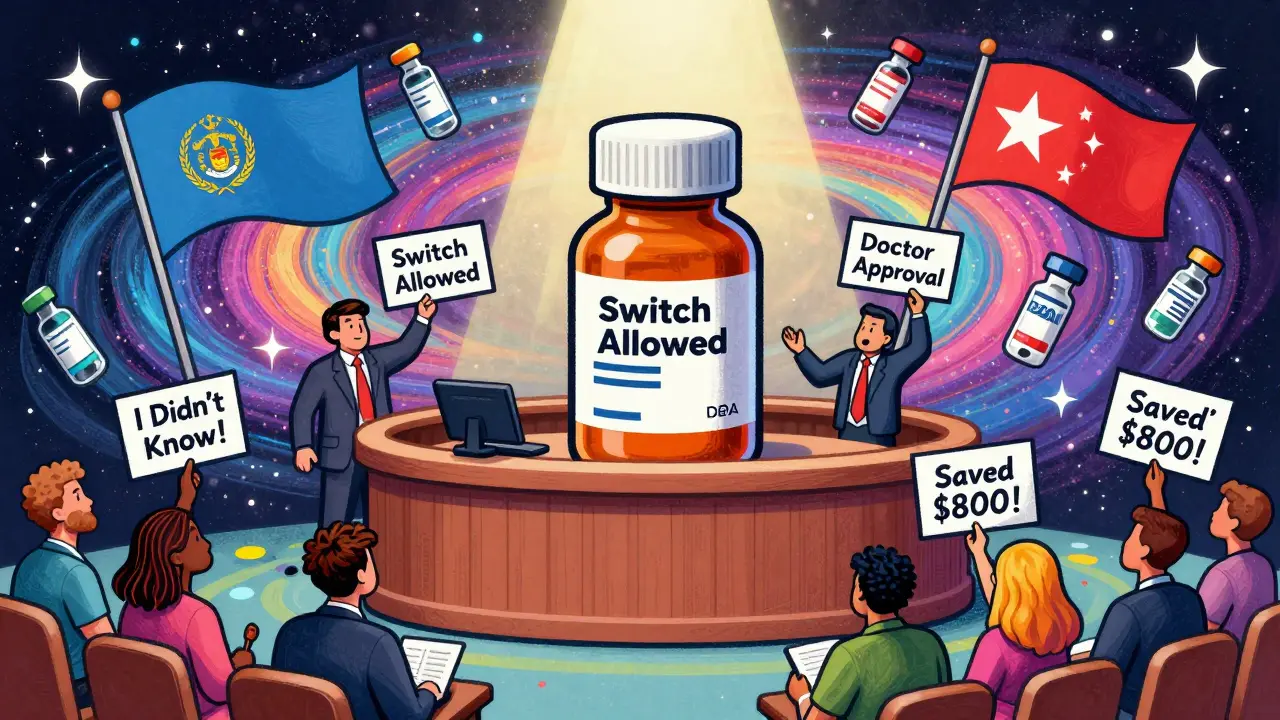
What’s Coming Next?
The market is shifting fast. By 2026, biosimilars could make up nearly half of the $168 billion biologics market. More drugs are losing patent protection. Insulin, Humira, Enbrel, and others are already facing competition. The FDA is working on streamlining the switching study requirements. Meanwhile, Congress is debating the Biosimilar Red Tape Elimination Act. It would remove the need for switching studies and make all approved biosimilars interchangeable by default. Supporters say it’s long overdue. Critics warn it could open the door to unsafe switches. Pharmacists are getting better trained. The American Pharmacists Association has trained over 12,000 pharmacists in biosimilar substitution since 2020. But the real challenge isn’t knowledge-it’s systems. Most pharmacy software doesn’t distinguish between state laws. That means human error is still common.Bottom Line
Interchangeability is meant to lower costs and improve access. And it’s working-where it’s allowed. But it’s not a magic bullet. It’s a complex system built on science, regulation, and state politics. If you’re on a biologic, know your rights. Ask questions. Demand transparency. Your health is worth it.Can my pharmacist switch my biologic without telling me?
In most states, yes-if the drug is designated as interchangeable and your doctor didn’t block substitution. But in some states, like Alabama and Washington, your doctor must approve the switch. Even where automatic substitution is allowed, pharmacists are required to notify you at the pharmacy counter. If you weren’t told, ask why.
Are interchangeable biosimilars safer than regular biosimilars?
No. All FDA-approved biosimilars, whether interchangeable or not, meet the same high standards for safety and effectiveness. The interchangeability label only means the drug has been tested for multiple switches without increased risk. It doesn’t mean it’s stronger, purer, or more effective.
Can I be switched from one biosimilar to another?
Not automatically. Interchangeability only applies to switching between the original brand and one biosimilar. If you’re on Cyltezo and your pharmacy has Hyrimoz, they can’t swap you without your doctor’s permission. This is a common point of confusion-even among pharmacists.
Why don’t all biosimilars get interchangeability status?
Because the switching studies are expensive and time-consuming. Companies have to run clinical trials where patients switch back and forth between the original and biosimilar multiple times. Many choose not to pursue it because the cost outweighs the benefit-especially if the drug already has strong market share without it.
What should I do if I think a biosimilar switch caused side effects?
Contact your doctor immediately. Keep the medication bottle-you’ll need the manufacturer and lot number. Report the reaction to the FDA’s MedWatch program. You may also want to ask your doctor to write "dispense as written" on future prescriptions to prevent future switches.




January 2, 2026 AT 07:51
Sarah Little
Interchangeability is a regulatory mirage. The FDA’s criteria for switching studies are laughably insufficient-no real-world pharmacovigilance data, no long-term immunogenicity tracking across multiple switches. We’re treating biologics like aspirin, and patients are the lab rats. The 10 interchangeable agents? All patented by Big Pharma subsidiaries. Coincidence? I think not.
And don’t get me started on state laws. California’s cost-based substitution rule is a joke. It incentivizes pharmacies to pick the cheapest biosimilar, not the most clinically appropriate one. What if the patient has a history of hypersensitivity to polysorbate 80? No one checks. No one cares.
January 4, 2026 AT 05:34
innocent massawe
Wow. This is so important for people like me who can't afford Humira 😔. In Nigeria, we don't even have biosimilars yet. I hope one day our health systems catch up. Thank you for explaining it so clearly. 🙏
January 5, 2026 AT 16:14
Tru Vista
Interchangeable ≠ better. Got it. But why do pharmacists still think they can swap between biosimilars? That’s a myth. And yeah, excipients matter. I had a rash after switching to Hadlima-turns out it had citrate. Humira didn’t. No one warned me. #FDAFail
January 5, 2026 AT 16:17
Vincent Sunio
It is both intellectually and ethically indefensible to conflate biosimilarity with interchangeability, as the public discourse frequently does. The FDA’s regulatory framework, while rigorous in theory, is undermined by commercial pressures and legislative fragmentation at the state level. The notion that cost reduction alone justifies substitution is a profound misapprehension of pharmacological science. One must not mistake economic expediency for clinical wisdom.
January 6, 2026 AT 05:20
JUNE OHM
THEY’RE SWITCHING OUR MEDS WITHOUT TELLING US??!! 😡 THIS IS A BIG PHARMA CONSPIRACY TO CONTROL US!!
Who’s behind this? The CDC? The WHO? The Illuminati??
I heard they’re putting microchips in the inactive ingredients now. I’m not taking anything that’s not made in America. #BuyAmerican #MedFreedom
January 7, 2026 AT 07:09
Philip Leth
Man, I used to work at a pharmacy in Texas. We had a guy come in every month for Humira. One day he got Hyrimoz. He didn’t say a word. Two weeks later he comes back with a printout of every biosimilar’s excipient list. Asked if we knew what was in it. We didn’t. He started asking every pharmacist. Now he’s the unofficial biosimilar guru at our clinic. Crazy how one person can change the culture.
Just say ‘what’s in it?’ and you’ll get answers. People forget they have rights.
January 7, 2026 AT 12:04
Angela Goree
Wait-so pharmacists can switch my insulin without telling me? In some states?!! That’s insane. And then they say ‘it’s the same thing’? No. It’s not. Different stabilizers. Different buffers. Different manufacturers. Different lot numbers. Different side effects. I’ve seen patients crash after switches. This isn’t generic lisinopril. This is a living molecule. And we’re treating it like a soda can. This is negligence. Someone needs to sue. Someone needs to testify. Someone needs to stop this.
January 9, 2026 AT 03:58
Shanahan Crowell
Look, I get the fear-but let’s not throw the baby out with the bathwater. Biosimilars have saved thousands of people from choosing between rent and insulin. The fact that 63% of patients are happy with them? That’s huge. Yeah, communication sucks. Yeah, state laws are a mess. But the solution isn’t to block substitution-it’s to fix the system. Better software. Mandatory pharmacist training. Clear labeling. Patient notifications. We can do this. We just need to stop screaming and start building.