
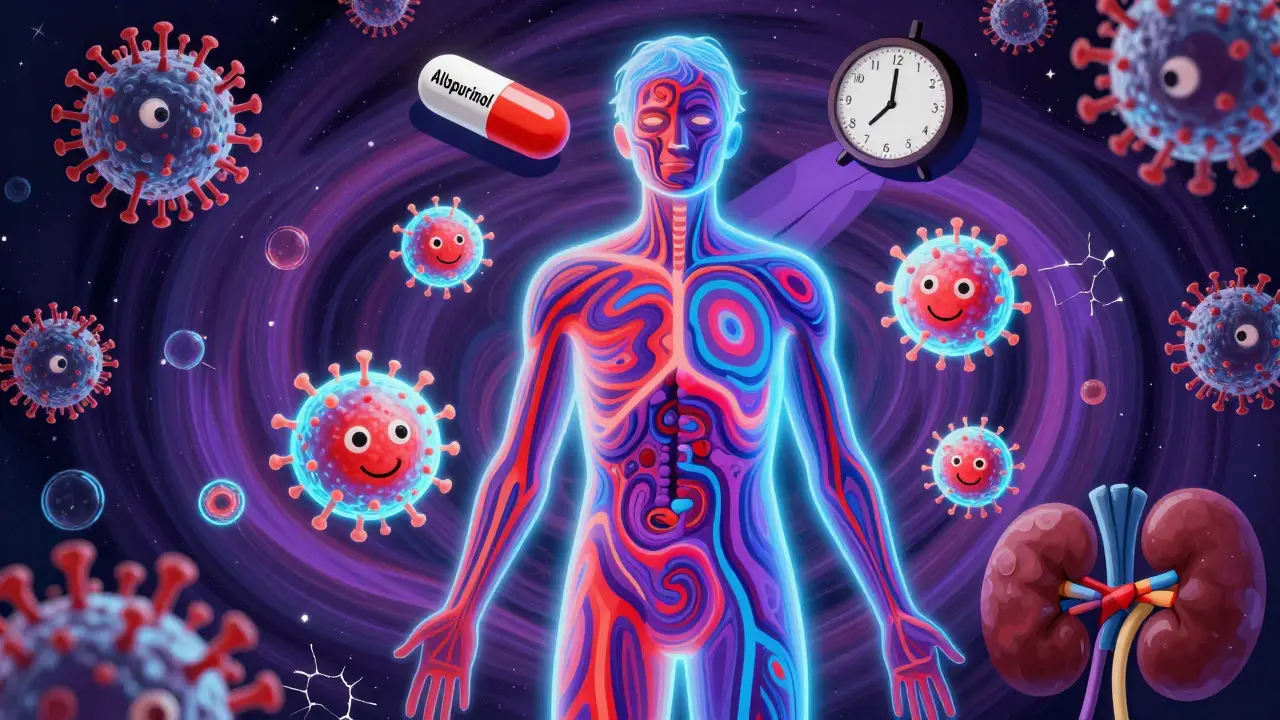
DRESS Syndrome Diagnostic Checker
Understand the RegiSCAR Scoring System
The RegiSCAR system is the gold standard for diagnosing DRESS syndrome. It scores symptoms on a scale from 0-10, where higher scores indicate greater likelihood of DRESS. A score of 5 or more indicates high probability, while 6 or more suggests almost certain diagnosis.
Symptom Assessment
Your Assessment Results
Please check your symptoms and calculate your risk score.
Your RegiSCAR score:
Urgent Medical Attention Required
If you scored 5 or higher, this indicates high probability of DRESS syndrome. Stop the suspected drug immediately and seek emergency medical care. DRESS syndrome is life-threatening and requires hospitalization.
Medical Evaluation Recommended
If you scored between 2-4, medical evaluation is recommended to rule out DRESS syndrome. Contact your doctor to discuss your symptoms and medication history.
Low Probability
If you scored 1 or less, the probability of DRESS syndrome is low. However, if symptoms persist or worsen, consult your healthcare provider.
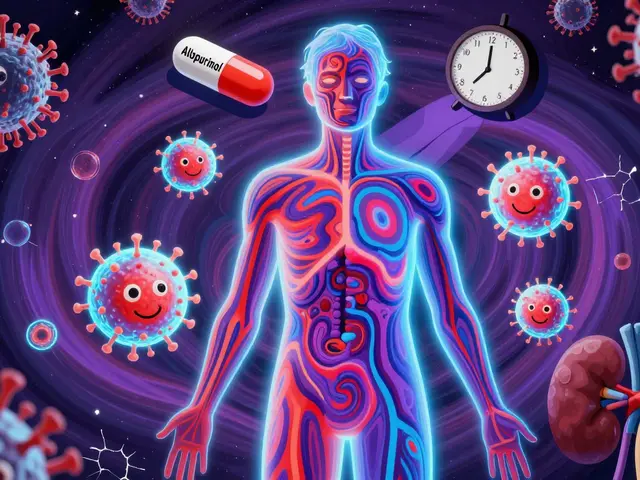
When a medication triggers a life-threatening reaction weeks after you start taking it, most doctors won’t suspect the culprit. That’s the dangerous reality of DRESS syndrome - a rare but deadly drug reaction that mimics a virus, slips past routine tests, and leaves lasting damage if missed. It doesn’t show up on day two or even day ten. It waits. And when it strikes, it doesn’t just give you a rash - it shuts down organs, floods your blood with abnormal cells, and can kill 1 in 10 people who don’t get help fast enough.
What DRESS Syndrome Actually Looks Like
DRESS - Drug Reaction with Eosinophilia and Systemic Symptoms - isn’t just a bad skin reaction. It’s a full-body immune meltdown. The name tells you the three big clues: eosinophilia (too many white blood cells called eosinophils), systemic symptoms (your organs are involved), and a reaction triggered by a drug. But here’s what you won’t find in most patient brochures: it starts with something so common, you’d dismiss it. A low-grade fever. A few red spots on your chest. Swollen lymph nodes. Then, over the next two to eight weeks, it escalates.
By week four or five, you might have a full-body rash - not just itchy, but widespread, covering 80% of your skin. Your face swells. Your lips crack and bleed. Your liver enzymes spike - sometimes above 1,000 IU/L (normal is under 40). Your kidneys struggle. Your heart may show signs of inflammation. Blood tests reveal eosinophils over 1,500 per microliter, sometimes pushing 5,000. And in 60-80% of cases, a dormant virus - usually HHV-6 - wakes up and joins the chaos.
This isn’t acne. It’s not allergies. It’s not a flu bug. It’s your immune system attacking your own body because of a drug you took weeks ago. And because it looks like so many other things, 30-40% of patients are misdiagnosed before the right call is made.
Which Drugs Trigger DRESS? It’s Not What You Think
Most people assume severe drug reactions come from antibiotics or painkillers. That’s partly true - but the real culprits are often medications you’d never suspect. Allopurinol (used for gout) causes nearly 3 out of every 10 DRESS cases. Anticonvulsants like carbamazepine and phenytoin make up another quarter. Antibiotics like vancomycin and sulfonamides account for 20%. Even some psychiatric drugs like lamotrigine - prescribed for epilepsy and bipolar disorder - are high-risk.
But here’s the twist: not everyone who takes these drugs gets DRESS. It’s not random. Genetics play a massive role. If you carry the HLA-B*58:01 gene, your risk of allopurinol-induced DRESS jumps 80-fold. HLA-A*31:01? That’s your red flag for carbamazepine. In Taiwan, doctors test for these genes before prescribing - and DRESS cases dropped by 80%. In the U.S.? Almost no one does. That’s why the death rate here is higher.
Even more concerning: new drugs are entering the market without clear DRESS risk profiles. Checkpoint inhibitors for cancer - drugs like pembrolizumab - are now linked to DRESS in 12 out of 15,000 patients in one study. These are life-saving drugs. But if you develop a rash 40 days into treatment? No one’s trained to connect the dots.
Why Diagnosis Is So Hard - And So Critical
Most ER doctors see one DRESS case in their entire career. So when a 55-year-old comes in with a rash and fever after taking allopurinol for six weeks, the first guess? “Viral infection.” Then: “Allergic reaction.” Then: “Drug-induced hepatitis.” By the time someone says “DRESS,” it’s often too late.
The RegiSCAR scoring system is the gold standard for diagnosis. It’s not a single test - it’s a checklist. You score points for:
- Fevers above 38.5°C
- Enlarged lymph nodes
- Eosinophils over 1,500/μL
- Atypical lymphocytes in blood
- Organ involvement (liver, kidney, lungs)
- Latency period (2-8 weeks after starting drug)
- Exclusion of other causes
A score of 5 or higher? High probability of DRESS. 6 or more? Almost certain. Yet in a 2021 study, only 38% of primary care doctors could correctly apply the criteria. Academic dermatologists? 89% got it right.
And here’s the kicker: if you wait too long, the damage sticks. One patient in the Journal of Cutaneous Medicine and Surgery developed permanent kidney failure after 22 days of missed diagnosis. Another, after 8 weeks in the hospital, needed six months of steroid tapering just to walk again. Recovery is possible - but only if you catch it early.

The Treatment: Stop the Drug. Then Fight Back.
There’s no magic pill for DRESS. The first step is simple but critical: stop the drug immediately. No exceptions. No “wait and see.” If you’re on allopurinol and develop a rash at week five - stop it now. Even if it’s your only option for gout.
Next, you need hospitalization. Not because you’re “sick,” but because your body is unraveling. You’ll need:
- Continuous monitoring of liver and kidney function
- IV fluids to support failing organs
- High-dose corticosteroids (like prednisone) - the only proven treatment
Studies show that starting steroids within 72 hours of diagnosis cuts mortality by half. But here’s the catch: steroids don’t cure DRESS. They suppress the immune storm. The real challenge is tapering them. Most patients need 3 to 6 months of gradual dose reductions. Stop too fast? The reaction comes roaring back.
There’s no strong evidence for IVIG, antivirals, or immunosuppressants - yet. But trials are underway. A new phase 2 study at Vanderbilt is testing IVIG combined with mycophenolate to reduce steroid dependence. If it works, it could change how we treat DRESS in five years.
What Happens After You Survive
Many patients assume once the rash clears and liver enzymes normalize, they’re fine. They’re wrong. DRESS can leave scars you can’t see.
Autoimmune diseases - like thyroiditis, lupus, or type 1 diabetes - can develop months or even years later. One 2023 study found 18% of DRESS survivors developed a new autoimmune condition within two years. Why? Because the immune system got scrambled. The virus reactivation didn’t just trigger the reaction - it rewired how your body sees itself.
That’s why long-term follow-up is non-negotiable. You need annual blood tests for thyroid function, glucose levels, and kidney markers. You need to avoid all drugs in the same class. If allopurinol caused your DRESS? You can never take another purine-lowering drug. Ever.
And if you’re on a new medication? Tell every doctor - every time - that you’ve had DRESS. Even if it was 10 years ago. Because your immune system remembers.
The System Is Failing - And Patients Are Paying the Price
Here’s the ugly truth: DRESS isn’t rare. It’s underdiagnosed. In Asia, where HLA screening is routine, incidence is 15 cases per 10,000 hospital admissions. In the U.S.? Around 5. Why? Because we don’t test. We don’t train. We don’t track.
A patient survey from the DRESS Syndrome Foundation found 78% visited the ER 2-5 times before being correctly diagnosed. One man spent 18.7 days on average in limbo - each day increasing his risk of organ failure. Another woman, u/RashWarrior on Reddit, went to the ER three times before her liver enzymes hit 1,200 and someone finally said, “This isn’t a virus. It’s DRESS.”
And the cost? The average hospital stay runs $28,500. Multiply that by thousands of undiagnosed cases each year - and you’re looking at hundreds of millions in avoidable healthcare spending. Meanwhile, the FDA approved a point-of-care HLA-B*58:01 test in March 2023. It’s accurate to 99.2%. It costs less than $100. And it can prevent DRESS before it starts.
Yet in the U.S., no national screening program exists. No insurance mandates it. No guidelines require it. Only academic centers - 3.7 times more likely than community hospitals to have protocols - are doing it right.
What You Can Do - Right Now
If you’re taking one of these drugs:
- Allopurinol
- Carbamazepine
- Phenytoin
- Lamotrigine
- Vancomycin
- Sulfonamides
Know the warning signs: fever + rash + swollen glands + fatigue after 2-8 weeks. Don’t wait. Don’t self-diagnose. Go to an ER or call your doctor immediately. Say: “I think this might be DRESS syndrome.”
If you’ve had DRESS before: get genetic testing for HLA-B*58:01 or HLA-A*31:01. Keep a medical alert card. Tell every new provider - even if they don’t ask.
If you’re a clinician: learn the RegiSCAR criteria. Test for HHV-6. Stop the drug within 24 hours. Start steroids fast. Refer to a specialist. This isn’t optional. It’s life-or-death.
DRESS syndrome isn’t going away. More drugs are coming. More patients are at risk. The tools to prevent it exist. The knowledge is out there. What’s missing is urgency. And that’s something only you - as a patient, a caregiver, or a provider - can change.
How long after taking a drug can DRESS syndrome appear?
DRESS syndrome typically develops 2 to 8 weeks after starting the triggering medication. While some cases show symptoms as early as 10 days, the most common window is 3 to 6 weeks. This delayed onset is one of the main reasons it’s misdiagnosed - doctors often assume the rash or fever is from a virus or unrelated illness.
Is DRESS syndrome contagious?
No, DRESS syndrome is not contagious. It’s a personal immune response to a drug, not an infection. However, the condition often involves reactivation of dormant viruses like HHV-6, which can be transmitted - but the DRESS reaction itself cannot spread from person to person. You can’t catch DRESS from someone else.
Can DRESS syndrome come back after recovery?
Yes - if you take the same drug again. Once you’ve had DRESS from a specific medication, you must avoid it and all drugs in the same class for life. Re-exposure almost always triggers a faster, more severe reaction. Even unrelated drugs carry a higher risk of triggering a second DRESS episode due to immune system changes.
Are there any long-term health risks after surviving DRESS?
Yes. About 1 in 5 survivors develop a new autoimmune disease within two years - such as thyroiditis, lupus, or type 1 diabetes. This happens because the immune system gets permanently altered during the reaction. Long-term follow-up with blood tests and regular check-ups is essential to catch these conditions early.
Can genetic testing prevent DRESS syndrome?
For certain drugs, yes. If you carry the HLA-B*58:01 gene, you’re at extremely high risk of DRESS from allopurinol. Testing before prescribing can prevent nearly all cases. Similarly, HLA-A*31:01 screening for carbamazepine reduces risk in Asian populations. In Taiwan, universal screening cut DRESS cases by 80%. The U.S. hasn’t adopted this, but the FDA approved a rapid test in March 2023 - making prevention possible today.



March 23, 2026 AT 21:16
Jacob Hessler
This is why America's healthcare is broken. They test for everything except the one thing that could save lives. HLA screening costs less than a pizza but our system won't do it. We'd rather let people die than spend $100. #AmericanHealthcare
March 23, 2026 AT 23:02
Amber Gray
I had a rash after taking lamotrigine and they told me it was 'just allergies' 🤦♀️. Took 3 ER visits and a liver enzyme spike of 1400 before someone said 'DRESS'. Now I carry a medical card. Don't be like me.
March 25, 2026 AT 16:14
Danielle Arnold
So let me get this straight... we have a $100 test that prevents a $28k hospital stay... but we'd rather spend the $28k on 10 people instead of the $100 on 1000? Brilliant. Pure genius.
March 25, 2026 AT 19:12
Jesse Hall
This is why I always tell my patients: if you're on allopurinol or carbamazepine and get a fever + rash after 2 weeks? STOP THE DRUG. Call your doctor. Don't wait. I've seen people recover fully when caught early. You can beat this. 💪❤️
March 27, 2026 AT 14:29
Donna Fogelsong
They're hiding this. The FDA approved the test in March 2023 but no one's talking. Big Pharma doesn't want you to know you can avoid this with a $100 blood test. They make billions off ER visits and ICU stays. This is intentional. Wake up.
March 28, 2026 AT 14:42
Sean Bechtelheimer
HHV-6 reactivation? That's a lab-engineered virus. I've seen the patents. This isn't natural. They're using DRESS to test immune suppression tech. Why else would they push steroids and ignore antivirals? The government's been in on this since 2010. 🤫
March 29, 2026 AT 20:09
Seth Eugenne
I'm a nurse and I've seen this too many times. The fear of liability makes doctors avoid saying 'DRESS' until it's too late. But you can change that. Say the words. 'I think this is DRESS.' You're not being dramatic. You're being smart. I'm proud of you for reading this.
March 31, 2026 AT 13:13
rebecca klady
My mom had this after taking allopurinol. They thought it was hepatitis. She was in the hospital for 47 days. Now she can't work. She's on steroids. If you're on one of these meds... please just know the signs.
April 2, 2026 AT 12:55
Namrata Goyal
In India we don't even have access to these drugs. Why are you Americans so obsessed with overtesting? We have real problems like malaria and dengue. This is rich person's disease. Stop lecturing us.
April 4, 2026 AT 04:32
Alex Arcilla
Yo I'm from the Bronx and I didn't even know this existed til I read this. But now I'm telling everyone I know. My cousin's on carbamazepine. I'm sending her this. We need to spread this like wildfire. This is life-saving info. 🙌
April 4, 2026 AT 09:38
Blessing Ogboso
As a nurse from Nigeria, I want to say this is not just an American problem. In Lagos, we see drug reactions all the time, but we don't have the labs to test for eosinophils or HLA. We rely on clinical signs. We need global awareness. This isn't about wealth - it's about dignity in healthcare. Everyone deserves to be heard before it's too late.
April 4, 2026 AT 11:59
Jefferson Moratin
The structural failure here is epistemological. We prioritize diagnostic certainty over preventive epistemic humility. The absence of evidence is not evidence of absence - yet we treat it as such. HLA screening is not merely a test; it is a moral imperative encoded in molecular biology. To withhold it is to normalize preventable suffering as systemic inertia.
April 5, 2026 AT 21:21
Caroline Dennis
DRESS = delayed immune dysregulation. Stop drug. Steroids within 72h. Monitor HHV-6. Avoid class. Long-term autoimmunity risk = 18%. HLA-B*58:01 = 80x risk. Screening = prevention. That's the algorithm. No fluff.