
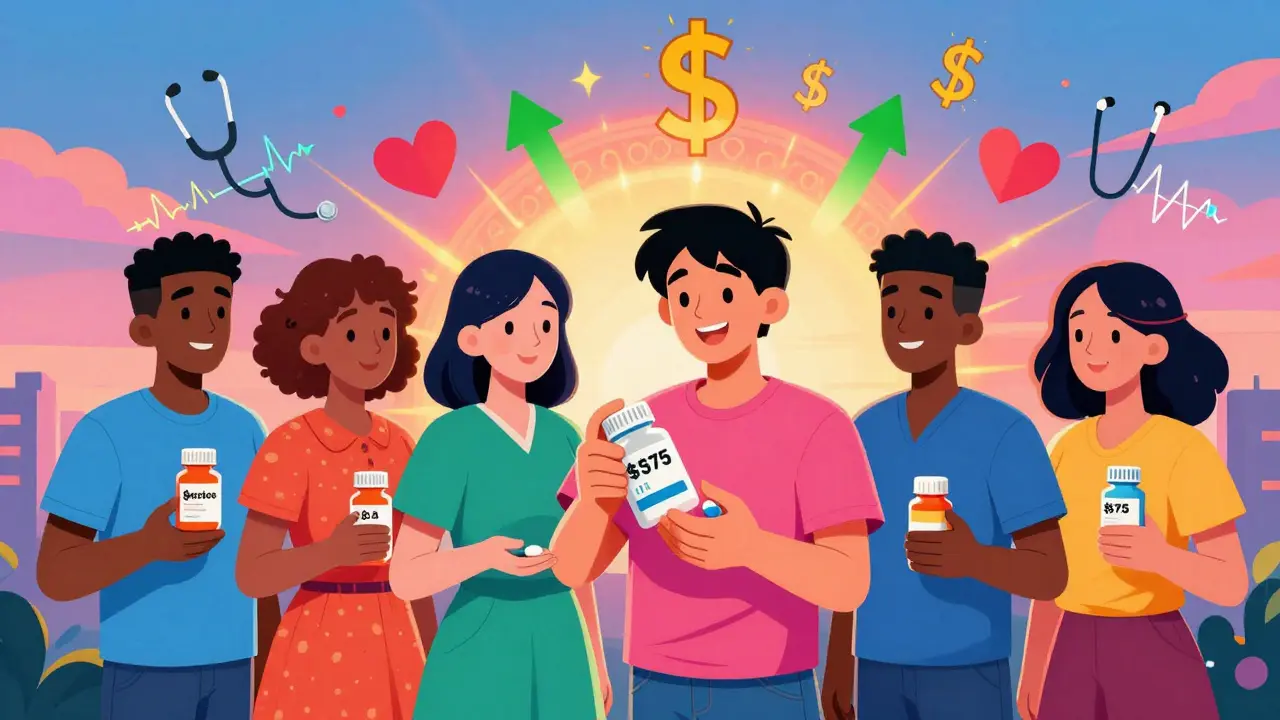
When a patient skips a dose because the copay is too high, it’s not just a personal choice-it’s a system failure. And it’s happening more often than most people realize. In the U.S., 32.7% of adults admit to skipping, cutting, or delaying their meds to save money. That’s more than one in three people. The result? More hospital visits, more complications, and more deaths-all preventable.
Why Cost Blocks Adherence
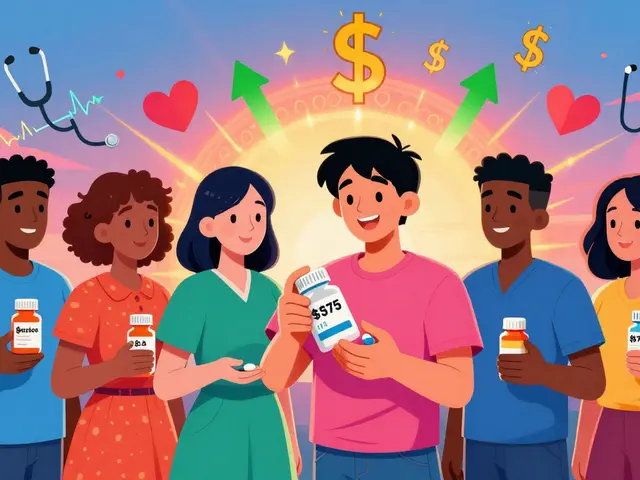
It’s simple: if a pill costs $75 a month and you’re on a fixed income, you’ll find a way to make it last longer. Maybe you skip every other day. Maybe you wait until the next paycheck. Maybe you borrow a pill from a neighbor. This isn’t laziness or forgetfulness-it’s rational behavior under financial pressure. Studies show a clear pattern: every $10 increase in out-of-pocket cost leads to a 2-4% drop in adherence. For drugs like GLP-1 agonists used for diabetes, each extra $10 cuts adherence by 3.7% and bumps up emergency room visits by 5.2%. These aren’t abstract numbers. They’re real people ending up in the ER because they couldn’t afford their daily pill. The problem is worst for chronic conditions-diabetes, high blood pressure, cholesterol, depression, and cancer. These aren’t one-time fixes. They’re lifelong treatments. And if you can’t pay, you stop. The FDA says generics are just as safe and effective as brand-name drugs. But if the brand costs $120 and the generic is $5, guess which one gets taken?Generics Work-And They’re Not Just Cheaper
Generic drugs aren’t knockoffs. They’re exact copies. The FDA requires them to have the same active ingredient, strength, dosage form, and route of administration as the brand. They must also match the brand’s absorption rate within 80-125%. That’s not close enough-it’s the same. And they’re cheaper. Like, 80-85% cheaper. That’s not a marketing claim. That’s real data from the FDA and the Association for Accessible Medicines. In 2023, generics made up 90% of all prescriptions filled in the U.S. But they only accounted for 23% of total drug spending. That’s $643 billion saved between 2009 and 2019. The impact on adherence? Huge. A 2011 study of breast cancer patients on aromatase inhibitors found those on generics had a 73.1% adherence rate. Those on brand names? Just 68.4%. That’s a 4.7-point gap-and it’s the same story across heart disease, diabetes, and mental health meds. One Reddit user, u/HeartHealthJourney, put it plainly: “Switched from Crestor ($75 copay) to generic rosuvastatin ($5 copay). Went from missing 3-4 doses a week to perfect adherence for 11 months.” That’s not luck. That’s cost removal.Insurance Tiers Are the Hidden Barrier
Insurance plans don’t treat all drugs the same. They use tiers. Tier 1: generics. Tier 2: preferred brands. Tier 3: non-preferred brands. Tier 4: specialty drugs. Copays jump from $5 to $100+ in a single step. A statin like atorvastatin might cost $5 as a generic. But if your plan puts it in Tier 3, your copay could be $50. That’s enough to make someone pause. A landmark 2012 study tracked Medicare Part D patients when atorvastatin and rosuvastatin moved from Tier 2 to Tier 1. Result? Adherence jumped by 5.9%-just because the price dropped. No counseling. No reminders. Just lower cost. This isn’t about willpower. It’s about design. Insurance systems are built to push patients toward cheaper options-but they don’t always make those options easy to find. That’s where real-time benefit tools (RTBTs) come in. These tools show the exact price of a drug at the pharmacy before the doctor even writes the prescription. In pilot programs, RTBTs improved adherence by 12-15% and cut care gaps by 40%.
What Happens When People Don’t Take Their Meds
Non-adherence isn’t just bad for patients. It’s a financial black hole for the system. Up to 50% of treatment failures are due to patients not taking their meds. That leads to 100,000+ preventable deaths every year in the U.S. And it costs between $100 billion and $300 billion in avoidable hospital stays, ER trips, and long-term care. A 2011 study in Health Affairs found that patients who stuck to their meds had 15-20% fewer hospitalizations-even though they spent more on drugs. The math is clear: paying more upfront for pills saves way more in hospital bills later. And it’s not just the elderly. A 2023 JAMA survey found that cost-related nonadherence cuts across age groups. People with jobs, insurance, and decent incomes still skip doses because the copay is too high. One woman said she stopped her blood pressure med because she couldn’t afford both it and her daughter’s school supplies.Policy Changes Are Starting to Help
The Inflation Reduction Act of 2022 capped insulin at $35 a month. That’s a start. By 2025, Medicare Part D will have a $2,000 annual out-of-pocket cap. That’ll help 1.4 million seniors. But the real game-changer is the push toward value-based insurance design. Instead of charging the same copay for every drug, some plans are starting to charge less for high-value meds-like statins, blood pressure pills, and diabetes drugs-and more for low-value ones. Pilot programs saw adherence jump 18.3% for these key drugs. The FDA is also speeding up generic approvals through GDUFA III, investing $1.1 billion to bring 1,500+ new generics to market by 2027. More generics mean more competition, which means lower prices.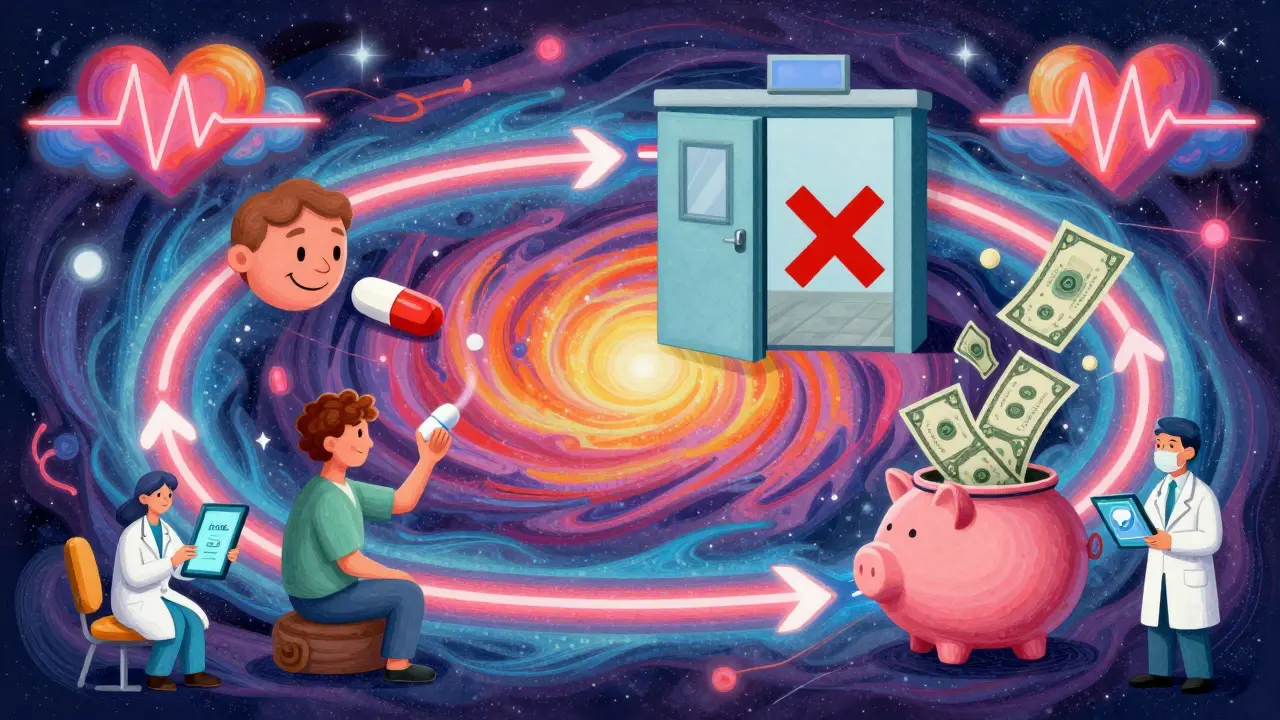
What Patients and Providers Can Do Now
You don’t have to wait for policy changes to act. If you’re a patient:- Ask your pharmacist: “Is there a generic version?”
- Use GoodRx or SingleCare to compare prices across local pharmacies.
- Ask your doctor: “Can we switch to a lower-cost option?”
- If you’re skipping doses because of cost, tell your provider. They can help.
- Use real-time benefit tools before prescribing.
- Don’t assume patients know generics are safe. Say it clearly: “This generic works just like the brand.”
- Know your formulary tiers. Know which drugs are $5 vs. $75.
- Prescribe by cost when clinically appropriate. It’s not compromising care-it’s enabling it.
The Bigger Picture
Americans pay 256% more for brand-name drugs than people in Canada, Germany, or Australia. That’s not because our drugs are better. It’s because our system lets companies charge whatever they want. Generics fix that. They don’t just save money. They save lives. When you lower the price, you lower the barrier. When you lower the barrier, people take their pills. When people take their pills, they stay out of the hospital. And when they stay out of the hospital, the whole system gets cheaper. This isn’t about politics. It’s about physics. Lower cost → higher adherence → better outcomes → lower spending. It’s a loop. And it works. The question isn’t whether we can afford to make generics cheaper. It’s whether we can afford not to.Do generic drugs work as well as brand-name drugs?
Yes. The FDA requires generic drugs to have the same active ingredient, strength, dosage form, and route of administration as the brand-name version. They must also be bioequivalent, meaning they work in the body at the same rate and to the same extent-within 80-125% of the brand. Thousands of studies confirm they’re just as safe and effective. The only differences are in inactive ingredients, like fillers or dyes, which don’t affect how the drug works.
Why do some people still prefer brand-name drugs?
Some people believe brand names are stronger or better because of marketing. Others have had a bad experience with a generic in the past-often due to a different filler causing mild side effects, not because the active ingredient didn’t work. In rare cases, like certain seizure meds, small variations in absorption can matter, but those are exceptions. For 95% of medications, generics are identical in effect. The FDA’s "It’s Okay to Use Generics" campaign helps clear up these myths.
How much can I save by switching to a generic?
On average, you’ll save 80-85%. For example, brand-name Lipitor costs around $150 a month without insurance. Generic atorvastatin? Often $5-$10 at Walmart or Costco. Even with insurance, copays can drop from $50 to $5. That’s $500-$1,000 saved per year. For chronic meds taken for decades, that adds up to tens of thousands in savings.
What if my insurance won’t cover the generic?
Ask your doctor to file a prior authorization or appeal. Many insurers will approve the generic if you show it’s medically appropriate. You can also use GoodRx or SingleCare coupons, which often beat insurance prices. Some pharmaceutical companies offer patient assistance programs for low-income patients. Don’t accept "no" as the final answer-there are always options.
Can switching to a generic cause side effects?
Rarely. The active ingredient is the same, so the main effects won’t change. But sometimes the inactive ingredients (like dyes or fillers) differ, which can cause minor reactions-like a rash or stomach upset-in a small number of people. If you notice a new side effect after switching, talk to your doctor or pharmacist. It doesn’t mean the generic doesn’t work-it just means your body reacted to something else in the pill. They can try a different generic brand or go back to the brand if needed.
Are there any drugs where generics don’t work as well?
For nearly all medications, generics work just as well. But there are a few narrow-therapeutic-index drugs-like warfarin, levothyroxine, and some epilepsy meds-where even tiny differences in absorption can matter. In these cases, doctors may prefer to stick with one brand for consistency. But even then, switching between generic manufacturers is usually fine. The key is consistency: if you start on one generic, try not to switch brands often unless your doctor advises it.
How do real-time benefit tools help with adherence?
Real-time benefit tools (RTBTs) show the exact out-of-pocket cost of a drug at the pharmacy before the prescription is even written. This lets doctors choose a lower-cost option on the spot-like switching from a $75 brand to a $5 generic-without the patient having to go through multiple pharmacy visits or appeals. In pilot programs, RTBTs improved adherence by 12-15% and reduced care gaps by 40%. They turn cost surprises into informed decisions.
December 23, 2025 AT 17:01
Jillian Angus
My grandma took her blood pressure med every day after switching to generic. She said the pills looked different but didn't feel different. She lived to 92.
December 23, 2025 AT 18:20
Joseph Manuel
The empirical data presented here is unequivocal: cost-related nonadherence constitutes a significant systemic externality in U.S. pharmaceutical economics. The elasticity of adherence with respect to out-of-pocket expenditure is consistently negative and statistically significant across multiple clinical domains. The FDA’s bioequivalence thresholds are robust and validated by thousands of pharmacokinetic studies. Policy interventions that reduce financial barriers demonstrably improve population health outcomes while reducing aggregate healthcare expenditures.
December 25, 2025 AT 16:28
EMMANUEL EMEKAOGBOR
It is fascinating to observe how economic constraints manifest in health behaviors across cultures. In Nigeria, many patients rely on traditional remedies not out of preference, but because modern medications are either unaffordable or inaccessible. The principle remains the same: if the cost is prohibitive, adherence declines. The solution is not merely to produce cheaper drugs, but to ensure equitable distribution and education. A pill is useless if it never reaches the hand that needs it.
December 27, 2025 AT 10:18
Adarsh Dubey
Let’s be clear: generics aren’t ‘cheaper alternatives.’ They’re the exact same medicine. The FDA doesn’t approve them lightly. The only difference is the label and the price tag. If your doctor says ‘it’s the same,’ believe them. I’ve been on generic metformin for eight years. No side effects. No drop in efficacy. Just saved $600 a year. Simple math.
December 27, 2025 AT 16:44
Chris Buchanan
So let me get this straight - we spend $400 billion a year on healthcare because people can’t afford $5 pills? And the solution is… to make the pills cheaper? Shocking. Who knew? Next you’ll tell me water is wet. Meanwhile, my insurance still won’t cover my $300 migraine med because it’s ‘non-preferred.’ But hey, at least my statin’s $5 now. Thanks for the TED Talk, doctor.
December 28, 2025 AT 02:41
Wilton Holliday
Big shoutout to anyone who’s ever skipped a dose because they had to choose between meds and groceries. You’re not lazy. You’re surviving. And if your doctor doesn’t ask you about cost, ask them. Say: ‘I can’t afford this.’ No shame. We’ve all been there. 💪💊
December 30, 2025 AT 01:08
Raja P
in india we call this ‘generic swag’ - same pill, half the price, no drama. my uncle switched from brand name diabetes med to generic and now he’s hiking every morning. he says the only thing that changed was his bank account. also, pharmacist gave him a free lollipop. win win.
December 30, 2025 AT 06:20
Blow Job
I used to be skeptical about generics until my dad had a heart attack. He was on a brand-name beta-blocker that cost $90. Switched to generic. Same effect. Same results. Saved $1,000 a year. He’s alive today because he didn’t skip doses. This isn’t theory. It’s survival.
December 31, 2025 AT 06:39
Payson Mattes
Did you know the FDA is secretly controlled by Big Pharma? Generics aren’t ‘the same’ - they’re watered down to make you dependent on the system. That’s why they push them so hard. The real reason insulin is $35? Because they want you to think you’re getting a deal while they raise prices on everything else. Wake up. This is all a distraction. The real cost is your autonomy.
January 1, 2026 AT 18:41
Isaac Bonillo Alcaina
People who take generics are just gambling with their health. You think your body can’t tell the difference? You’re wrong. That’s why ER visits are rising - because people are taking inferior drugs. And now you want to make it cheaper? Brilliant. Let’s turn medicine into Walmart aisle 12. No wonder the U.S. is dying.
January 3, 2026 AT 07:47
siddharth tiwari
generics are fine i guess but what about the fillers? i read online that some have talc and thats bad for lungs? and dont get me started on how they test them in china? my cousin took a generic and his skin turned green for a week. maybe its just me but i trust the brand name more. also why is this article so long?
January 3, 2026 AT 11:57
suhani mathur
Oh wow, a 4.7% adherence gap between brand and generic? That’s the same as the difference between a 90% and 85% student. You’d fail that class. But somehow, we’re okay with people failing their own health because of a $70 copay? I’m not even mad. I’m just disappointed.
January 5, 2026 AT 02:04
Andrea Di Candia
It’s not just about money - it’s about dignity. When you’re forced to choose between your medication and your kid’s lunch, you’re not just poor. You’re broken by a system that treats health like a luxury. Generics aren’t a Band-Aid. They’re a recognition that human life has value. And that’s not a policy change - that’s a moral one.
January 6, 2026 AT 02:35
Bartholomew Henry Allen
Our country spends billions on foreign generics while American manufacturers shut down. This is economic treason. We used to make everything here. Now we import pills from countries that don’t even have FDA standards. We’re not saving money - we’re surrendering sovereignty. Fix the supply chain or stop pretending this is about patients.
January 6, 2026 AT 16:58
CHETAN MANDLECHA
As someone who works in pharma logistics, I can confirm: generics are identical. The only difference is the packaging. We ship both. The brand has fancy logos. The generic has a plain label. Same factory. Same machine. Same batch code. The price difference? Pure profit margin. Patients aren’t dumb. They just want to live.
January 7, 2026 AT 23:30
Andrea Di Candia
And that’s why we need RTBTs everywhere - not just in pilot programs. Imagine if your doctor could see the price before writing the script. No more surprise bills. No more shame. Just better care. It’s not complicated. It’s just been ignored for too long.