
When your child starts developing small, round bumps on their skin-pink, pearly, or skin-colored, with a tiny dimple in the middle-it’s natural to panic. Is it an allergy? A rash? Something contagious? If you’ve seen these bumps before, you might recognize them as molluscum contagiosum. It’s not dangerous, but it’s stubborn, visible, and spreads easily. And if you’re a parent, a teenager, or an adult who caught it through intimate contact, you know how frustrating it can be to live with something that doesn’t hurt but won’t go away.
What Exactly Is Molluscum Contagiosum?
Molluscum contagiosum is caused by a virus called MCV, short for molluscum contagiosum virus. It’s part of the poxvirus family, the same group that includes smallpox, but it’s nowhere near as serious. The virus doesn’t go deep into your body-it stays in the top layers of your skin, creating small, raised bumps. These bumps are usually 2 to 6 millimeters wide-about the size of a pencil eraser-and have a distinctive dip or dot in the center. That’s the key sign doctors look for. It’s most common in kids between 1 and 10 years old. But adults get it too, usually through sexual contact. People with weak immune systems, like those with HIV or on long-term steroids, can develop much larger and more numerous bumps-sometimes over 30 millimeters across. In healthy people, the bumps usually clear up on their own, but it can take anywhere from 6 months to 4 years. Most resolve within 18 months without any treatment.How Does It Spread?
This virus is sneaky. It doesn’t need to be airborne. It spreads through direct skin contact. If your kid touches a bump on their arm and then rubs their face, the virus moves. If they share a towel, a toy, or even a pool float with someone infected, it can spread. Swimming pools are a known hotspot, especially in warm, humid areas. The virus survives on surfaces for hours, sometimes days. It’s also more likely to spread if you have eczema. Studies show kids with eczema are 30% more likely to get molluscum than those without. The broken skin from scratching makes it easier for the virus to take hold. And once it’s there, scratching can make it worse-each scratch can spread the virus to nearby skin, multiplying the number of bumps by up to 300%. In adults, genital molluscum is almost always sexually transmitted. That’s why it’s sometimes mistaken for an STI. But unlike herpes or HPV, molluscum doesn’t cause pain, tingling, or ulcers. It’s just bumps. Still, the emotional toll can be heavy. Many adults report anxiety about dating, avoiding intimacy, or even hiding their bodies for months.How Is It Different From Other Skin Problems?
It’s easy to confuse molluscum with other skin issues. Here’s how to tell them apart:- Warts (caused by HPV) are rough, hard, and don’t have that central dimple. They’re often on fingers or feet.
- Herpes blisters are painful, fluid-filled, and come in clusters. They burn or itch before they appear.
- Chickenpox causes hundreds of itchy blisters all over the body, not just a few isolated bumps.
- Impetigo is bacterial, not viral. It forms honey-colored crusts and often oozes. It needs antibiotics.
Should You Treat It-or Just Wait?
This is the biggest question. The American Academy of Dermatology says: for healthy kids and adults, watchful waiting is the best approach. Why? Because most treatments cause more discomfort than the bumps themselves. Cryotherapy (freezing with liquid nitrogen) is common, but it hurts. It can leave scars, especially on a child’s face. Cantharidin-a blistering agent applied by a doctor-is more effective, clearing up lesions in about 73% of cases after 12 weeks. But it still causes blisters. Topical creams like potassium hydroxide (5-10%) are popular among parents. Amazon reviews for products like MolluDab show 63% of users saw full clearance in 8 weeks. But these aren’t FDA-approved, and instructions are often unclear. The bottom line: if the bumps aren’t bothering you, don’t rush to treat them. Let your immune system do the work. But if they’re on your face, spreading fast, or causing emotional stress, treatment makes sense.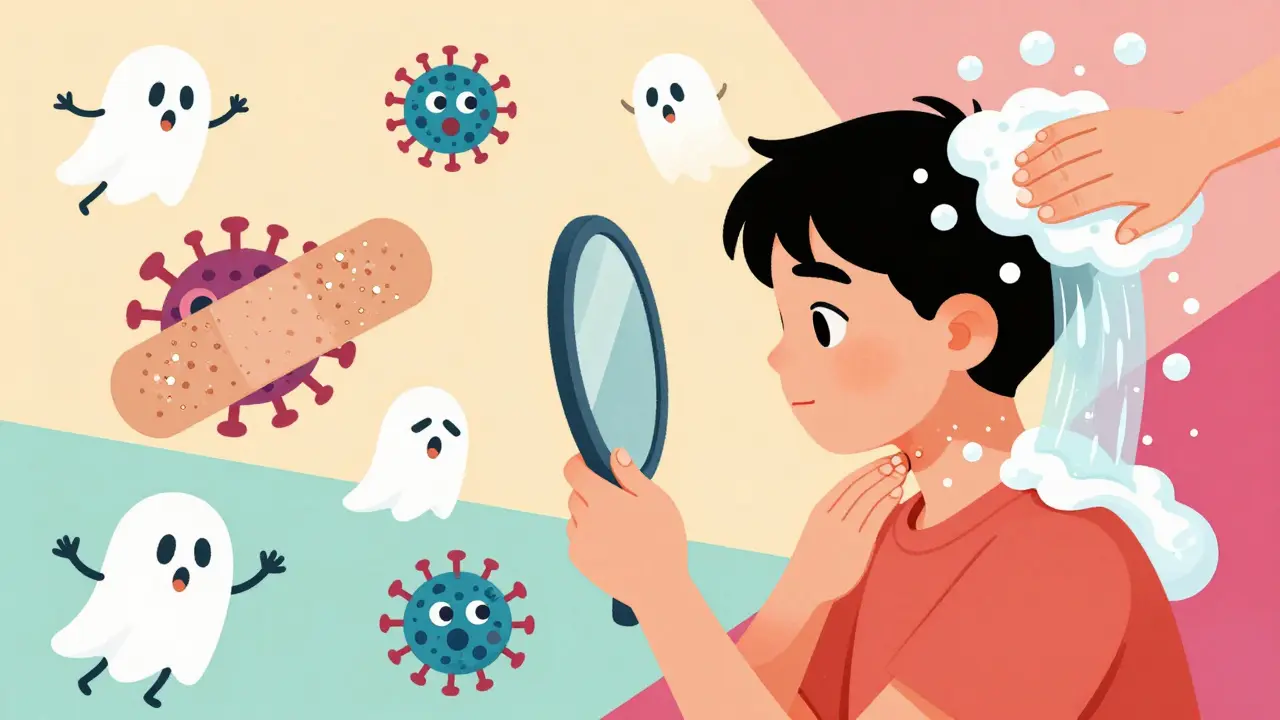
What About Adults With Genital Molluscum?
For adults, the stakes feel higher. These bumps can appear on the genitals, inner thighs, or lower abdomen. They don’t hurt-but they make people feel exposed. Many delay seeing a doctor out of embarrassment. That’s a mistake. A dermatologist can confirm the diagnosis and rule out STIs like herpes or syphilis. Treatment options for adults are similar: topical creams, cryotherapy, or curettage (scraping). But the goal isn’t just to remove bumps-it’s to reduce anxiety and prevent spreading to partners. Avoid sex until the bumps are gone. Use condoms if you’re sexually active, but remember: condoms don’t fully protect you because the virus can be on skin outside the covered area. One thing to know: in people with HIV and low CD4 counts, molluscum can become severe and persistent. In these cases, treating the underlying immune issue (like starting or adjusting antiretroviral therapy) is the most effective way to clear the bumps.How to Stop It From Spreading
Even if you’re not treating the bumps, you can stop them from spreading:- Don’t scratch or pick. This is the #1 way it spreads to other parts of your body.
- Avoid sharing towels, clothes, or bath toys. Studies show this cuts household transmission by 57%.
- Cover bumps with waterproof bandages during swimming. Many U.S. pools require this.
- Wash hands often. Especially after touching the bumps.
- Don’t shave over affected areas. Razor blades can spread the virus.
What’s New in Treatment?
The biggest recent development? The CDC updated its guidelines in January 2023. They now say: no child should be kept out of school or swimming because of molluscum. That’s a big shift. Previous advice told parents to keep kids home. Now, experts say the risk of spreading in schools or pools is low if you follow basic hygiene. There’s also a new topical treatment in phase 2 trials-an immunomodulator that boosts the skin’s own defenses. Early results show 82% clearance in 12 weeks, compared to 35% with placebo. It’s not available yet, but it’s promising. Meanwhile, the use of apps like the American Academy of Dermatology’s “Molluscum Manager” is growing. It lets you take photos of bumps over time and track progress. For parents, it takes the guesswork out of “Is this getting better?”
When to See a Doctor
You don’t need to rush to the doctor for every bump. But call if:- The bumps are getting bigger, multiplying fast, or turning red and swollen (signs of infection).
- You have a weakened immune system.
- The bumps are on your face and causing distress.
- You’re an adult with genital bumps and aren’t sure what it is.
- They haven’t cleared after 2 years.




December 20, 2025 AT 07:27
Mark Able
My kid had this for like a year and we tried everything-cryotherapy, creams, even that weird duct tape thing people swear by. Nothing worked until it just… vanished. Zero drama. Now I just tell every new parent: chill out. It’s not cancer. 😅
December 20, 2025 AT 13:14
Dorine Anthony
I’m a nurse and I’ve seen hundreds of these cases. Parents panic way too fast. The virus is everywhere, but the body handles it fine. No need to turn it into a battlefield. Let nature take its course.
December 22, 2025 AT 05:10
Marsha Jentzsch
Okay but WHY is no one talking about how this is linked to 5G? I mean, think about it-kids get it right after they start using tablets, and the bumps look exactly like the ‘nanotech residue’ from cell towers! And don’t even get me started on pool chemicals! They’re literally injecting the virus into the water! My cousin’s neighbor’s dog had this after swimming-and dogs don’t even HAVE molluscum! It’s a cover-up! Someone’s profiting off this! 🤯
December 23, 2025 AT 08:59
Henry Marcus
So the CDC says kids don’t need to stay home? That’s rich. They also said masks didn’t work and now we’re all wearing them. Who’s really in charge here? The pharmaceutical companies? The pool industry? The shampoo brands? They all profit when you’re scared. Molluscum? More like Molluscum-Corporate-Propaganda. I’ve got 17 bumps and I’m not touching anything. Not even my own face. I’m living in a Faraday cage now. 🛡️
December 25, 2025 AT 03:07
Carolyn Benson
There’s a metaphysical layer here. Molluscum isn’t just a virus-it’s a mirror. It reflects the internal dissonance we refuse to acknowledge. The bumps? They’re the physical manifestation of suppressed emotions. The dimple? That’s the void we keep ignoring. We treat it like a skin issue when it’s a soul issue. We’re medicating symptoms while ignoring the silence between heartbeats. And yet… we still reach for the cream.
December 25, 2025 AT 23:02
Aadil Munshi
Bro, you think you’re the first person to deal with this? In India, we call it ‘chhota chickenpox’ and we just let it run. No creams, no freezing, no panic. We use neem leaves and pray. It clears. Your body is smarter than your Amazon cart. Stop overcomplicating. Also, why are you reading this on your phone? That’s probably how you got it.
December 26, 2025 AT 23:23
Danielle Stewart
If you’re feeling overwhelmed, you’re not alone. Many parents feel guilty, even though this isn’t your fault. Focus on hygiene, not fear. You’re doing great just by being aware. And if you need to cry, that’s okay too. Healing isn’t linear. Take it one day at a time. 💪
December 28, 2025 AT 10:01
mary lizardo
It is imperative to note that the term 'molluscum contagiosum' is etymologically derived from Latin, and its usage in modern vernacular often reflects a concerning decline in linguistic precision. Furthermore, the assertion that 'it's not dangerous' is an oversimplification that disregards the potential for secondary bacterial infection, which, while uncommon, is not negligible. The author's casual tone is unbecoming of a medical discourse. One must maintain rigor.
December 28, 2025 AT 10:26
Sajith Shams
Let me break this down for you. You think the immune system clears it? Wrong. The virus goes dormant and hides in your lymph nodes. It reactivates when you're stressed. That’s why it comes back. That’s why it spreads. That’s why you need to detox your liver, cut out dairy, and sleep on copper sheets. I’ve studied this for 14 years. I’ve seen 87 cases. You’re not ready for the truth.
December 28, 2025 AT 11:33
Adrienne Dagg
My husband got it on his neck from our pool. We didn’t even know. Then he kissed me. Then I had 12. Now I’m mad. But also… kinda funny? 😂 We call them ‘pimple ghosts.’
December 29, 2025 AT 03:42
Erica Vest
For those considering topical potassium hydroxide: ensure the concentration is between 5-10% and apply only to individual lesions using a cotton swab. Avoid contact with surrounding skin. Occlusion with a bandage improves efficacy, as noted in multiple clinical studies. Discontinue if irritation persists beyond 72 hours. Always patch-test first. Evidence supports this method over cryotherapy in pediatric cases due to lower scarring risk.
December 31, 2025 AT 00:18
Chris Davidson
Just let it go. It’ll disappear. Stop treating it like a war. You’re not fighting a virus. You’re fighting your own fear. That’s the real problem.
December 31, 2025 AT 11:29
Kinnaird Lynsey
I used to think the duct tape method was ridiculous… until my daughter’s bumps vanished after three weeks. Not because of the tape, I think-but because we stopped stressing about it. Sometimes the cure is just… stopping. 🤷♀️
December 31, 2025 AT 20:03
benchidelle rivera
As a pediatric dermatologist with over 20 years of clinical experience, I must emphasize that the majority of molluscum cases resolve spontaneously without intervention. Aggressive treatments in children carry a significant risk of iatrogenic scarring and psychological trauma. The emphasis should be on education, hygiene, and reassurance-not eradication. Parents are not patients; they are caregivers. Their anxiety must be addressed with compassion, not protocols. This post, while well-intentioned, inadvertently fuels unnecessary panic. Let us prioritize the child’s emotional well-being as much as their dermatological health.