

Why Proper Inhaler Technique Matters for Kids
If your child has asthma, the inhaler isn’t just a tool-it’s their lifeline. But here’s the hard truth: asthma inhaler technique for kids makes all the difference between relief and crisis. Most parents think giving the puff is enough. It’s not. Without a spacer and mask, only 10-20% of the medicine actually reaches the lungs. That’s like filling a cup halfway and expecting it to quench thirst. The rest sticks in the mouth, throat, or gets spit out. That’s why so many kids keep having flare-ups even when they’re on medication.
Research from the National Heart, Lung, and Blood Institute shows that when technique is done right-with a spacer and mask-up to 80% of the dose gets where it needs to go. That’s not a small improvement. That’s the difference between staying home and ending up in the ER. And it’s not just theory. A 2022 study found that 68% of kids labeled as "steroid-resistant" were just using their inhalers wrong. Their bodies weren’t rejecting the medicine. Their technique was.
What You Need Before You Start
Before you even touch the inhaler, gather everything you need. You’ll need:
- The prescribed metered-dose inhaler (MDI)
- A valved holding chamber (spacer) with a face mask
- A timer or clock with a second hand
- A clean cloth or paper towel (for wiping the mask)
Not all spacers are the same. For infants under 12 months, use a spacer with a volume of 150-350 mL. Toddlers (1-3 years) need 350-500 mL. Preschoolers (3-8 years) need 500-750 mL. If the mask covers their cheeks or doesn’t reach from the nose to the chin, it’s the wrong size. A poor seal means wasted medicine.
Check the spacer’s condition. If it’s cloudy or has a static cling when you rub it, it’s not working right. Static charge can trap up to 30% of the medication. Wash it once a week with mild soap and water. Don’t towel-dry it-let it air-dry. Some brands say washing isn’t needed, but studies show washed spacers deliver more medicine. And always shake the inhaler for 10 full seconds before each puff.
Step-by-Step: How to Use an Inhaler with Spacer and Mask
Follow these steps exactly. Don’t skip or rush any part.
- Prepare the spacer and mask. Attach the inhaler to the spacer. Make sure the mask fits snugly-no gaps. If your child has a runny nose, gently wipe their face first.
- Shake the inhaler. Shake it hard for 10 seconds. This mixes the medicine properly. If you skip this, the dose won’t be even.
- Position the mask. Place the mask over your child’s nose and mouth. Press gently but firmly. The seal must be tight. No air should escape. For babies, hold them upright in your lap. For older kids, have them sit still.
- Press the inhaler. Push down on the inhaler once to release one puff into the spacer. Don’t press more than once.
- Have your child breathe. For infants and toddlers (under 3), let them take 5-10 normal breaths. Don’t force deep breaths. Just let them breathe naturally. For kids 3-8, 6 breaths is enough. Watch the valve in the spacer-it should move with each breath.
- Wait before repeating. If your child needs a second puff, wait at least 1 minute. Don’t rush. The medicine needs time to settle.
- Remove the mask and clean. After the last breath, take the mask off. Wipe the inside with a dry cloth. Don’t rinse the spacer after every use-just weekly.
- Monitor for side effects. If your child gets a sore throat or hoarse voice, rinse their mouth with water after the dose. This helps prevent thrush.
That’s it. Eight steps. Simple. But if you miss one, the medicine doesn’t work.
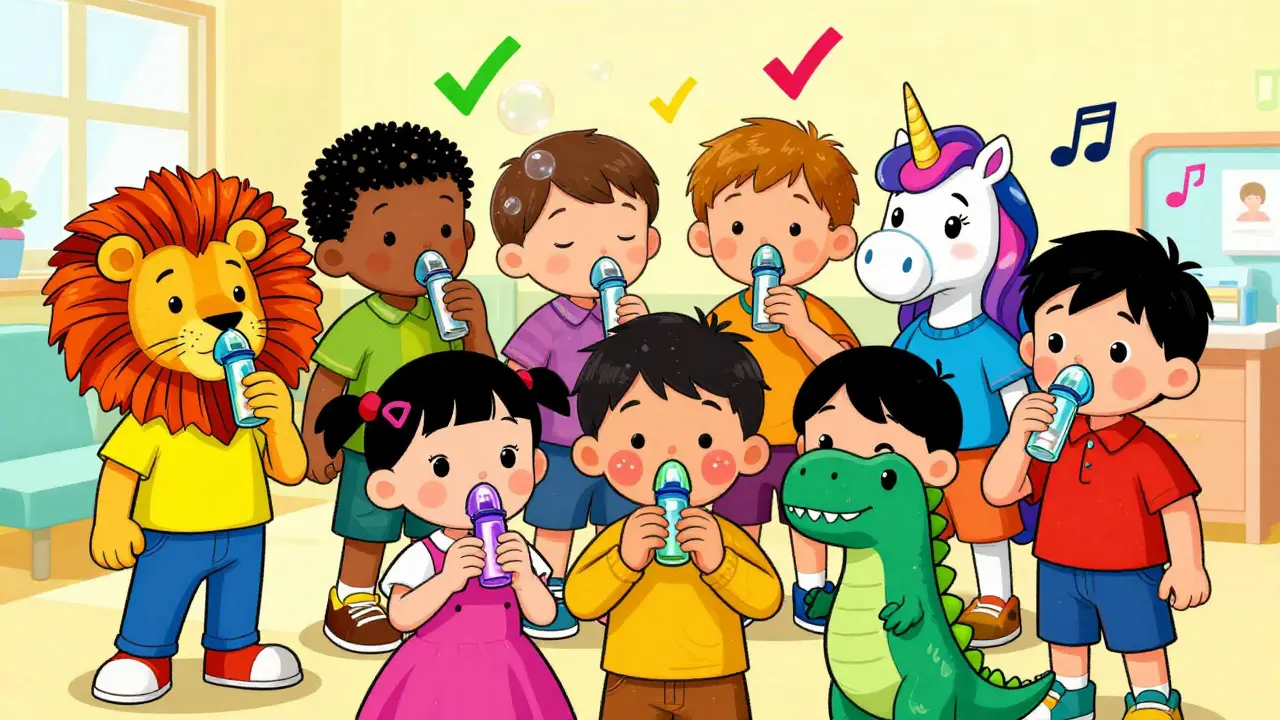
Age-Specific Tips: What Works for Babies vs. Toddlers vs. School-Age Kids
One size doesn’t fit all. Your approach changes as your child grows.
For babies (under 12 months): They can’t follow instructions. Use the tidal breathing method. After the puff, let them breathe normally for 5-10 breaths. Hold them close. Try swaddling them slightly to reduce movement. Some parents find that singing a short song (like "Twinkle Twinkle") helps them stay still.
For toddlers (1-3 years): This is the hardest age. They’re mobile and resistant. Use distraction: a favorite toy, tablet video, or book. A mask with a cartoon character helps. One parent on a parenting forum said, "My son only lets me put the mask on if it has Spider-Man on it. Now it’s his superhero tool." That’s not silly-it’s smart.
For kids 4-8 years: You can start teaching them to use a mouthpiece instead of a mask. But only if they can hold still and breathe in deeply. Show them how to puff out their cheeks like a fish, then inhale slowly. Practice with just air first. Once they get the rhythm, add the medicine. If they can hold their breath for 10 seconds after inhaling, that’s ideal. But don’t force it. If they cough or gag, go back to the mask.
Common Mistakes (and How to Fix Them)
Most families make the same mistakes. Here are the top five-and how to fix them.
- Mistake: Not shaking the inhaler long enough. Fix: Count to 10 out loud. Make it a game. "Shake it like you’re trying to wake up a sleepy dragon!"
- Mistake: Poor mask seal. Fix: Use your fingers to press the mask firmly against the face. Check for gaps. If you see air escaping, readjust.
- Mistake: Too many puffs too fast. Fix: Wait a full minute between puffs. Set a timer. Rushing wastes medicine and can cause choking.
- Mistake: Using the wrong mask size. Fix: Measure from the bridge of the nose to the bottom of the chin. The mask should fit that space without covering the cheeks.
- Mistake: Forgetting to clean the spacer. Fix: Put a sticky note on the spacer: "Wash me every Sunday."
A 2022 audit found that 63% of parents had a poor mask seal. That’s the #1 reason medicine doesn’t work. Fix that, and you fix half the problem.
What to Do When Your Child Resists
Many kids hate the mask. It feels strange. It blocks their vision. It’s scary.
Don’t force it. Build trust. Start with the spacer and mask as a toy. Let them hold it. Let them put it on their stuffed animal. Play "doctor" with them. Reward them with stickers after each practice. One dad said, "We made a chart. Every time they let me put the mask on, they got a star. After five stars, they picked a movie." Within two weeks, they stopped fighting.
Use distraction. Play their favorite song. Watch a short video. Blow bubbles together before and after. One mom on a parenting forum said, "I told my daughter to blow out birthday candles. She blew hard-then I said, ‘Now pretend the spacer is the candle.’ She inhaled like a pro. We’ve done it every time since."
If your child has autism or sensory issues, talk to your pediatrician. Some clinics have occupational therapists who specialize in medical desensitization. It’s not a failure-it’s a need.

When to Call the Doctor
You don’t need to be perfect. But if you see any of these signs, call your pediatrician or asthma specialist:
- Your child still wheezes after using the inhaler correctly
- They need their rescue inhaler more than twice a week
- You notice white patches in their mouth (possible thrush)
- The inhaler runs out faster than it should (you’re using more than 200 puffs)
- Your child is coughing or choking after every dose
Don’t wait. Poor technique is the #1 reason asthma stays uncontrolled. A 2023 study showed that when parents got proper training, emergency visits dropped by 47%.
Tools and Resources to Help
There are free, high-quality resources you can use right now.
- Johns Hopkins Medicine YouTube video: "Pediatric Inhaler Technique with Spacer" (147,892 views). It shows real kids and parents doing it right.
- Children’s Hospital of Philadelphia (CHOP) printable guide: Step-by-step pictures with age-specific instructions.
- AeroChamber with Mask: The most common spacer in the U.S. (42% market share). It’s quiet, easy to use, and fits most inhalers.
- Smart spacers: New devices like the Halo nebulizer system give audio feedback. They’re FDA-cleared and can help kids learn proper breathing.
Ask your doctor for a video demonstration. Don’t rely on written instructions alone. A 2023 study found that parents who watched a video and did a return demonstration had 72% better technique than those who only got a handout.
The Big Picture: Why This Matters Long-Term
Childhood asthma affects 6.2 million kids in the U.S. Every year, thousands end up in the hospital because their inhaler didn’t work-not because the medicine was weak, but because the technique was wrong.
Proper technique isn’t just about today’s cough. It’s about preventing lung damage, avoiding missed school days, and letting your child run, play, and breathe without fear. The data is clear: spacer use cuts hospitalizations by 39% in kids under 5. That’s not a small win. That’s life-changing.
And the future is getting better. By 2025, most pediatric clinics will ask parents to submit videos of inhaler use during telehealth visits. You’ll be ahead of the curve if you practice now.






December 25, 2025 AT 17:59
Natasha Sandra
OMG THIS IS SO IMPORTANT!!! 🙌 I used to just hand my kid the inhaler and hope for the best... until she ended up in the ER twice. Now we use the spacer with the dinosaur mask (yes, it’s a thing) and I swear it’s like night and day. My little one actually asks for it now 😭💖
December 26, 2025 AT 14:04
Erwin Asilom
The step-by-step guide is accurate and well-structured. Of particular note is the emphasis on spacer cleaning and inhaler shaking duration. Studies confirm that inadequate shaking reduces dose uniformity by up to 22%. Adherence to these protocols significantly improves pulmonary deposition.
December 27, 2025 AT 04:51
Becky Baker
Why are we even talking about this? In my day, we just blew into a puff and that was it. Kids today are too coddled. If they can’t breathe right, maybe they shouldn’t be running around like maniacs. America’s getting soft.
December 28, 2025 AT 04:24
Rajni Jain
this helped me so much!! i was using the wrong size mask for my 2yo and didnt even know it 😅 my lil one was coughing after every puff... now we wash the spacer every sunday like u said and she breathes so much better. thank u from india 🙏❤️
December 30, 2025 AT 04:01
sakshi nagpal
The inclusion of age-specific techniques is commendable. Particularly insightful is the suggestion to use distraction techniques with toddlers. In cultures where medical adherence is often viewed as a parental obligation rather than a collaborative process, these behavioral strategies represent a paradigm shift toward child-centered care.
December 31, 2025 AT 19:52
Sandeep Jain
i tried this with my son and it worked!! i was doing the mask thing wrong like everyone else... now he dont cry anymore when i put it on. just one thing tho: u said dont towel dry the spacer but i did and it was fine? maybe its just my brand idk
January 1, 2026 AT 20:39
roger dalomba
Wow. A 12-page essay on how to press a button. Next up: How to hold a spoon. Truly, the pinnacle of modern medical wisdom.
January 3, 2026 AT 12:52
Brittany Fuhs
I read this and immediately thought: why are we letting untrained parents handle life-saving devices? This should be mandatory training in pediatric clinics. Not some YouTube video you watch while scrolling TikTok. Honestly, America’s healthcare system is a joke if this is the best we can do.