
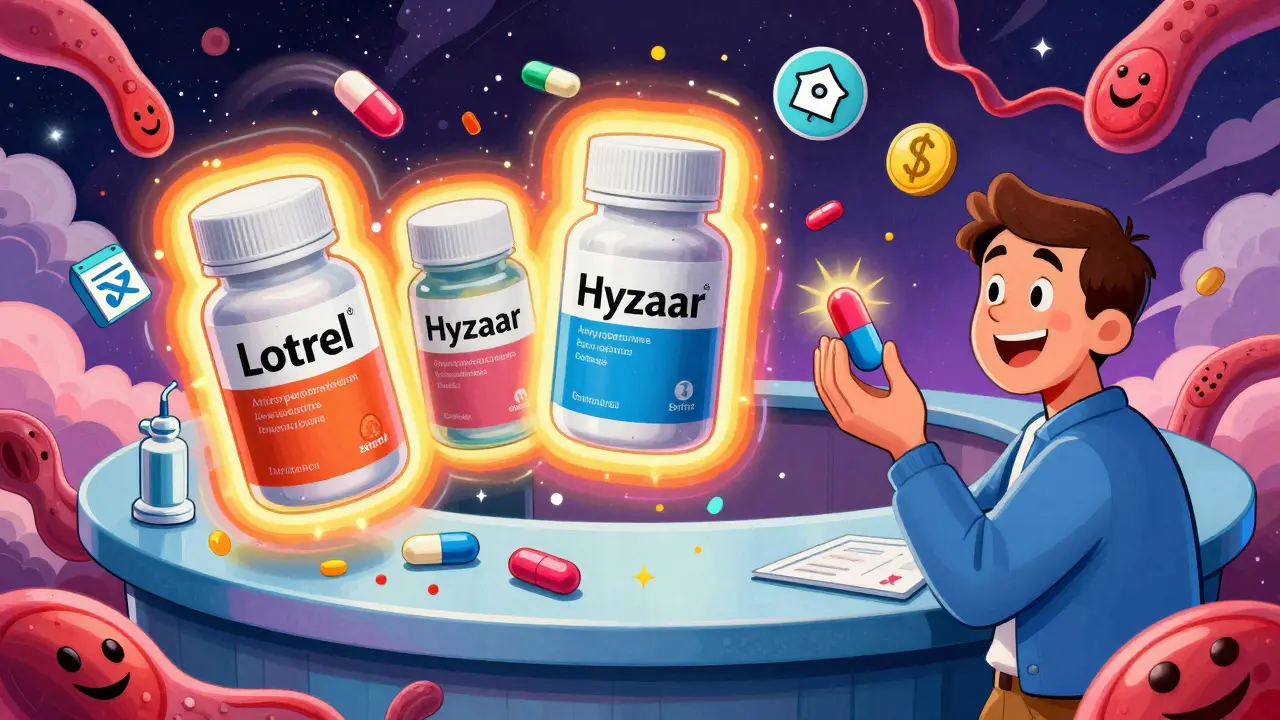
Most people with high blood pressure don’t need just one pill. They need two, sometimes three. That’s not because their condition is complicated-it’s because antihypertensive combination generics are the most effective way to get blood pressure under control. Yet many patients still take three separate pills a day, confused by cost, insurance, or just not knowing what’s out there. This guide cuts through the noise. It tells you exactly which combination generics are available, how much they cost, why some insurance plans won’t cover them even when they make sense, and what to do when your doctor prescribes a dose that doesn’t exist.
What Are Antihypertensive Combination Generics?
These are single pills that contain two or three blood pressure medications already proven to work together. They’re called Single-Pill Combinations (SPCs) or Fixed-Dose Combinations (FDCs). The idea isn’t new-FDA approved the first one, Uniretic (enalapril + hydrochlorothiazide), back in 1987. But today, there are over 30 different generic versions on the market, and most of them cost less than $20 a month.
Common combinations include:
- Amlodipine + benazepril (Lotrel)
- Losartan + hydrochlorothiazide (Hyzaar generic)
- Valsartan + amlodipine (Exforge generic)
- Amlodipine + valsartan + hydrochlorothiazide (Triamterene combo)
- Lisinopril + hydrochlorothiazide (Zestoretic generic)
Each combo pairs drugs from different classes-like a calcium channel blocker (amlodipine) with an ACE inhibitor (benazepril) or an ARB (losartan) with a diuretic (HCTZ). That’s not random. These pairings work because they attack high blood pressure from different angles. One relaxes blood vessels, another flushes out fluid, and together they do more than either could alone.
Why Do Doctors Recommend Them?
Studies show that 70-80% of people with hypertension need more than one drug to reach their target blood pressure. The 2017 ACC/AHA guidelines say SPCs should be the first choice for most patients with stage 2 hypertension (140/90 or higher). Why? Because adherence skyrockets.
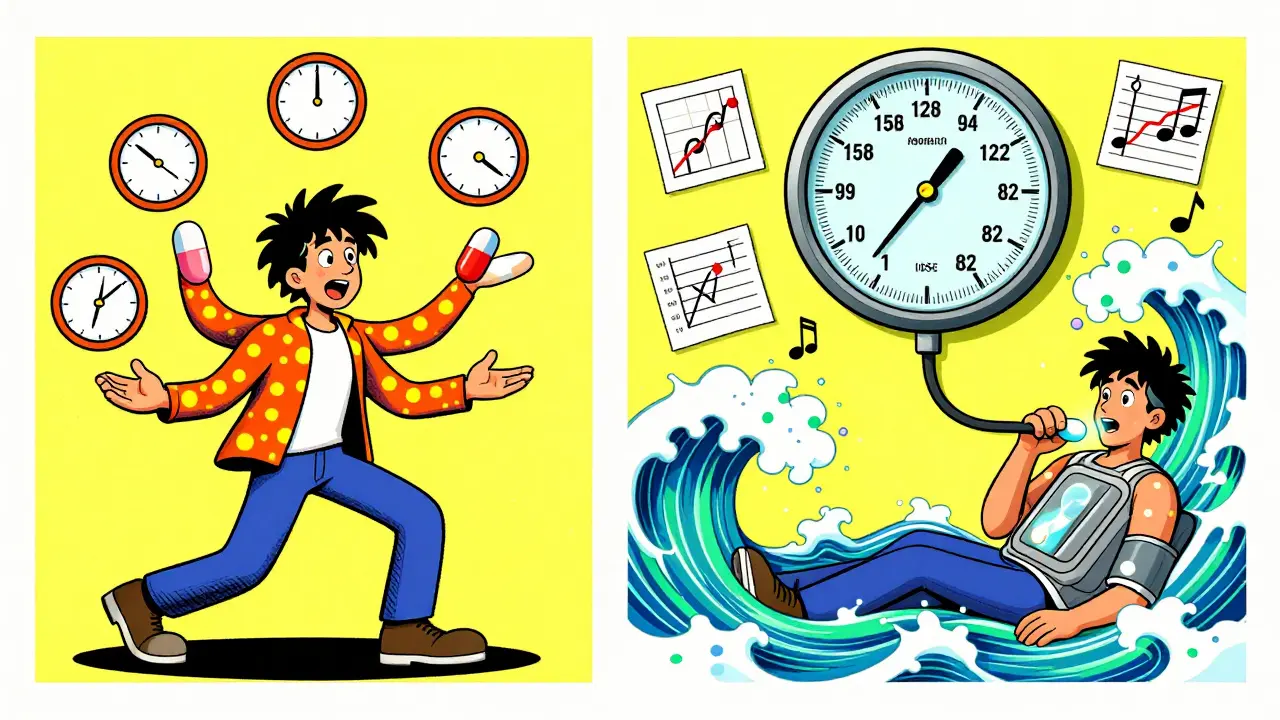
When you take three pills a day, you forget. You skip one. You run out. You get frustrated. But one pill? You remember. Clinical trials show adherence improves by 15-25% with SPCs. In the STRIP trial, 68% of patients on a combination pill reached their blood pressure goal. Only 45% did with separate pills.
It’s not just about remembering to take them. Fewer pills mean fewer side effects from overlapping instructions, less confusion about timing, and less stigma. One Reddit user wrote: “Switched from three pills to one. My BP dropped from 158/94 to 122/82 in two months. I finally feel like I’m in control.”
How Much Do They Cost?
Price varies wildly by pharmacy, insurance, and region. But here’s what you can realistically expect in the U.S. as of late 2023, based on GoodRx data:
| Combination | Generic Brand | Lowest Cash Price | Cost of Separate Generics |
|---|---|---|---|
| Amlodipine + Benazepril | Lotrel | $17.55 | $4.50 + $8.20 = $12.70 |
| Losartan + HCTZ | Hyzaar | $10.60 | $5.00 + $4.80 = $9.80 |
| Valsartan + Amlodipine | Exforge | $18.75 | $7.80 + $4.50 = $12.30 |
| Amlodipine + Valsartan + HCTZ | Triple combo | $28.90 | $4.50 + $7.80 + $4.80 = $17.10 |
Here’s the twist: sometimes, buying the individual generics separately is cheaper. That’s because the market shifted. When all three drugs became generic, the price of the combo didn’t drop as fast. So if your insurance covers the individual pills for $5 each, the combo might cost $45-making no financial sense.
But cost isn’t the only factor. If you’re paying cash, the combo is often cheaper than buying three separate prescriptions. If you’re on Medicare Part D, the combo might fall into a lower tier. Always check with your pharmacy. Ask: “If I buy the combo, will my copay be lower than buying the three pills separately?”
What Doses Are Actually Available?
This is where things get messy. Not every combination of doses exists. You can’t just ask for “amlodipine 2.5mg + valsartan 160mg.” That combo doesn’t come in a pill. Manufacturers only make specific ratios.
For example:
- Amlodipine/valsartan comes in: 5/80mg, 5/160mg, 10/80mg, 10/160mg
- Amlodipine/benazepril comes in: 2.5/10mg, 5/10mg, 5/20mg, 10/20mg
- Losartan/HCTZ comes in: 50/12.5mg, 50/25mg, 100/12.5mg, 100/25mg
If your doctor wants to give you a dose that isn’t made, you’ll have to take two pills-or switch to separate generics. That’s why some patients stop using SPCs. They can’t get the exact dose they need. A 2021 study found that 65% of people who quit their combination pill did so because the right dose wasn’t available.
Always ask your pharmacist: “Is this exact combination made? If not, what’s the closest?” Don’t assume your doctor knows every available dose. Pharmacists are the ones who know the inventory.
Why Won’t My Insurance Cover the Combo?
This is the biggest frustration. Insurance companies often cover the individual generics at $5 copays but charge $40+ for the combo-even when the pharmacy pays less than $15 for it. Why? Because they assume you’re paying cash. Or because the combo is listed as a “brand-name” product in their system-even if it’s generic.
Here’s what to do:
- Call your insurance. Ask: “Is this specific generic combination on formulary?”
- If not, ask: “Can you make an exception? The patient is on three separate generics that cost more in total.”
- Ask your doctor to write a letter of medical necessity. Say: “SPC improves adherence and reduces risk of hospitalization.”
- Use GoodRx or SingleCare coupons. Sometimes they beat insurance.
One PatientsLikeMe user wrote: “My insurance covers amlodipine and losartan for $5 each. The combo? $45. I’m paying out of pocket for the three pills. It’s ridiculous.”

Availability Around the World
In the U.S., 85% of antihypertensive combination prescriptions are generic. But globally, it’s a different story. In low-income countries, less than 15% of patients have access to these combos-even though 95% of them need them. The WHO says 46% of low-income countries have less than 50% availability of essential antihypertensive medicines.
Why? Manufacturing, distribution, and lack of local guidelines. Only 12 of 26 low- and middle-income countries surveyed included SPCs in their national hypertension guidelines. So even if the pills exist, doctors don’t prescribe them.
That’s changing slowly. Triple-combination generics are now being developed for global use. One 2022 study estimated they could cut the treatment gap in LMICs by 35%. But availability alone isn’t enough. You need education, supply chains, and insurance coverage.
What’s New in 2025?
The FDA released new draft guidance in September 2023 to make it easier to approve new generic combinations. That means more options are coming-especially triple combos. A 2023 study presented at the American Heart Association showed patients on SPCs had 28% fewer hospitalizations for uncontrolled hypertension than those on separate pills.
Also, pharmacies are starting to stock more non-standard doses. If you need amlodipine 2.5mg + valsartan 160mg, ask your pharmacist if they can compound it. Some specialty pharmacies can.
What to Do Next
If you’re on multiple blood pressure pills:
- Write down every pill you take, including dose and frequency.
- Go to GoodRx.com and search each one. Note the cash price.
- Search for the combination version of your drugs. See if a combo exists at a lower price.
- Ask your doctor: “Is there a generic combo that includes these three?”
- Call your pharmacy. Ask: “Can you get me the 5/160mg amlodipine/valsartan combo?”
- If insurance won’t cover it, ask for a prior authorization or use a coupon.
If you’re just starting treatment for high blood pressure:
- Ask your doctor: “Can I start on a combination pill?”
- Don’t accept “we’ll start with one and add more later.” If your BP is 150/95 or higher, you likely need two drugs from day one.
- Get the lowest-cost combo that matches your dose needs.
High blood pressure doesn’t care how many pills you take. It only cares if you take them. Combination generics make it easier. You just have to know what’s out there-and how to ask for it.
Are generic combination blood pressure pills as effective as brand-name ones?
Yes. The FDA requires generic combination pills to be bioequivalent to the brand-name version within a 90% confidence interval of 80-125% in how the body absorbs them. Studies show they lower blood pressure just as well. The only difference is cost-generics are usually 80-90% cheaper.
Can I split a combination pill if I need a lower dose?
Only if the pill is scored. Some combinations like amlodipine/benazepril come with a score line and can be safely split. Others, like losartan/HCTZ, are not scored and shouldn’t be split. Splitting can lead to uneven dosing. Always ask your pharmacist if splitting is safe for your specific pill.
Why do some doctors still prescribe three separate pills instead of a combo?
Some don’t know the available combos. Others think they need flexibility to adjust doses independently. But guidelines now say SPCs should be first-line for most patients with stage 2 hypertension. If your doctor resists, ask: “Is there a combination pill that includes these three drugs?” If not, ask for a referral to a pharmacist who specializes in hypertension.
What if my combination pill isn’t covered by insurance?
Try GoodRx or SingleCare coupons-they often beat insurance prices. You can also ask your doctor to write a letter of medical necessity. Some pharmacies offer discount programs for low-income patients. And if the individual generics are cheaper, ask your insurer to cover them separately instead.
Are there any risks with taking combination pills?
The risks are the same as the individual drugs. But because you’re taking two or three at once, side effects like dizziness, swelling, or low potassium can be more likely. If you feel worse after switching to a combo, talk to your doctor. Don’t stop cold-you might need a different combination, not a return to separate pills.




December 16, 2025 AT 08:42
John Brown
I switched to amlodipine/losartan combo last year after my doc pushed me on it. My BP dropped from 155/98 to 124/80 in six weeks. I used to forget one pill, then another, then just stop. Now I toss one pill in the morning with my coffee and forget about it. Life’s easier.
Also, GoodRx had it for $11. I was paying $32 for the three separate ones. Total win.
December 16, 2025 AT 13:47
John Samuel
One must acknowledge the paradigmatic shift in cardiovascular pharmacotherapy that has emerged in the wake of evidence-based guidelines from the ACC/AHA. The adoption of fixed-dose combinations represents not merely a logistical convenience, but a statistically significant improvement in therapeutic adherence-thereby reducing morbidity and mortality at the population level.
Moreover, the economic argument is compelling: while individual generics may appear cheaper in isolation, the hidden costs of non-adherence-ER visits, hospitalizations, lost productivity-are exponentially greater. One must therefore advocate, with urgency, for policy reform that aligns insurance formularies with clinical reality.
December 18, 2025 AT 08:24
Benjamin Glover
Americans still can't even get a decent pill. In the UK, we've had triple combos on the NHS for years. You're all still arguing over $12. Pathetic.
December 19, 2025 AT 19:33
Mike Nordby
It is important to clarify that while fixed-dose combinations demonstrably improve adherence, they are not universally optimal. Individual pharmacokinetic variability, renal function, and electrolyte balance must be considered before initiating combination therapy. A one-size-fits-all approach risks overlooking critical patient-specific factors.
Additionally, the assumption that lower pill burden always equates to better outcomes is not supported by all longitudinal studies. Some patients report increased anxiety when forced into a rigid dosing regimen, particularly when dose titration is restricted.
December 21, 2025 AT 03:34
Sai Nguyen
India makes these pills cheaper than water. Why do Americans pay $45 for something we get for 50 rupees? Your system is broken.
December 22, 2025 AT 23:52
Michelle M
I used to think taking three pills meant I was doing everything right. Turns out, I was just doing it the hard way.
My grandma used to say, "If it takes more than one hand to hold your medicine, you’re holding too much." I didn’t get it until I switched to the combo. Now I feel like I’m finally taking care of myself-not just going through the motions.
It’s funny how something so simple can make you feel less like a patient and more like a person.
December 23, 2025 AT 07:49
Lisa Davies
OMG YES!! 😭 I was on three pills for 3 years and felt like a walking pharmacy. Switched to the amlodipine/valsartan combo last month and my BP is finally normal!! My pharmacist even helped me find a coupon that cut it to $8!!
Y’all need to talk to your pharmacists-they’re the real MVPs. My doctor didn’t even know the 10/160 combo existed 😅
December 24, 2025 AT 06:08
Nupur Vimal
Why do people make this so complicated? Just take the pills. If you can't afford them go to the free clinic. Stop complaining about insurance. You think the NHS gives you free stuff? No. You pay taxes. Same here. Get over it.
And stop using GoodRx. It's just a scam to make pharmacies look bad. The real price is what your insurance says.
December 26, 2025 AT 02:53
Cassie Henriques
From a clinical pharmacology standpoint, the bioequivalence threshold of 80-125% AUC and Cmax is robust for monotherapies but less validated for multi-component FDCs due to potential drug-drug interactions altering absorption kinetics.
Additionally, the pharmacodynamic synergy between ARBs and CCBs is well-documented, yet the inclusion of HCTZ in triple combos introduces a risk of hypokalemia and metabolic syndrome exacerbation in predisposed individuals. The current data lacks stratification by BMI, age, and eGFR-critical confounders.
Until large-scale RCTs account for these variables, advocating for universal SPC use remains premature. The 2023 AHA study you cite had a 12-month follow-up-insufficient for hard endpoints.
December 27, 2025 AT 23:38
Jake Sinatra
This is an excellent, well-researched guide. I appreciate the emphasis on patient agency-asking the right questions, verifying doses with pharmacists, and not accepting outdated prescribing norms.
As someone who works in primary care, I’ve seen firsthand how SPCs reduce no-show rates and improve long-term outcomes. The real barrier isn’t medical-it’s systemic. Insurance policies, formulary limitations, and physician inertia are the true villains here.
Thank you for giving patients the tools to advocate for themselves. That’s half the battle.
December 28, 2025 AT 14:36
RONALD Randolph
THIS IS WHY AMERICA IS FALLING APART! You people can't even take ONE PILL correctly! We have the best medicine in the world, but you're too lazy to take it right! You want free stuff? You want coupons? You want your insurance to pay for your laziness? NO! You need to take responsibility! Stop blaming the system! Take your pills! Simple! No excuses! Get it together!
December 30, 2025 AT 02:11
Raj Kumar
in india we use amlodipine+telmisartan combo, its super cheap like 50 rs/month. but doctors here still give separate pills because they think patients wont understand combo. its funny. we know what we need.
also my uncle took triple combo for 5 years, no problem. my mom still on 3 pills. why? because doctor never asked.
December 30, 2025 AT 19:13
Melissa Taylor
I never realized how much mental energy I was wasting just trying to keep track of pills. It felt like I was failing every day. Switching to the combo didn’t just fix my blood pressure-it fixed my peace of mind.
Thank you for writing this. I wish I’d found it two years ago.
December 31, 2025 AT 13:46
Christina Bischof
My dad’s on a combo now. He said it’s the first time in 10 years he hasn’t felt like a walking medicine cabinet. He still forgets to take it sometimes, but now he just feels guilty for one pill instead of three.
Also, he’s been using the same pill bottle for months. No more juggling three containers. Small wins, you know?