When you pick up a pill, you’re not just taking one thing. You’re swallowing a mix of ingredients - some that make the medicine work, and others that don’t. But here’s the thing: the ones that don’t seem to do anything might still be affecting you in ways you never thought possible.
What’s actually in your pill?
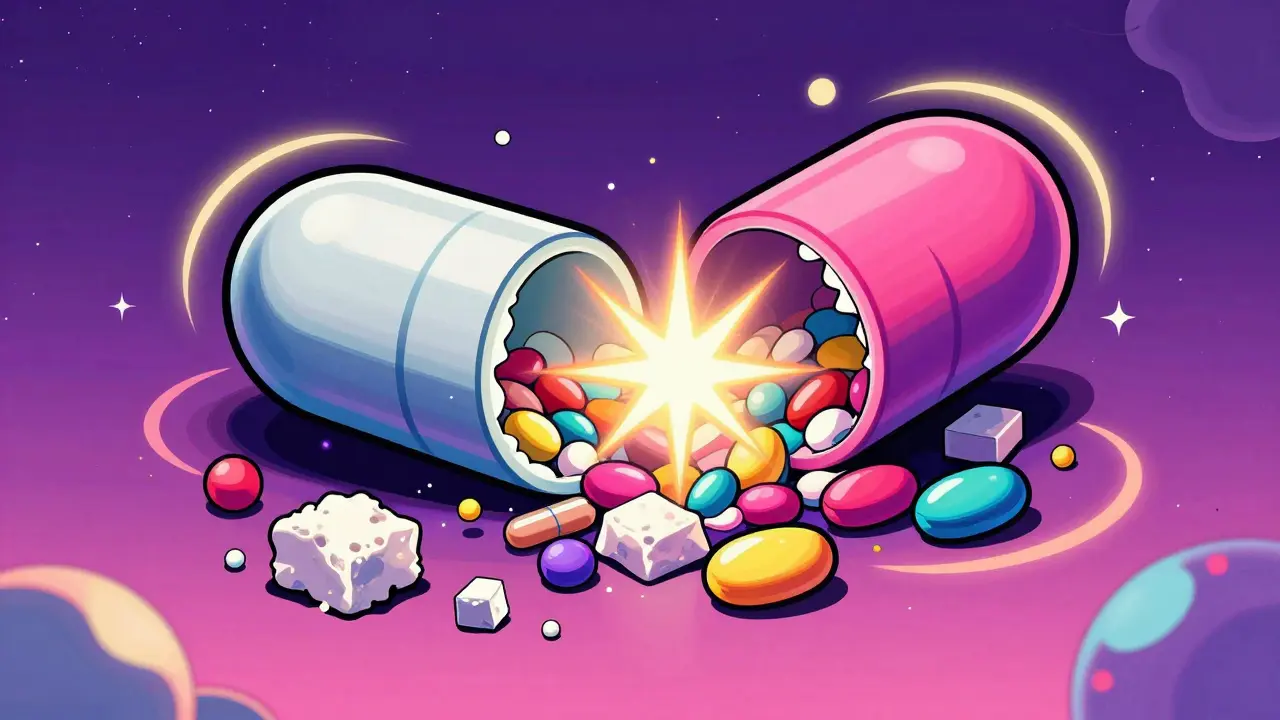
The active ingredient is what your body reacts to. It’s the part that lowers your blood pressure, kills bacteria, or stops your headache. Acetaminophen in Tylenol. Ibuprofen in Advil. Atorvastatin in Lipitor. These are the stars. They’re the reason the drug exists. The FDA requires these to go through years of testing to prove they’re safe and effective before they can be sold. But here’s where most people get confused: the active ingredient is usually less than 10% of the pill. The rest? That’s the inactive stuff - also called excipients. These are the fillers, binders, coatings, and preservatives. Lactose. Microcrystalline cellulose. Magnesium stearate. Gelatin. Shellac. Parabens. They’re not there by accident. They’re there because without them, the pill wouldn’t hold together, wouldn’t dissolve properly, or would spoil before you even took it.Why do inactive ingredients even exist?
Think of a pill like a car. The active ingredient is the engine. The inactive ingredients are the tires, the fuel line, the dashboard, the seatbelts. They don’t move the car forward by themselves, but without them, the engine wouldn’t work right - or at all. Some inactive ingredients help the medicine get absorbed. Take fenofibrate, a cholesterol drug. A newer version with special surfactants increased how much of the drug your body absorbed by 35%. That’s not a small change. That’s the difference between the drug working and not working. Others keep the medicine stable. If your pill broke down in the bottle before you took it, you’d be wasting your money - and maybe risking your health. Preservatives like parabens stop mold and bacteria from growing in liquid medications. Coatings prevent the pill from dissolving in your stomach when it’s supposed to release in your intestines. And then there’s taste. If a liquid antibiotic tastes like bitter chalk, kids won’t take it. Flavorings and sweeteners make it palatable. That’s not just convenience - it’s compliance. If you can’t swallow the pill, it doesn’t matter how good the active ingredient is.Are inactive ingredients really ‘inactive’?
The name itself is misleading. In 2021, a major study from the University of California, San Francisco, and Novartis tested 639 FDA-approved inactive ingredients against over 3,000 human proteins. They found that about 14% of these so-called ‘inactive’ substances actually interacted with biological targets. That’s not a tiny fraction. That’s 89 compounds with potential biological effects. One color additive, D&C Red 7 calcium lake, bound strongly to proteins involved in inflammation. Propyl gallate, a preservative, showed activity at levels found in everyday medications. These aren’t random chemicals. They’re in your medicine right now. The FDA didn’t ignore this. In 2022, they launched the Excipient Safety Initiative, putting $4.2 million into research to better understand these interactions. They’re now requiring extra testing for certain excipients used in long-term or high-dose medications. Pharmaceutical companies are catching on too. Sixty-eight of the top 100 drugmakers now use computer screening tools to check excipients for hidden activity before they even start manufacturing.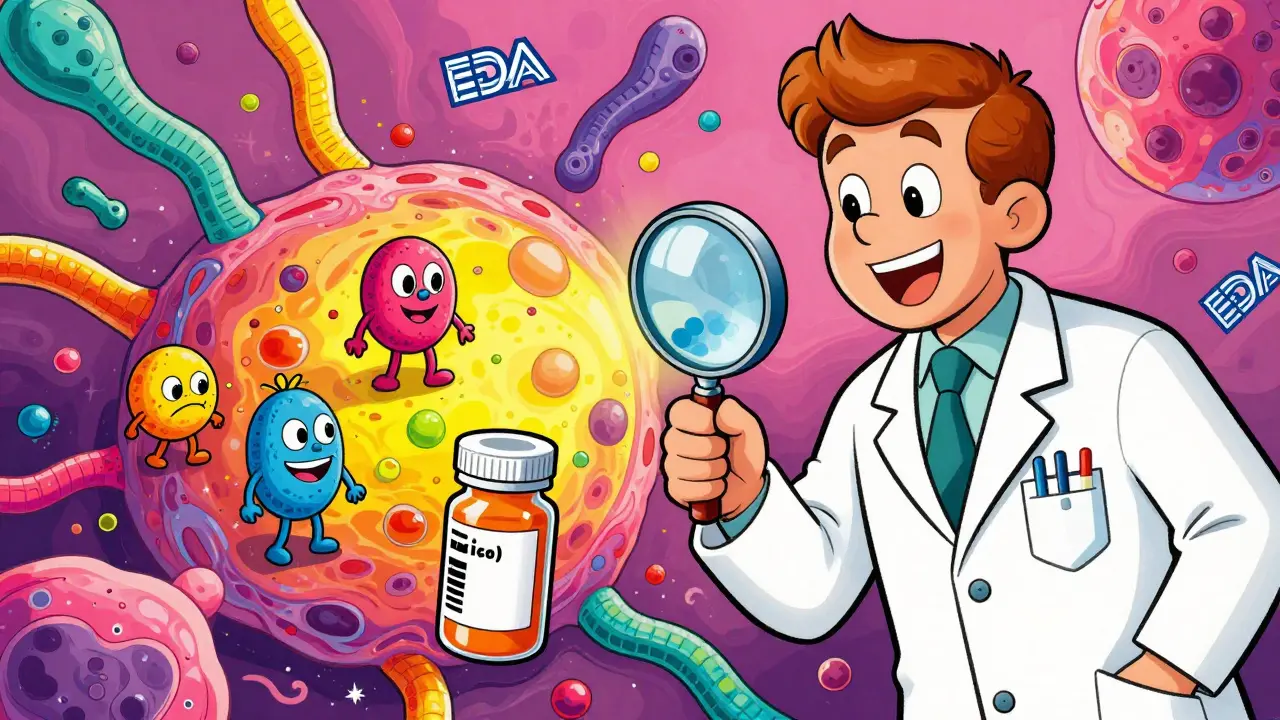
What if you’re sensitive to something in your pill?
Lactose is in nearly half of all oral medications. About 65% of the world’s population can’t digest it properly. For them, a simple painkiller might cause bloating, cramps, or diarrhea. That’s not a side effect of the drug - that’s a reaction to the filler. Gluten is another hidden problem. Some pills use wheat starch as a binder. People with celiac disease - about 1 in 100 Americans - can’t tolerate even tiny amounts. A 2022 survey found that 22% of medication switches by pharmacists were due to inactive ingredient issues, not the active drug. Even preservatives like sulfites in injectable drugs can trigger asthma attacks in sensitive people. Benzyl alcohol, used in some IV solutions, can be toxic to newborns. The FDA sets strict limits: 50mg of lactose per dose is fine in a tablet, but only 1mg of benzyl alcohol is allowed in an IV bag. You can’t just assume your pill is safe because it’s FDA-approved. You have to read the label.How to check what’s in your medication
Over-the-counter drugs list active and inactive ingredients right on the box. Prescription meds include them in the package insert. But most people don’t read it. They see ‘acetaminophen’ and think that’s all there is. The FDA’s Inactive Ingredient Database has over 1,000 excipients listed, with approved amounts for each route - oral, injectable, topical, etc. Pharmacists use this to find alternatives. If you have a dairy allergy and your painkiller has lactose, your pharmacist can find one with starch instead. If you’re gluten-sensitive, they can switch you to a capsule without wheat starch. Ask for the ingredient list. Don’t be shy. Your pharmacist is trained to help with this. And if you’re on multiple meds, keep a list of all your ingredients. That way, you can spot patterns - like if every pill that makes you sick has the same preservative.
The bigger picture: Why this matters for your health
We’ve been taught to focus on the active ingredient. But medicine isn’t just about chemistry. It’s about biology. And biology doesn’t care if something is labeled ‘inactive.’ If it interacts with your body, it matters. This isn’t just about allergies. It’s about precision medicine. If we start treating excipients like potential players - not just background noise - we can design better drugs. Drugs that don’t trigger reactions. Drugs that work better for people with specific conditions. Drugs that are truly tailored. The FDA and drugmakers are slowly moving in this direction. Australia now requires prescriptions to list active ingredients by name, not brand. That helps patients avoid duplicates and hidden interactions. In the U.S., active ingredient prescribing has grown 37% since 2017. More doctors are asking, ‘What’s the actual drug?’ - not just ‘What’s the brand?’ That’s progress. But it’s not enough. We still treat inactive ingredients like afterthoughts. They’re not. They’re part of the equation. And if you’re someone who’s had unexplained side effects, or if you have allergies or sensitivities, ignoring them could be costing you your health.What you can do today
- Look at the label on your next pill. Find the inactive ingredients. Google one you don’t recognize. You might be surprised. - Talk to your pharmacist. Ask if there’s a version of your medication without lactose, gluten, or dyes. - Keep a log. Note which medications make you feel off - and what’s in them. Patterns matter. - Don’t assume ‘FDA-approved’ means ‘safe for everyone.’ Approval means it’s safe for most. Not all. Medicine isn’t magic. It’s chemistry. And chemistry doesn’t care about labels. It reacts to what’s there. So if you’re taking something every day - whether it’s for blood pressure, cholesterol, or pain - you owe it to yourself to know what’s really in it.Are inactive ingredients safe?
Yes - for most people, most of the time. The FDA requires inactive ingredients to be generally recognized as safe (GRAS) at the levels used in medications. But ‘safe for most’ doesn’t mean safe for everyone. People with allergies, sensitivities, or certain medical conditions can react to things like lactose, gluten, dyes, or preservatives. About 0.5% of all adverse drug reactions reported to the FDA are linked to inactive ingredients.
Can inactive ingredients affect how well a drug works?
Absolutely. Inactive ingredients control how fast a drug dissolves, where it’s absorbed, and how much enters your bloodstream. For example, changing the surfactants in fenofibrate boosted absorption by 35%. If the excipients are wrong, the active ingredient might not reach the right place in the right amount - making the drug ineffective.
Why don’t doctors talk about inactive ingredients?
Most doctors aren’t trained to focus on them. Medical school teaches you about pharmacology - the active ingredients. But the science of excipients is still emerging. That’s changing, though. As more research shows their impact, especially in chronic conditions and sensitive populations, pharmacists and specialists are starting to ask more questions about formulations.
How do I know if I’m sensitive to an inactive ingredient?
If you get symptoms like bloating, diarrhea, rash, or headaches after taking a medication - and those symptoms go away when you switch to a different brand or generic version - you might be reacting to an excipient. Keep a log: note the drug name, the inactive ingredients (found on the label), and how you feel. Bring it to your pharmacist. They can compare formulations and find alternatives.
Are generic drugs safer or riskier because of inactive ingredients?
The active ingredient in generics must be identical to the brand-name version. But the inactive ingredients can be different. That’s why two generics of the same drug might affect you differently. One might have lactose; another might use starch. One might use a different dye. That’s not a flaw - it’s allowed by law. But it’s why switching generics can sometimes cause side effects, even if the active drug hasn’t changed.
If you’re on long-term medication, especially for chronic conditions, don’t overlook the filler. It might be the key to why you feel off - or why you feel great.