
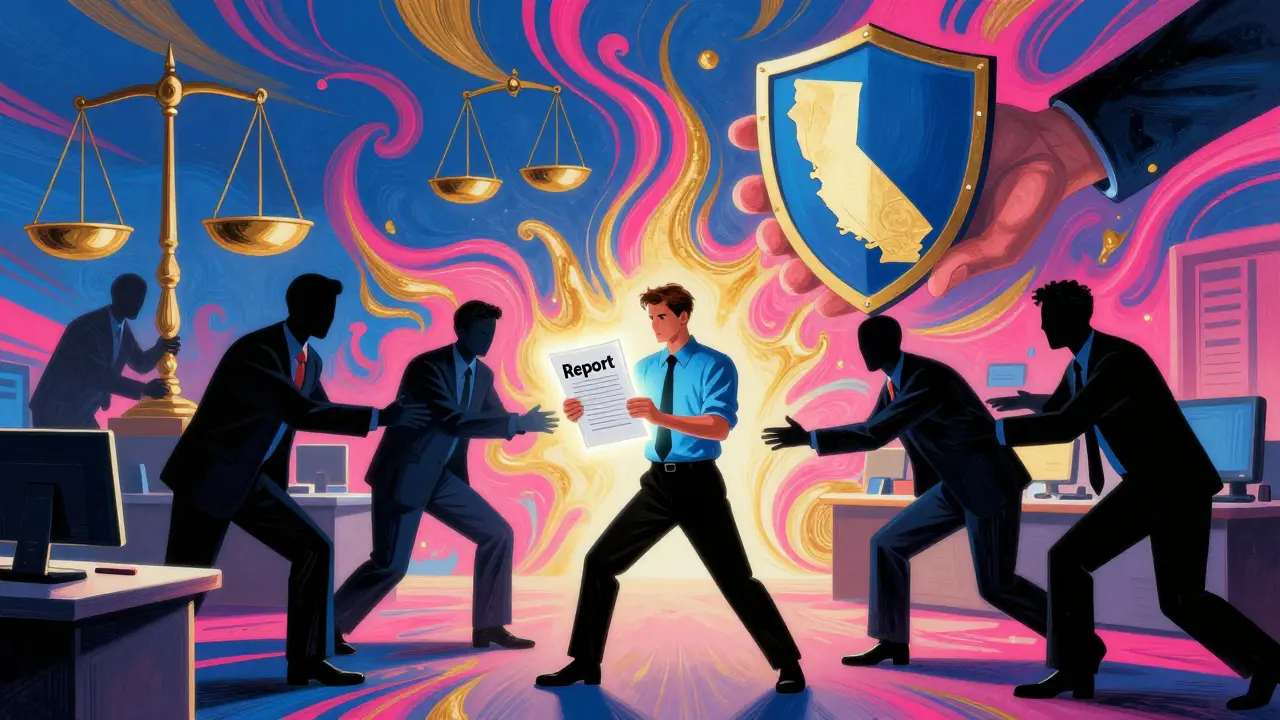
Reporting illegal or dangerous behavior at work isn’t just the right thing to do-it’s protected by law. But knowing your rights isn’t enough. If you’re thinking about speaking up, you need to understand whistleblower laws before you act. Otherwise, you risk losing your job, your income, or even your career-despite the protections that are supposed to be there.
What Counts as Protected Reporting?
Whistleblower laws don’t protect every complaint. They cover specific types of violations, and only if reported the right way. Under California’s Labor Code Section 1102.5, you’re protected if you report what you reasonably believe is a violation of state or federal law. That includes safety violations, fraud, environmental damage, or even illegal data practices. You don’t need proof. You just need a good-faith belief.Federal laws are more narrow. The Sarbanes-Oxley Act only protects employees of public companies who report financial fraud. The False Claims Act covers fraud against government programs like Medicare or defense contracts. The Dodd-Frank Act even pays out rewards-10% to 30% of recovered funds-if your tip leads to a successful case over $1 million. But if you report something outside these narrow categories, you might not be protected at all.
That’s why timing and method matter. Reporting to your boss? That’s protected. Reporting to a government agency? Also protected. But posting about it on social media? That’s risky. Courts have ruled that public disclosures aren’t always covered unless they’re part of a formal complaint process.
What Counts as Retaliation?
Retaliation doesn’t always look like being fired. It’s often quieter-and harder to prove.Being moved to a night shift after reporting a safety issue? That’s retaliation. Being denied a promotion, given impossible deadlines, or cut from key projects? That’s retaliation. Even being ignored, isolated, or subjected to constant criticism can count. California law explicitly lists these as illegal. The Department of Labor’s OSHA enforces 25 federal whistleblower laws, all of which ban retaliation in some form.
But here’s the catch: employers don’t usually say, “I’m firing you because you reported fraud.” They say, “Your performance has declined.” That’s why documentation is everything. Save emails, performance reviews, shift schedules, and text messages. If you’re suddenly labeled “unreliable” the week after you report a violation, that’s not coincidence-it’s evidence.
California’s New Rules (2025)
Starting January 1, 2025, every employer in California must post a clear, visible notice about whistleblower rights. It must include the Attorney General’s hotline (1-800-952-5225) in at least 14-point font. No exceptions. Not for small businesses. Not for remote workers. If you’re an employer in California, you must display this notice in a common area-like a break room or near the time clock.This change came from Assembly Bill 2299, signed in July 2024. The goal? To make sure workers know their rights before they’re punished for using them. Violations carry fines up to $10,000 per incident. That’s far higher than most federal penalties.
But here’s the gap: federal law doesn’t require any posting. No notice. No reminder. Workers in other states might never know they’re protected unless they stumble on it online.

How Long Do You Have to Act?
Time is your enemy. If you’re retaliated against, you have a very short window to file a complaint.For federal laws, deadlines range from 30 to 180 days:
- 30 days: Clean Air Act, CERCLA
- 90 days: Anti-Money Laundering Act
- 180 days: Consumer Financial Protection Act
Miss the deadline, and you lose your case-even if the retaliation was clear. California’s law doesn’t have a strict deadline, but the Division of Labor Standards Enforcement (DLSE) recommends filing within one year. The longer you wait, the harder it is to prove your case.
And here’s the problem: OSHA, the agency that investigates these claims, misses its own deadlines 63% of the time. A 90-day investigation window? It often takes over a year. That means you could be waiting 18 to 24 months for a decision-without a paycheck.
Real Stories, Real Consequences
A nurse in San Diego reported unsafe staffing levels that put patients at risk. She was fired the next week. After 14 months and $287,000 in back pay, she won her case. But she lost a year of income, her health insurance, and her peace of mind.On Reddit, users describe being assigned “graveyard shifts” after reporting OSHA violations-forcing them to quit. On Glassdoor, 37% of reviews mentioning whistleblower concerns include phrases like “hostile work environment.”
A 2024 survey by the National Whistleblower Center found that 68% of whistleblowers still faced retaliation, even with legal protections. Why? Because HR often claims, “Your report didn’t meet the legal threshold.” They don’t have to prove you’re wrong-they just have to delay, confuse, or intimidate you until you give up.
What You Need to Do Before Speaking Up
1. Document everything. Save emails, texts, performance reviews, and witness statements. Write down dates, times, and what was said. 2. Know your law. Are you covered by California’s law? Or a federal statute? Each has different rules. 3. Don’t rely on HR. HR works for the company-not you. Their job is to protect the business, not you. 4. Consult a lawyer. The National Whistleblower Center says 78% of successful cases had legal representation. Free help is available through nonprofits and state hotlines. 5. File fast. If you’re covered by a federal law, you have 30 to 180 days. Don’t wait.There’s no guarantee you’ll win. But if you act quickly, document carefully, and know your rights, you dramatically increase your chances.
What’s Coming Next?
The biggest change on the horizon? The AI Whistleblower Protection Act, introduced by Senator Grassley in May 2025. It would give tech workers legal protection if they report unethical AI practices-like biased algorithms, secret surveillance, or misuse of personal data.California’s 2025 posting rule is already reshaping how businesses handle compliance. More states are likely to follow. The European Union’s 2019 whistleblower directive forced companies to create internal reporting systems-and the U.S. is starting to catch up.
Meanwhile, the SEC paid out $637 million to whistleblowers in 2023. That’s up 27% from the year before. More people are reporting. More cases are being filed. And more companies are being held accountable.
Where to Get Help
You don’t have to go it alone:- California Attorney General’s Whistleblower Hotline: 1-800-952-5225
- OSHA Whistleblower Protection Program: 1-800-321-6742
- National Whistleblower Center: Free legal aid for qualifying cases
These aren’t just phone numbers. They’re lifelines. Use them before you speak up-not after you’re fired.
Is This Worth the Risk?
Yes-if you’re prepared.Whistleblower laws exist because society needs people to speak up. Without them, unsafe drugs stay on shelves, polluters keep dumping, and fraudsters keep stealing. But the system isn’t perfect. It’s slow, inconsistent, and often stacked against the person who speaks out.
If you’re thinking about reporting, ask yourself: Do I have proof? Do I know my rights? Have I talked to someone who’s been through this? If the answer is yes, then go ahead. The law is on your side. But only if you use it correctly.





December 18, 2025 AT 08:28
amanda s
This is why America’s getting destroyed-people think they can just snitch on their bosses and expect medals. No one cares about your ‘good-faith belief’ when you’re tanking a company’s reputation over a mislabeled coffee machine. Wake up. The system doesn’t reward whistleblowers-it punishes them with lawsuits, blacklisting, and social exile. And now we’re making employers post signs like they’re in a kindergarten? Pathetic.
Stop pretending this is justice. It’s just performance activism with a paycheck.
December 19, 2025 AT 14:08
Salome Perez
Thank you for such a thorough, compassionate breakdown. I’ve worked in healthcare for 18 years, and I’ve seen firsthand how HR departments weaponize ambiguity to silence good people. The 2025 California posting requirement? Long overdue. It’s not about fear-it’s about dignity.
For those outside California: reach out to the National Whistleblower Center. They’ve helped me navigate three cases. No one should have to choose between their conscience and their rent.
And yes-document everything. Even the ‘casual’ comment your manager makes in the break room. It’s evidence. Not gossip. Evidence.
December 19, 2025 AT 20:23
Kent Peterson
Let’s be brutally honest: 87% of whistleblower claims are frivolous. You think reporting ‘unsafe staffing levels’ is protected? Tell that to the nurse who called 911 because someone didn’t refill the soap dispenser. The law is being gamed by people who can’t handle workplace stress-and now we’re giving them 10% of a $1M settlement? That’s not justice-that’s a lottery ticket for disgruntled employees.
And don’t get me started on the ‘AI Whistleblower Protection Act.’ Next they’ll protect people who report their chatbot was ‘rude.’
Also: OSHA misses deadlines 63% of the time? That’s not a flaw-it’s a feature. Let the system rot. It’s better than empowering mob justice.
December 21, 2025 AT 10:20
Martin Spedding
lol the nurse got 287k after 14 months? what a joke. they shoulda just quit and got a job at starbucks. no one cares about your ‘ethics’ when you’re broke and bitter.
December 22, 2025 AT 17:04
Raven C
It’s profoundly disheartening to witness the erosion of professional decorum under the guise of ‘protection.’ One cannot help but note the alarming conflation of emotional grievance with legal entitlement. The notion that a ‘good-faith belief’ suffices as evidentiary foundation is not merely legally unsound-it is philosophically bankrupt.
And yet, the proliferation of emotive testimonials-replete with anecdotal hyperbole-only further corrodes the integrity of the very institutions meant to uphold rationality. One wonders: if we continue to reward performative outrage, what remains of accountability?
December 24, 2025 AT 05:10
Patrick A. Ck. Trip
Just wanted to say thank you for this. I was scared to speak up about safety violations at my warehouse job last year. Didn’t know the law protected me until I found this. Took me 6 months to file, but I did it. Got my job back. Still get side-eyed in the break room… but I’m alive. And my team is safer now.
Don’t let anyone tell you silence is strength. Sometimes it’s just fear in a nice suit.
December 25, 2025 AT 16:14
Chris Van Horn
Oh, so now we’re glorifying tattletales? Let me guess-you think you’re the hero in this story? You’re not. You’re the reason companies hire lawyers instead of HR reps. You’re the reason good people get fired for ‘culture fit’ while you collect sympathy points on Reddit.
And the AI whistleblower act? Are you kidding me? Next they’ll protect coders who report their LLM said ‘bad word’ in a training loop. This isn’t progress-it’s the death of workplace autonomy.
Also: HR doesn’t work for you? Shocking. Newsflash: nobody works for you. Not even your therapist.
December 26, 2025 AT 23:21
Virginia Seitz
this is why i love california 🇺🇸❤️ 100% behind the poster law. if i see it in my break room, i’ll take a pic and tag my boss 😎
December 28, 2025 AT 19:21
Peter Ronai
Let’s cut through the noise: whistleblowers don’t win. They survive. And ‘surviving’ means you lost everything else-your career, your reputation, your sleep. The 68% retaliation rate isn’t a statistic-it’s a confession. The system doesn’t protect you. It just gives you a longer funeral.
And if you think the SEC paid $637M to whistleblowers because they’re heroes? Think again. That’s corporate money laundering disguised as justice. The real winners? The law firms taking 40%.
December 29, 2025 AT 01:32
Michael Whitaker
It’s interesting how the article frames HR as the enemy. But HR is just the face of a system designed to protect capital over conscience. The real villain isn’t the manager who moves you to nights-it’s the boardroom that incentivizes silence through bonuses, stock options, and vague performance metrics.
And yet, we still ask individuals to bear the entire burden of moral courage. We don’t fix the system. We just tell people to ‘document everything’ and hope they don’t break.
Maybe the real reform isn’t more laws-but a cultural shift that rewards integrity, not just compliance.
December 30, 2025 AT 11:43
Naomi Lopez
Let’s be real-whistleblower laws are a luxury for those who can afford lawyers. If you’re hourly, undocumented, or working two jobs just to survive, you don’t have the bandwidth to ‘document everything.’
And yet, the people who need protection most? They’re the ones getting fired first. The system isn’t broken. It was built this way.
California’s poster rule? Cute. But it doesn’t help the warehouse worker who doesn’t speak English. Or the single mom working night shifts. We’re decorating the coffin, not fixing the grave.