

Psoriasis isn’t just a skin rash. It’s a full-body immune disorder that shows up on the skin as thick, scaly patches - but the damage goes deeper. About 125 million people worldwide live with it, and for most, it’s not a one-time flare. It’s a lifelong condition that can affect joints, heart health, and even mental well-being. The good news? Treatment has changed dramatically in the last five years. What used to mean years of trial-and-error with steroids and light therapy now often means targeted biologics that clear 90% of plaques with just a few injections a year.
Understanding the Three Main Types of Psoriasis
Not all psoriasis looks the same. The three most common forms - plaque, guttate, and systemic - require different approaches. Plaque psoriasis is by far the most common, making up 80 to 90% of cases. It shows up as raised, red patches covered with silvery scales, usually on elbows, knees, scalp, and lower back. These plaques don’t just itch; they can crack, bleed, and hurt. For many, it’s a constant reminder of a condition they can’t hide.
Guttate psoriasis looks completely different. It appears as small, drop-like spots, often covering the torso, arms, and legs. It usually hits suddenly - often after a strep throat infection - and is more common in kids and young adults. While it can clear on its own, it sometimes turns into plaque psoriasis if not managed. The key difference? Guttate doesn’t usually respond well to topical creams alone. It often needs systemic treatment from the start.
Systemic psoriasis isn’t a type you see on the skin - it’s what happens when the inflammation spreads. This is where psoriatic arthritis, heart disease, and metabolic syndrome come in. About 30% of people with psoriasis develop joint pain and swelling. Another 40-50% have metabolic syndrome - high blood pressure, insulin resistance, and belly fat. That’s why treating psoriasis isn’t just about clearing skin. It’s about stopping the inflammation before it damages your organs.
Topical Treatments: Where It All Starts
For mild psoriasis - covering less than 5% of your body - topical treatments are still the first step. But they’re not magic. Corticosteroid creams work fast, but using them too long can thin your skin. That’s why doctors now combine them with vitamin D analogs like calcipotriol. One study showed that a 0.005% calcipotriol and betamethasone foam cleared 89% of genital psoriasis cases in 8 weeks - a game-changer for a sensitive area most people avoid treating.
Newer topicals like tapinarof cream (1%) are changing the game. It works by calming the immune response without steroids. In clinical trials, 35% of users saw 75% skin clearance after 12 weeks. It’s safe for long-term use, doesn’t cause skin thinning, and can be applied anywhere - even on the face. But here’s the catch: it takes time. You won’t see results in a week. Most people need 8 to 12 weeks before they notice a real difference.
For stubborn plaques, dermatologists often recommend occlusion: covering the cream with plastic wrap or a bandage overnight. This boosts absorption. For nail psoriasis, a single injection of triamcinolone directly into the nail bed improves pitting in 75% of cases within 12 weeks. It’s not glamorous, but it works.
Oral Systemic Medications: Beyond Steroids
If your psoriasis covers more than 5% of your skin, or if it’s affecting your joints, you’ll likely need something stronger than a cream. Oral systemic drugs are the bridge between topicals and biologics. They work inside your body to slow down the overactive immune response.
Methotrexate has been the go-to for decades. Taken once a week, it clears 50-60% of plaques in 16 weeks. But it can damage your liver and lower your white blood cell count. Regular blood tests are a must. Cyclosporine works faster - 60-70% clearance in 12 weeks - but it’s hard on the kidneys and can’t be used long-term. Acitretin, a vitamin A derivative, helps with thick, scaly plaques, but it’s not safe for women who might get pregnant. It stays in your body for years.
The newer oral options are less toxic and easier to manage. Apremilast (Otezla) is a pill taken twice daily. It reduces inflammation by blocking an enzyme called PDE4. It clears about 33% of plaques at 16 weeks - not as strong as biologics, but it’s safe for people with liver or kidney issues. Deucravacitinib is a breakthrough. Taken as one pill a day, it targets a specific immune pathway (TYK2) and clears 59% of plaques at 16 weeks. It’s the first oral drug that rivals some biologics in effectiveness, without the need for injections or frequent blood work.

Biologics: The Precision Medicine Revolution
Biologics are the most powerful tools we have today. These are injectable or infused drugs made from living cells that target specific parts of the immune system. Unlike older drugs that suppress your whole immune system, biologics are like snipers - they hit only the cells causing psoriasis.
There are three main families: TNF inhibitors, IL-17 inhibitors, and IL-23 inhibitors. TNF blockers like adalimumab (Humira) were the first. They clear about 78% of plaques at 16 weeks. But they’re expensive - around $28,500 a year - and carry a higher risk of infections and reactivating tuberculosis.
IL-17 inhibitors like secukinumab (Cosentyx) are faster. They start working in 2 weeks and clear 79% of plaques at 90% clearance (PASI 90) by 16 weeks. But they’re not ideal if you have Crohn’s disease or other inflammatory bowel conditions - they can make those worse.
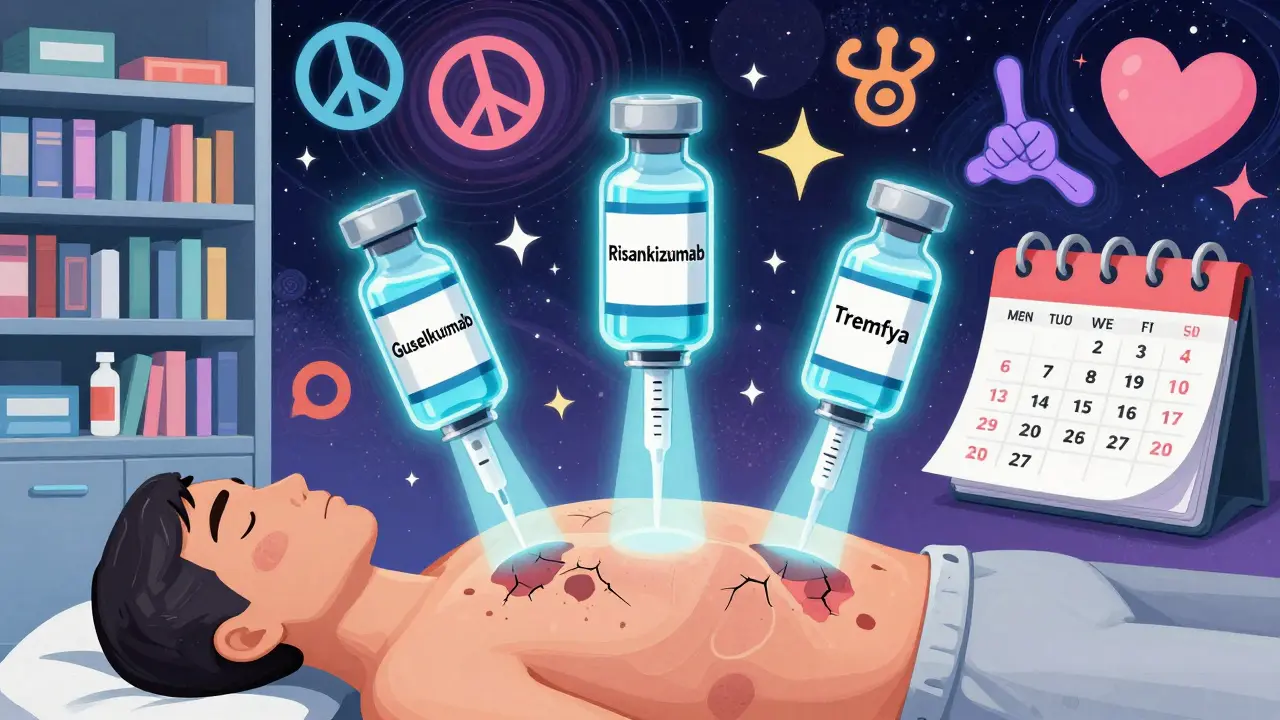
IL-23 inhibitors are now the gold standard. Guselkumab (Tremfya), risankizumab (Skyrizi), and tildrakizumab (Ilumya) block a protein higher up in the inflammation chain. That means they’re more effective and longer-lasting. Guselkumab clears 84% of plaques at PASI 90 in 16 weeks. Risankizumab has the highest patient retention - 78% of users stay on it after a year. Best of all? You only need an injection every 8 to 12 weeks. Some patients who achieve complete clearance can even stop treatment for months without flare-ups.
Choosing the Right Treatment for You
There’s no one-size-fits-all. Your choice depends on how much skin is affected, whether you have joint pain, your other health conditions, and even your lifestyle.
- If you have mild psoriasis and hate needles: start with tapinarof or calcipotriol/betamethasone foam.
- If you have moderate disease and want something easy: try deucravacitinib. One pill a day, no blood tests needed.
- If you have severe plaque psoriasis or psoriatic arthritis: go straight to an IL-23 inhibitor. Guselkumab or risankizumab give you the best chance at near-complete clearance with the fewest injections.
- If you have IBD: avoid IL-17 inhibitors. Stick with IL-23 blockers or TNF inhibitors.
- If you’re young and want long-term remission: early use of IL-23 inhibitors may allow you to stop treatment later. Early intervention could mean years without flares.
Don’t be discouraged if your first treatment doesn’t work. About 20-25% of people don’t respond to IL-17 blockers because their psoriasis is driven by a different immune pathway - type I interferon, not Th17. That’s why some dermatologists now use genetic testing to match patients to the right drug. It’s not standard yet, but it’s coming.
Cost, Access, and Real-World Challenges
Yes, biologics are expensive. Guselkumab costs $34,200 a year. But here’s the reality: 85% of insured patients pay $0 to $150 a month thanks to manufacturer assistance programs. If you’re on Medicare or Medicaid, ask your dermatologist about patient support services. Most drug companies offer free injections, co-pay cards, and even home nursing for injections.
Insurance approval can take 4 to 6 weeks. Many clinics now use electronic prior authorization systems that cut that time to under a week. Don’t wait - start the paperwork the same day your doctor prescribes it.
Injection anxiety is real. But most patients get used to it. Training videos from the National Psoriasis Foundation show 95% success after one or two sessions. And quarterly injections? That’s less frequent than a yearly flu shot.
What’s Next? The Future of Psoriasis Treatment
The next wave of treatments is coming fast. Oral peptides - pills that mimic biologics - are in phase 3 trials. One drug, targeting the IL-23 receptor, cleared 82% of plaques in early studies. If approved, it could replace injections for many.
Topical JAK inhibitors are also in development. By 2027, they may clear 50-60% of plaques without steroids. And for the rare but severe pustular psoriasis, drugs like spesolimab are already showing results - clearing pustules in under two weeks.
One of the most exciting developments? The GUIDE trial is testing whether stopping treatment after early, aggressive therapy with guselkumab can lead to long-term remission. Early results suggest some patients stay clear for over a year after stopping. This isn’t a cure - but it’s the closest we’ve ever come.
Real Patient Experiences
Reddit user u/PsoriasisWarrior shared: "After failing methotrexate and adalimumab, guselkumab cleared 95% of my plaques in 3 months. Quarterly shots. Life-changing. Cost $500 a month with insurance. Worth every penny." Another user on Drugs.com wrote: "I waited 4 months for secukinumab to work. I had a job interview in 6 weeks. I switched to risankizumab - cleared 80% in 6 weeks. Don’t wait if you need fast results." For others, the win is smaller but just as meaningful: "I used to hide my hands. Now I wear short sleeves. My nails look normal. That’s all I ever wanted." These aren’t outliers. They’re the new normal.
Can psoriasis be cured?
There’s no permanent cure yet, but some patients achieve long-term remission - especially with early use of IL-23 inhibitors. The GUIDE trial is testing whether stopping treatment after deep clearance can lead to years without flares. For many, psoriasis becomes manageable, not life-limiting.
Which treatment works fastest?
IL-17 inhibitors like secukinumab start working in as little as 2 weeks. IL-23 inhibitors take about 4 weeks. TNF inhibitors and oral drugs like apremilast can take 8 to 12 weeks. If you need quick results - for an event, job interview, or social anxiety - IL-17 blockers are your best bet.
Are biologics safe long-term?
Yes, when monitored. Biologics don’t weaken your immune system the way methotrexate or cyclosporine do. They target specific pathways. The biggest risk is infection - especially TB or fungal infections. That’s why you get screened before starting. Long-term data shows IL-23 inhibitors have the best safety profile over 5+ years.
Why does my psoriasis come back after stopping treatment?
Psoriasis is a chronic immune disorder. Stopping treatment doesn’t fix the underlying problem - it just removes the brake. Most people will flare again. But early, aggressive treatment with IL-23 inhibitors may retrain your immune system. Some patients stay clear for months or even years after stopping - and that’s a major breakthrough.
Can I use natural remedies instead of medication?
Sunlight, moisturizers, and stress reduction help manage symptoms, but they won’t stop the immune system from attacking your skin. If you have moderate to severe psoriasis, natural remedies alone aren’t enough. They can support treatment, but they shouldn’t replace it. Always talk to your dermatologist before stopping prescribed meds.
What should I do if my current treatment stops working?
Don’t just switch to another biologic. Your psoriasis might have shifted immune pathways. Some patients don’t respond to IL-17 blockers because their disease is driven by type I interferon, not Th17. Ask your doctor about genetic profiling or switching to an IL-23 inhibitor - which works across multiple pathways. Sequential trials without a plan often waste time and money.
How do I know if I need systemic treatment?
If your psoriasis covers more than 5% of your body (about the size of two palms), or if it’s affecting your joints, sleep, or self-esteem, it’s time to consider systemic options. The DLQI (Dermatology Life Quality Index) is a simple tool doctors use - if your score is above 10, you’re likely a candidate for biologics or oral drugs.



December 31, 2025 AT 06:49
Glendon Cone
Just read this after my 3rd guselkumab shot - 90% clear and I actually wore shorts today. No joke, I cried in the pharmacy. This isn’t just skin deep, it’s soul deep. 🙏
December 31, 2025 AT 18:48
henry mateo
i just wanted to say thank you for writing this. i’ve had psoriasis since i was 12 and this is the first time i’ve read something that actually gets it. the part about mental health? yeah. that’s the real battle. ty for not just talking about creams and injections. 💙
January 1, 2026 AT 12:36
Kelly Gerrard
If you’re still using steroids for more than 6 weeks you’re doing it wrong. This isn’t 2010. Get on a biologic or get out of the way. Your quality of life is not optional.
January 2, 2026 AT 02:18
Aayush Khandelwal
IL-23 inhibitors are the new black magic. Think of it like hacking the immune system’s firmware - you’re not deleting the OS, you’re just patching the buggy module. The body doesn’t hate you. It’s just running outdated code. 🧬
January 3, 2026 AT 14:26
Kunal Karakoti
In India, access to biologics is a luxury. But even here, we’re seeing patients respond to low-dose apremilast + turmeric + sunlight. Sometimes the most radical thing is patience. Not every war needs a sniper - sometimes a steady hand works better.
January 4, 2026 AT 20:52
Sandeep Mishra
To anyone scared of injections: I used to panic at the sight of a needle. Now I do my own guselkumab every 8 weeks while watching Netflix. The first time was terrifying. The 12th? I forgot to set a reminder. It’s not about being brave. It’s about being consistent. You’ve got this.
January 5, 2026 AT 14:18
Cheyenne Sims
While the clinical data is compelling, the article’s omission of socioeconomic disparities in access to care is a glaring oversight. Biologics are not merely expensive - they are structurally inaccessible to the underinsured, the undocumented, and the rural poor. Aesthetic efficacy cannot be decoupled from equity. This is medicine as privilege.
January 6, 2026 AT 09:30
Joseph Corry
Let’s be honest - this is just another case of Big Pharma repackaging immunosuppression as ‘precision medicine.’ You’re not curing anything. You’re just buying time with a $34,000 annual subscription to temporary relief. The real solution? Stop treating symptoms and start asking why 125 million people’s immune systems are screaming. But that’s too philosophical for a pill.