
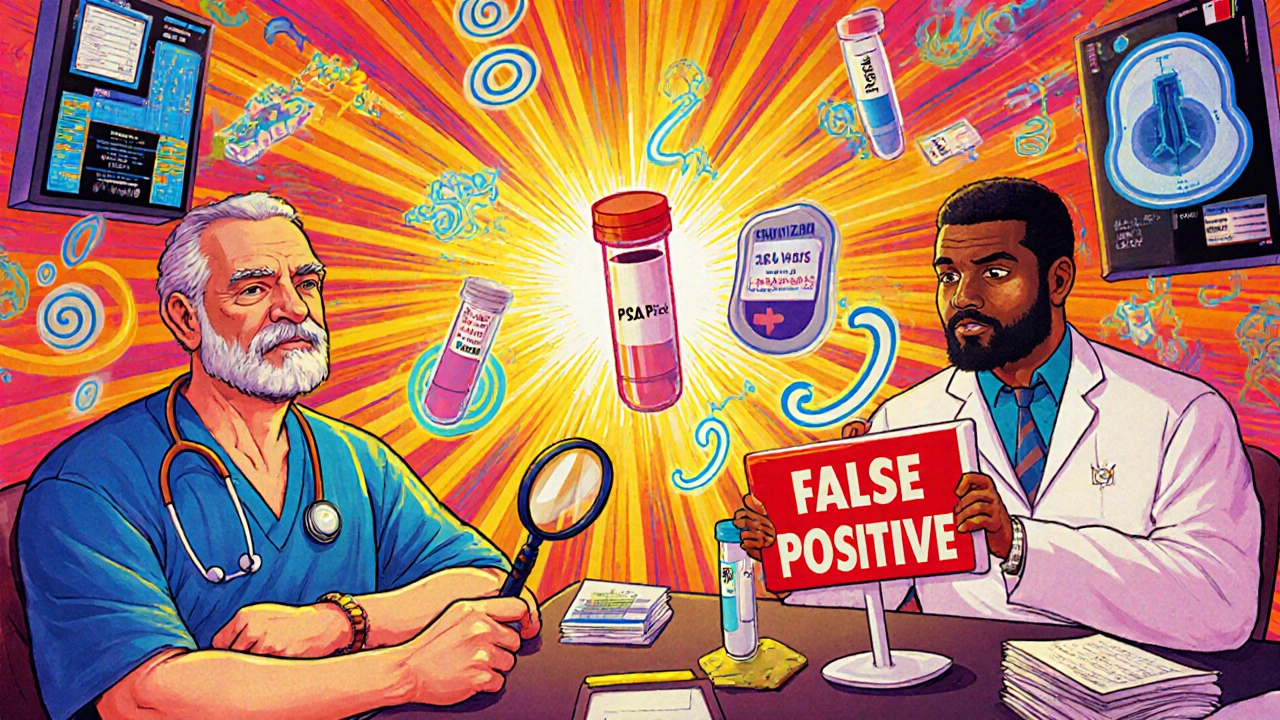
Every year, millions of men get a simple blood test called PSA screening, hoping it will catch prostate cancer early. But here’s the truth: PSA screening isn’t a clear win. It saves some lives, but it also leads to thousands of unnecessary biopsies, surgeries, and lifelong side effects for men who never needed treatment. The real question isn’t whether you should get tested-it’s whether you’ve had a real conversation about what that test could mean for you.
What PSA Screening Actually Does (and Doesn’t Do)
The PSA test measures a protein made by the prostate gland. High levels can signal cancer, but they can also come from a swollen prostate, an infection, or even riding a bike. About 75% of men with a PSA between 4 and 10 ng/mL don’t have cancer at all. And here’s the twist: 15% of men with aggressive prostate cancer have PSA levels below 4.0 ng/mL. That means the test misses some of the worst cases while flagging plenty of harmless ones.
Studies show conflicting results. The European study found that screening cut prostate cancer deaths by about 21%. But the U.S. PLCO trial found no real benefit. Why the difference? In Europe, men were screened more regularly and followed up more carefully. In the U.S., many men got tested once and never saw a specialist again. The bottom line? PSA screening can help-but only if it’s part of a smarter, ongoing plan.
The Harms Are Real-and Common
For every 1,000 men aged 55 to 69 screened every year for a decade:
- 1 to 2 prostate cancer deaths are prevented
- 100 to 120 men get false positives and go through painful biopsies
- 80 to 100 men are diagnosed with cancers that would never have hurt them
That last group is the biggest problem. These are slow-growing tumors that might never cause symptoms in a man’s lifetime. But once diagnosed, most men feel pressured to treat them-surgery, radiation, hormone therapy. The side effects? Incontinence, impotence, bowel problems. One man in his 60s had surgery after a PSA of 4.7. He spent the next five years dealing with permanent urinary leakage. His cancer? Low-risk. He could have waited.
And it’s not just about physical side effects. The emotional toll is heavy. Men report anxiety, guilt, and regret after being told they have cancer-even if it’s harmless. One Reddit user wrote: “I thought I was saving my life. Turns out I just ruined my sex life.”
Shared Decision-Making Isn’t Just a Buzzword
Since 2018, major medical groups-including the American Cancer Society, the Urological Association, and the U.S. Preventive Services Task Force-agree on one thing: PSA screening should only happen after a shared decision-making conversation. That means your doctor doesn’t just hand you a slip of paper saying “get tested.” They explain the risks, the benefits, and the alternatives. You get to ask questions. You get to say no.
But here’s the problem: most doctors don’t do this well. A 2022 study found primary care doctors spend an average of 3.7 minutes on PSA discussions during a checkup. The recommended time? 15 to 20 minutes. That’s not enough to explain that 80 out of 100 men diagnosed through PSA screening don’t need treatment. It’s not enough to show that a biopsy carries a 1 in 100 risk of serious infection. It’s not enough to help you understand that your race, family history, or baseline PSA level changes your risk.
And it’s worse for Black men. They’re 70% more likely to get prostate cancer and more than twice as likely to die from it. Yet they’re 23% less likely to have a real conversation about screening. That’s not just a gap in care-it’s a systemic failure.

What Comes After PSA? New Tools, Better Answers
PSA isn’t going away-but it’s no longer the only tool. Newer tests are helping doctors make smarter calls:
- 4Kscore: Combines four blood proteins with age and family history to predict risk of aggressive cancer. It’s 95% accurate at ruling out high-grade disease.
- mpMRI: A special MRI scan of the prostate can spot suspicious areas before a biopsy. One study showed it cut unnecessary biopsies by 27%.
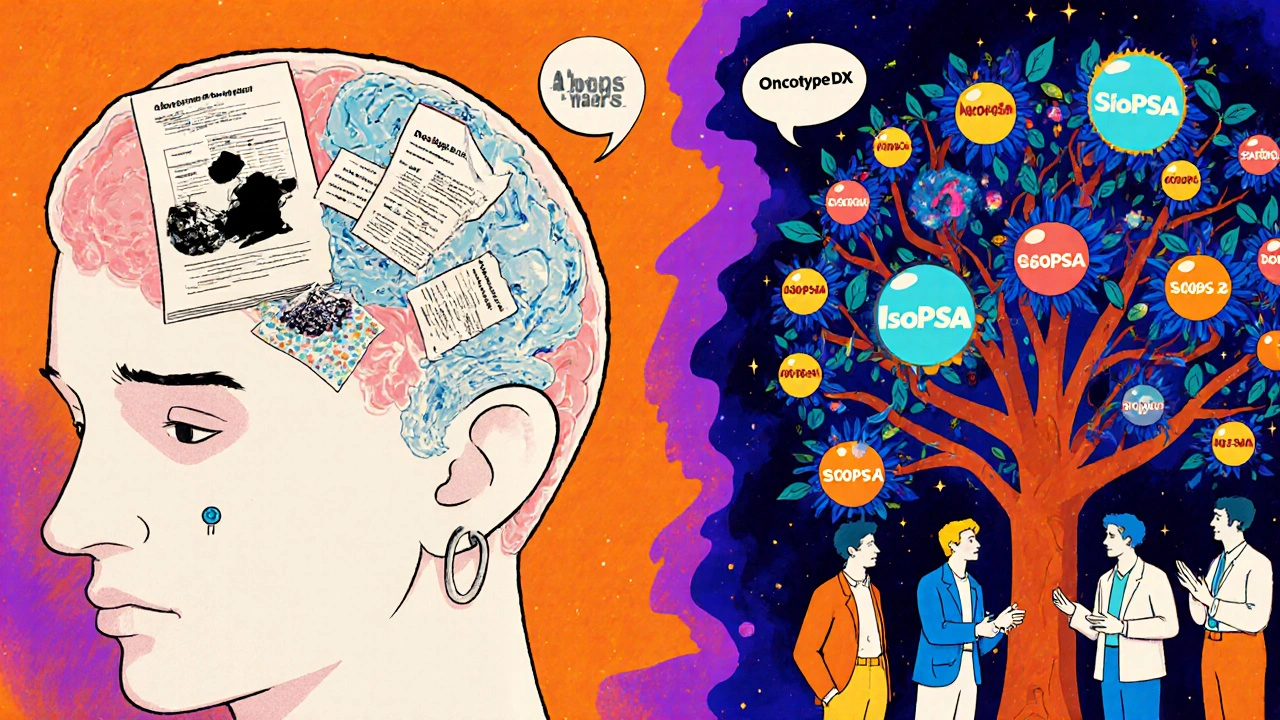
- Genomic tests like Oncotype DX and Prolaris: Used after diagnosis to tell you if your cancer is likely to grow slowly or aggressively. This helps avoid unnecessary surgery.
- IsoPSA: A newer version of the PSA test that’s 92% accurate at spotting dangerous cancers-compared to just 25% for the old test.
These tools aren’t perfect. They’re expensive. Most insurance won’t cover them unless you’ve already had a high PSA. But they’re changing the game. Instead of “test, biopsy, treat,” we’re moving toward “assess, risk-stratify, decide.”
What Should You Do?
If you’re a man between 55 and 69, here’s what matters:
- Ask for a decision aid. Tools like the Ottawa Personal Decision Guide or the Mayo Clinic’s screening tool use simple charts to show you the odds: “For every 1,000 men like you, 1 or 2 will avoid death from prostate cancer. 240 will have unnecessary biopsies.” Seeing it visually changes everything.
- Know your baseline. If your PSA is under 1.0 ng/mL at age 45 to 50, your risk of aggressive cancer is very low. You might not need another test for 5 to 10 years.
- Know your risk. Black men, men with a family history of prostate cancer, and men with BRCA mutations have higher risk. You may benefit more from screening.
- Ask about active surveillance. If you’re diagnosed with low-risk cancer, waiting isn’t giving up-it’s the smartest choice for most men.
If you’re over 70? Screening usually does more harm than good. The chance of dying from prostate cancer is low, and the risks of treatment are high. Unless you’re in great health and have a strong family history, skip it.
If you’re under 55? Don’t get screened unless you have symptoms or a strong family history. No one needs a PSA test just because their friend got one.
The Bigger Picture
The PSA controversy isn’t about whether cancer is dangerous. It’s about whether we’re using the right tools, at the right time, with the right expectations. We’ve spent decades treating every prostate cancer like it’s a threat. Now we’re learning that most aren’t. The real breakthrough isn’t a better test-it’s better conversations.
Men who use decision aids are 35% less likely to feel conflicted about their choice. They’re more likely to say they understood the risks. They’re more likely to choose active surveillance when appropriate. And they’re less likely to regret their decision later.
PSA screening won’t disappear. But the way we use it is changing. The future isn’t about testing more men. It’s about testing smarter. And that starts with a conversation-not a form, not a reminder, not a pop-up on your doctor’s screen. A real, honest, two-way talk about what you value, what you fear, and what you’re willing to live with.
What If Your Doctor Pushes You to Get Tested?
If your doctor says, “Everyone should get this test,” or “It’s just a simple blood test,” push back. Say: “I’ve read about the risks of overdiagnosis. Can we talk about my personal risk and what happens if the test comes back high?”
If they don’t have time, ask for a follow-up appointment. If they refuse, find a doctor who will listen. Your health isn’t a checkbox. It’s a choice.



November 29, 2025 AT 14:44
Robert Bashaw
PSA screening is the medical equivalent of asking your ex if they still love you-half the time, you just wanna know so you can suffer longer. I got mine at 58, PSA was 5.2, went full panic mode, biopsied like a man possessed, ended up with a diagnosis of ‘indolent tumor that probably wouldn’t kill me before my cat did.’ Now I’m on active surveillance, take turmeric like it’s candy, and still can’t look at a bicycle without sweating. Don’t get tested unless you’re ready to live with the ghost of cancer haunting your prostate for the rest of your life. And no, I don’t regret it. I just regret not knowing this sooner.
November 29, 2025 AT 20:45
Jennifer Wang
While the emotional and psychological ramifications of overdiagnosis are indeed significant, the clinical data must be interpreted within the context of population-level outcomes. The European Randomized Study of Screening for Prostate Cancer (ERSPC) demonstrated a statistically significant reduction in prostate cancer-specific mortality, with a number needed to treat of 274 men screened over 13 years to prevent one death. This benefit, while modest, is non-trivial in a disease that carries a 29% mortality rate among metastatic cases. The challenge lies not in the test’s sensitivity or specificity, but in the absence of standardized decision-making protocols across primary care settings, which leads to inconsistent risk stratification and patient counseling.
December 1, 2025 AT 16:47
Subhash Singh
As a physician from India, I find this discussion profoundly relevant. In our setting, PSA testing is often done without any counseling-patients come in, get tested, and panic if the number is above 4.0. There is virtually no access to mpMRI or genomic tests, and active surveillance is considered a ‘Western luxury.’ We need context-specific guidelines. For example, in rural India, where urologists are scarce and follow-up is nearly impossible, a high PSA might mean death from untreated cancer. But in urban centers with resources, the same test becomes a source of unnecessary trauma. We must adapt, not copy.
December 3, 2025 AT 04:24
Sohini Majumder
OMG I JUST GOT MY PSA DONE AND IT WAS 6.8?? I’M GONNA DIE?? I’M 61 AND I JUST WANTED TO KNOW IF I WAS ‘FINE’ BUT NOW I’M SCARED TO SLEEP?? MY WIFE IS CRYING AND MY DOCTOR JUST SAID ‘WE’LL SEE’?? WHY DO THEY EVEN MAKE THIS TEST IF IT’S SO CONFUSING?? I’M JUST A MAN WHO WANTS TO LIVE TO SEE HIS GRANDKIDS, NOT BE A LAB RAT FOR MEDICAL GUESSWORK!!!
December 3, 2025 AT 07:39
tushar makwana
I read this whole thing and felt like someone finally understood. My dad died of prostate cancer at 67, but he never had a real talk about it. He just got tested and went straight to surgery. He lost his bladder control and never smiled the same after. I’m 52 now. I asked my doctor about the 4Kscore and mpMRI. He looked at me like I was speaking Mandarin. I had to pay out of pocket for the MRI. It came back clean. I didn’t need a biopsy. I didn’t need to be scared. Just talk to me. That’s all. Just talk.
December 4, 2025 AT 19:12
Richard Thomas
It is imperative to recognize that the reduction in prostate cancer mortality observed in the ERSPC trial is attributable to a combination of factors, including the high frequency of screening intervals, the rigorous follow-up protocols, and the centralized pathological review of biopsy specimens-all of which are absent in the majority of primary care practices in the United States. The PLCO trial’s null result is therefore not a refutation of screening per se, but rather a reflection of suboptimal implementation. To conflate the two is to commit an ecological fallacy. The solution is not to abandon screening, but to institutionalize structured, evidence-based decision-making frameworks that ensure fidelity to clinical guidelines.
December 5, 2025 AT 08:04
Monica Lindsey
Men who don’t get tested are just ignoring reality. If you’re a man over 50 and you’re not getting screened, you’re gambling with your life. And if you’re too lazy to have a 15-minute conversation with your doctor, maybe you don’t deserve to live past 70.
December 7, 2025 AT 04:09
Sullivan Lauer
Let me tell you something: I used to be the guy who thought PSA was a joke. I thought, ‘I’m healthy, I run marathons, why would I need this?’ Then my buddy Mike got diagnosed at 56-aggressive cancer, stage 3. He’s been on hormone therapy for four years now. His wife told me he cries every night because he can’t hold her like he used to. I went in the next week. My PSA was 4.9. I did the 4Kscore. It said 1% chance of aggressive cancer. I did the mpMRI. Clean. I didn’t get a biopsy. I didn’t panic. I got educated. And now? I’m the guy who talks to every guy I know about this. You don’t have to be scared. You just have to be smart. Your prostate isn’t your enemy. Ignorance is.
December 8, 2025 AT 09:32
Brandy Johnson
Let’s be clear: this is liberal medical hand-wringing disguised as ‘shared decision-making.’ In America, we don’t need to be coddled with decision aids-we need to be told the truth: if you’re a man over 50, you get screened. Period. The Europeans are smarter. They don’t ask if you ‘feel ready.’ They test. They save lives. This ‘active surveillance’ nonsense is just a way for doctors to avoid liability and for men to pretend they’re in control while quietly dying. If you’re not willing to get tested, don’t complain when you’re gone.
December 8, 2025 AT 15:54
jamie sigler
I got my PSA tested last year. It was high. I didn’t do anything. I just… waited. I didn’t want to know. I didn’t want to be ‘one of those guys.’ Now I’m 59 and I feel like I’ve been living under a cloud. I’m not mad at anyone. I’m just… tired. I wish I’d known sooner that it’s okay to say no. But I also wish I’d known it’s okay to say yes. I don’t know what I should’ve done. I just know I wish I hadn’t ignored it.
December 9, 2025 AT 22:41
Bernie Terrien
PSA is a junk test. It’s like using a metal detector to find a specific coin in a sandbox full of bottle caps. The new IsoPSA? That’s the real deal. 92% accuracy? That’s not progress-that’s a revolution. But no one’s talking about it because Big Pharma doesn’t profit from a test that cuts biopsies by 80%. The system isn’t broken. It’s designed to keep you scared, tested, and spending.