
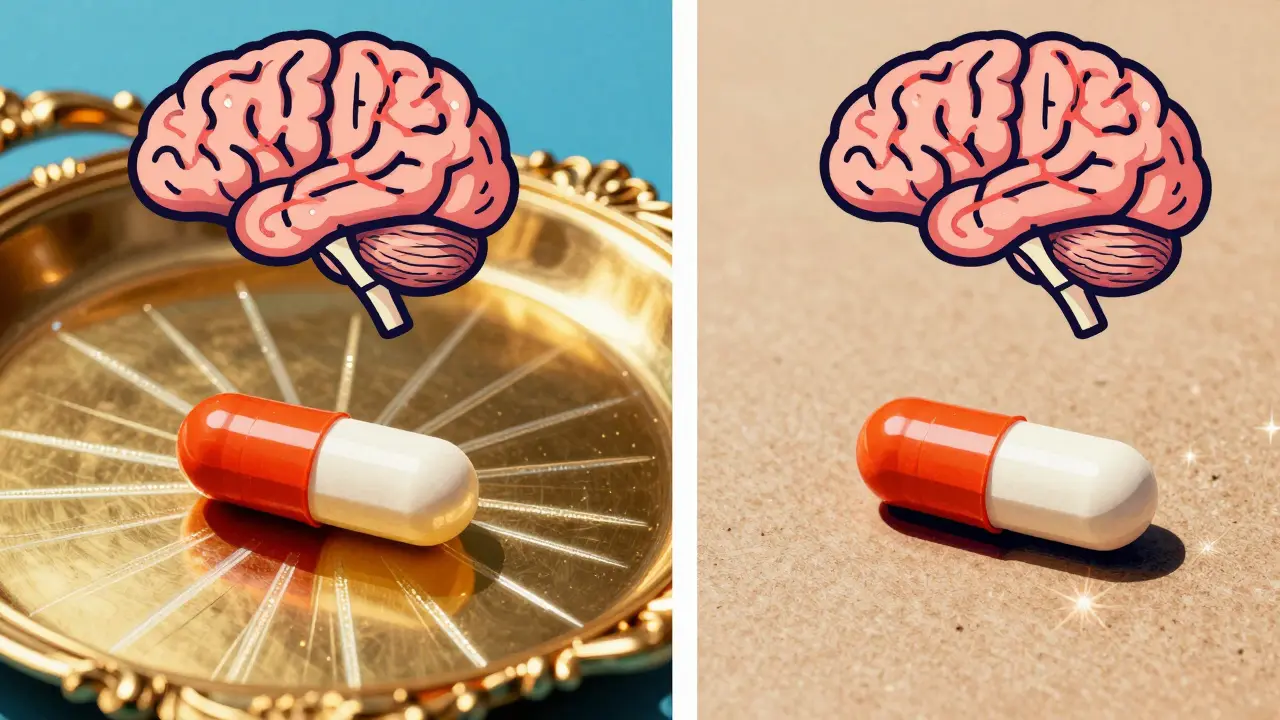
The placebo effect is a fascinating phenomenon where a person's belief in a treatment influences its effectiveness, even when the treatment has no active ingredients. This effect is particularly relevant when switching to generic medications. Research shows that simply changing the label on a pill can alter how patients experience its effects. For example, a sugar pill labeled as a brand-name drug can provide better pain relief than the same pill labeled as generic, even though both are identical.
What the Placebo Effect Really Means for Generic Medications
Placebo effect is a psychological response where belief in a treatment leads to physiological changes isn't just about "thinking" something works. It's a measurable brain activity phenomenon. When patients expect a medication to be effective, their brains release natural painkillers like endorphins. A 2014 study in Health Psychology found that patients given identical placebo pills reported 32.7mm less pain on a visual scale when the pills were labeled as a brand-name drug versus a generic version. This difference comes from the brain's predictive processing, not chemistry.
Generic drugs are chemically identical to brand-name versions. The U.S. Food and Drug Administration (FDA) requires generics to have the same active ingredients, strength, and dosage form. They must also meet strict bioequivalence standards, meaning they deliver the same amount of medicine into the bloodstream as the brand name. However, psychological factors like packaging, price, and perceived quality can change how patients experience the drug.
How Labeling Changes Patient Experience
Brand-name medications often cost more, and patients associate higher price with better quality. This expectation triggers real physiological responses. In one study, healthy volunteers given a placebo labeled as a $2.50 pill reported 64% more pain relief than identical pills labeled as $0.10. This shows how pricing influences perception. For generics, the lower price can accidentally trigger negative expectations. Patients might think, "This must be weaker because it's cheaper," even when the drug is identical.
Brain imaging studies confirm this. When patients receive a placebo labeled as a brand-name drug, their dorsolateral prefrontal cortex (a brain area linked to expectation) activates 27% more than when the same placebo is labeled as generic. This neural activity directly correlates with reported pain reduction. For analgesics like ibuprofen, brand-labeled placebos produced 45.3mm pain reduction on a visual scale, while generic-labeled placebos only achieved 28.1mm. That's a 38% difference purely from labeling.
Real-World Impact on Treatment Success
The placebo effect isn't just about pain relief. It affects adherence and outcomes across many conditions. For antidepressants, patients given generic-labeled sertraline reported 22% higher dropout rates due to perceived inefficacy compared to identical medication with brand-name labeling. In statin trials, patients informed they were taking a generic drug reported muscle pain at 8.7-11.2% rates, compared to 1.9-3.4% when told it was a neutral medication. This "nocebo effect"-where negative expectations worsen side effects-can lead to unnecessary treatment changes.
Long-term adherence suffers too. A study in Annals of Internal Medicine found brand-name users had 18.3% higher 12-month adherence rates for cardiovascular medications despite identical formulations. This matters because poor adherence is a leading cause of treatment failure. For chronic conditions like hypertension or diabetes, missing doses due to perceived ineffectiveness can lead to serious complications.
How Healthcare Providers Can Help
Clear communication can bridge the gap between chemistry and psychology. A 2021 JAMA Internal Medicine study showed a simple 3-minute explanation reduced nocebo responses by 47%. Effective strategies include:
- Explaining FDA bioequivalence standards (90% confidence interval of 80-125% for absorption rates)
- Acknowledging that perception differences may occur psychologically but not pharmacologically
- Providing a 2-week transition period with close monitoring
Healthcare providers trained in these techniques achieved 32% greater success in maintaining generic adherence. The FDA's 2020 consumer guide, "Generic Drugs: Same Medicine, Different Price," has been downloaded 1.2 million times and helps patients understand why generics work the same. Consistent pill appearance also matters-changing color or shape increases nocebo responses by 29%, so manufacturers now maintain consistent designs for generics.
| Medication Type | Brand-Name Placebo Effect | Generic Placebo Effect |
|---|---|---|
| Analgesics | 45.3mm pain reduction (VAS) | 28.1mm reduction |
| Antidepressants | Lower dropout rates | 22% higher dropout rates |
| Statin drugs | 1.9-3.4% muscle pain reports | 8.7-11.2% with generic labeling |
What Patients Can Do
Patients can take control of their expectations. If switching to a generic, ask your doctor or pharmacist to explain the bioequivalence standards. Remember: the FDA tests generics rigorously to ensure they work the same. If you notice changes in how you feel, discuss them before stopping the medication. Sometimes the difference is psychological, not physical.
For example, a patient on generic lisinopril for high blood pressure reported no issues after their doctor explained, "This is chemically identical to the brand name, but costs less. Some people notice small differences at first due to expectations, but it works the same." This simple explanation prevented unnecessary switching.
Frequently Asked Questions
What is the placebo effect in the context of generic medications?
The placebo effect in generic medications occurs when a patient's belief about the drug's effectiveness influences their actual experience. For example, a sugar pill labeled as a brand-name drug may provide better pain relief than the same pill labeled as generic, even though both are identical. This psychological response is due to expectations shaped by branding and pricing.
Do generic drugs work as well as brand-name drugs?
Yes. The FDA requires generics to have the same active ingredients, strength, dosage form, and bioequivalence as brand-name drugs. They must deliver the same amount of medicine into the bloodstream within the same time frame. Clinical studies confirm that generics perform identically in treating conditions when used as directed. The only differences are in inactive ingredients (like fillers) and cost.
Can psychological factors affect how well a generic drug works?
Absolutely. Expectations about a drug's effectiveness can trigger real physiological changes. Studies show patients who believe they're taking a brand-name drug report better symptom relief than those who think they're taking a generic, even when both are identical placebos. This is why clear communication from healthcare providers is crucial-managing expectations helps patients get the full benefit of their medication.
How can healthcare providers address the placebo effect with generics?
Providers can use simple, evidence-based communication strategies. For example, explaining the FDA's bioequivalence standards (90% confidence interval of 80-125% for absorption), acknowledging that perception differences may occur but aren't due to the drug's chemistry, and offering a short transition period with monitoring. A 2021 study showed this approach reduced nocebo responses by 47% in patients switching to generics.
Why do some people feel generics don't work as well?
This often stems from psychological factors, not drug chemistry. Patients may associate lower price with lower quality, or they may notice small differences in pill appearance (like color or shape) that trigger expectations of reduced effectiveness. Studies show that changing pill design increases nocebo responses by 29%. Additionally, if a patient was previously on a brand-name drug, they might expect the generic to feel different simply because it's labeled as such.
What does the FDA say about generic drugs?
The FDA states that generic drugs are "therapeutically equivalent" to brand-name drugs. They must meet the same strict quality, safety, and efficacy standards. Generics undergo rigorous testing to ensure they work the same way in the body. The FDA's "Generic Drugs: Same Medicine, Different Price" guide emphasizes that switching to generics is safe and effective, with no difference in treatment outcomes when used as directed.




February 6, 2026 AT 03:19
Laissa Peixoto
The placebo effect is a powerful demonstration of the mind-body connection. When patients believe a treatment works, their brains release natural painkillers like endorphins. This isn't just 'thinking' it works-it's a measurable physiological response. Understanding this helps us address patient concerns without dismissing their experiences. It's about managing expectations, not denying biology.
February 7, 2026 AT 23:06
Diana Phe
Foreign generics are dangerous. The FDA is corrupt and only approves American-made ones. Anyone saying otherwise is working against the US. This is a plot to undermine our healthcare system!
February 8, 2026 AT 12:52
Danielle Vila
Oh my god, you're so right! Big Pharma is definitely controlling the FDA. They're making generics with fake ingredients to make people sick on purpose. I read online that they add rat poison to generic pills to keep us dependent on brand names. It's all part of the plan!
February 9, 2026 AT 12:29
Nancy Maneely
This is a disaster! Generics don't work at all! I've taken them before and felt awful. The government should ban them immediately. It's a scam to save money while patients suffer!
February 10, 2026 AT 09:59
Thorben Westerhuys
Oh my goodness! This is so important! I can't believe people are saying generics don't work! It's heartbreaking to see how misinformation is spreading. We need to educate everyone about the FDA's strict standards! It's a tragedy!
February 10, 2026 AT 19:53
Pamela Power
The placebo effect is merely a symptom of societal ignorance. Those who rely on generics are unwitting participants in a grand deception orchestrated by pharmaceutical companies. A true connoisseur of medicine would never stoop to such inferior alternatives.
February 12, 2026 AT 10:53
Katharine Meiler
The bioequivalence standards mandated by the FDA (80-125% confidence interval) ensure therapeutic equivalence. However, psychological factors such as branding can modulate clinical outcomes through neurobiological pathways.
February 12, 2026 AT 12:55
Lana Younis
Hey folks, just wanted to say that generics are totally fine! They have to meet the same standards as brand names. Sometimes people think they're different because of the looks or price, but it's all in their head. Just a heads up, ya know?
February 13, 2026 AT 16:00
Tehya Wilson
The FDA confirms generics are therapeutically equivalent to brand-name drugs.
February 15, 2026 AT 06:46
Andre Shaw
Actually, the placebo effect is exaggerated. Studies show that most patients can't tell the difference between generics and brands. The whole thing is a myth perpetuated by big pharma to keep prices high.
February 16, 2026 AT 01:43
Dr. Sara Harowitz
This article is completely wrong! The FDA standards are clear-generics are identical. People who think otherwise are just being irrational! I've seen this in my practice for years. It's time to stop this nonsense!