
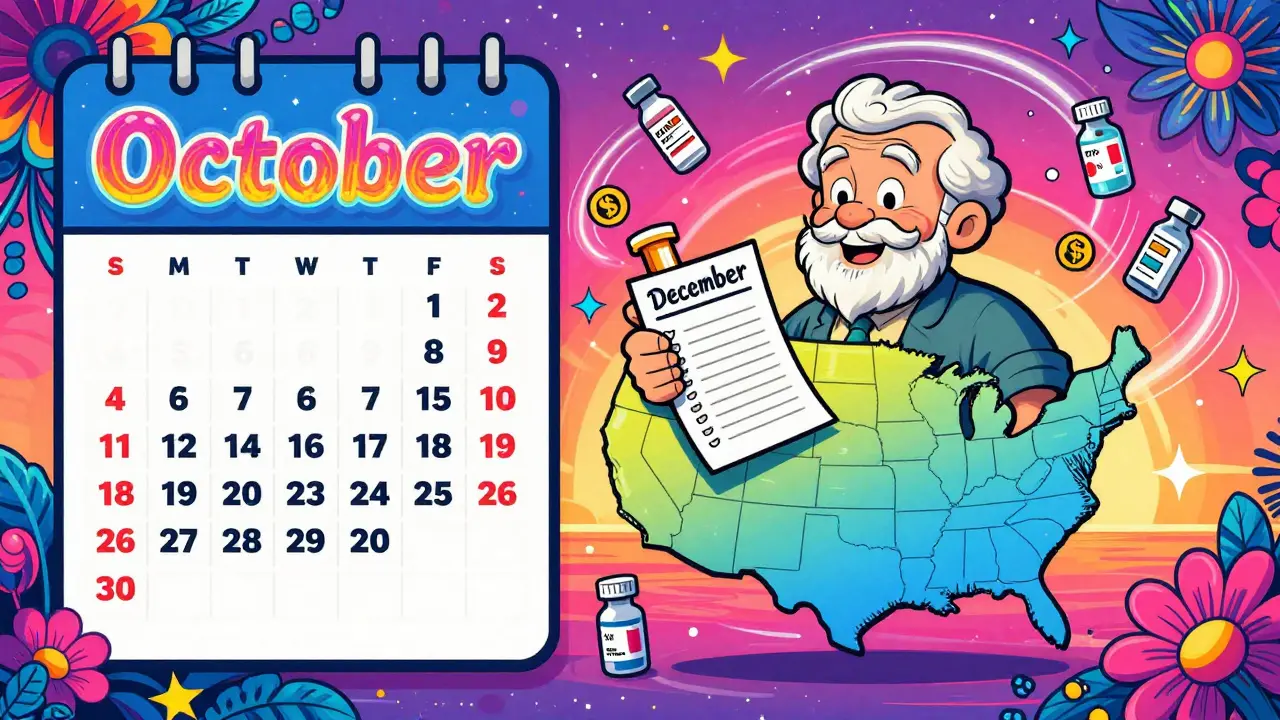
Every year, millions of Medicare beneficiaries miss out on hundreds - sometimes over a thousand - dollars in savings on their medications. Why? Because they don’t review their prescription drug coverage during Annual Open Enrollment. If you take even one medication regularly, this isn’t just a paperwork task. It’s a money-saving window you can’t afford to ignore.
What Is Medicare’s Annual Open Enrollment Period?
Medicare’s Annual Open Enrollment Period (AEP) runs from October 15 to December 7 every year. During these six weeks, you can change your Medicare drug coverage for the next calendar year. Any changes you make take effect on January 1. This isn’t optional. Plans change every year - premiums go up, formularies get rewritten, pharmacies drop out of networks, and your favorite medication might suddenly cost 30% more.
This period was created by the Medicare Modernization Act of 2003 to give beneficiaries control over their coverage. Since 2006, it’s been the only time most people can switch plans without penalty. Missing it means you’re stuck until next year - unless you qualify for a Special Enrollment Period, which is rare.
Why Your Medication Coverage Changes Every Year
Medicare Part D plans and Medicare Advantage plans with drug coverage update their formularies annually. That means the list of drugs they cover, and how much you pay for each, can shift dramatically. In 2024, 60% of Part D plans changed at least one drug’s tier or coverage status. In 2025, 42% of plans increased cost-sharing on specialty drugs like those for diabetes or rheumatoid arthritis.
For example, if you take Ozempic or another GLP-1 drug, your plan might have covered it at Tier 2 last year - meaning you paid $15 per prescription. This year, it could move to Tier 4, costing you $120. That’s a $1,260 annual increase. And it’s not rare. Reddit users in r/medicare reported 29 threads in October 2024 alone about medications moving to higher tiers.
Networks change too. Your local pharmacy might be removed from your plan’s preferred list. Suddenly, filling your prescription costs $40 instead of $12. Or your insurer adds prior authorization for your blood pressure med - now you need a doctor’s note every time you refill.
Know the Difference Between Medicare Parts
Before you compare plans, understand your options.
- Original Medicare (Parts A and B) covers hospital and doctor visits but doesn’t include prescription drugs. You must add a standalone Part D plan to get coverage.
- Medicare Advantage (Part C) bundles Parts A, B, and usually D into one plan. Most (90% in 2025) include drug coverage. But they often limit which doctors and pharmacies you can use.
- Part D (Stand-Alone Prescription Drug Plans) only cover medications. You keep Original Medicare and add this plan on top.
Medicare Advantage plans have an out-of-pocket maximum capped at $8,000 in 2025. Original Medicare has no cap. If you take expensive medications, that cap can save you thousands. But if you travel often or see specialists outside your area, Medicare Advantage might not work for you - only 43% of plans offer out-of-network coverage.
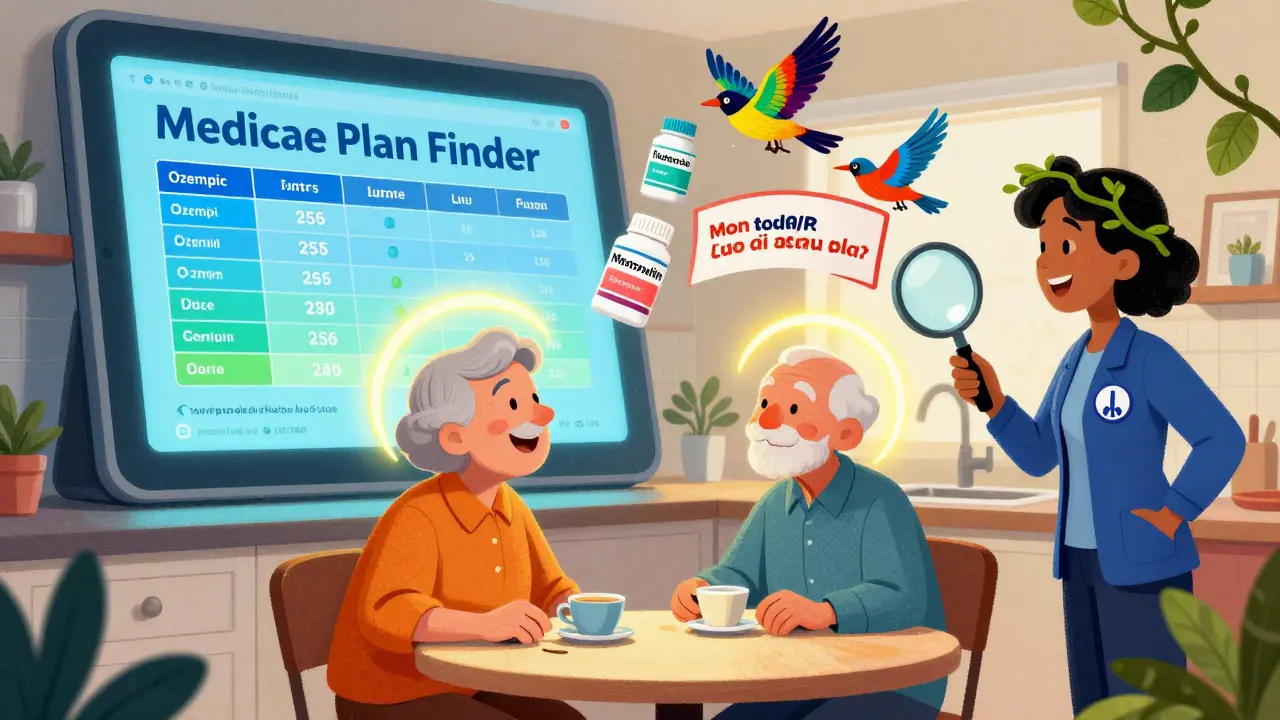
Step-by-Step: How to Plan Your Medication Coverage
Don’t just look at premiums. Look at your actual out-of-pocket costs for the drugs you take. Here’s how to do it right.
- Gather your medication list - October 1-10. Include every drug, dosage, and how often you take it. Don’t forget over-the-counter meds your doctor recommended. Write down the exact brand or generic name. If you take insulin, note the type.
- Get your Annual Notice of Change (ANOC) - October 10-15. Your current plan must send this by September 30. It tells you what’s changing: new premiums, higher deductibles, drugs removed or moved to higher tiers. Read it. Don’t ignore it.
- Use the Medicare Plan Finder - October 15-20. Go to Medicare.gov/plan-compare. Enter your zip code, your medications, and your preferred pharmacy. The tool calculates your estimated annual cost for each plan - including what you pay for each prescription, your deductible, and your out-of-pocket max. It’s the only way to see real savings.
- Check your pharmacy network - October 20-25. If you fill prescriptions at CVS, Walgreens, or a local pharmacy, confirm they’re in-network. Preferred pharmacies often cut your copay by half. If your pharmacy isn’t listed, you’ll pay more - or need to switch.
- Verify supplemental benefits - October 25-30. Some Medicare Advantage plans offer extra perks like dental, vision, or transportation. But 31% of plans have eligibility rules that aren’t clearly shown. If you’re dual-eligible (Medicare + Medicaid), check if the plan still covers your benefits.
On average, this process takes 3.7 hours. Most people need help. Call your State Health Insurance Assistance Program (SHIP). They’re free, local, and trained to walk you through this. There are over 9,400 counselors across the U.S.
What to Watch for in 2026
Starting January 1, 2026, Medicare Advantage plans must cover all Part B drugs administered in outpatient settings - like chemotherapy or infusions. That’s new. Also, the Medicare Plan Finder tool will now show a “total cost” estimate based on your exact drug list, not just average prices.
Insulin is capped at $35 per month in 2025 - and that cap stays in place. The Part D coverage gap (donut hole) is fully closed. You’ll still pay 25% for brand-name drugs in the catastrophic phase, but you won’t hit a spending wall anymore.
But premiums are expected to rise 4.2% in 2026 due to new drug pricing rules. That’s why reviewing your plan matters more than ever. A plan with a $5 lower premium might cost you $300 more in drug costs.

Common Mistakes and How to Avoid Them
- Mistake: Only comparing monthly premiums. Solution: Use the Plan Finder’s total cost calculator. A $0 premium plan with a $590 deductible and high copays can cost more than a $40/month plan with low copays.
- Mistake: Assuming your current plan is still the best. Solution: Even if you’re happy, compare. Justice in Aging found beneficiaries who reviewed plans saved $532 on average per year.
- Mistake: Missing the December 7 deadline. Solution: Set two calendar reminders - one for October 15 and one for December 1. Enroll by December 7, not 8.
- Mistake: Not checking for formulary changes. Solution: Download your ANOC and compare it to last year’s. If your drug moved from Tier 2 to Tier 4, it’s time to switch.
One woman in Charleston switched from a $48/month Part D plan to a $21/month plan after discovering her metformin moved to Tier 1. She saved $780 a year. That’s not luck. That’s planning.
What If You Miss Open Enrollment?
If you miss December 7, you’re locked in until next year - unless you qualify for a Special Enrollment Period. Those are rare. They only happen if you move, lose other coverage, or become eligible for Medicaid. No exceptions.
There’s a second window - Medicare Advantage Open Enrollment Period (MAOEP) - from January 1 to March 31. But you can only switch from one Medicare Advantage plan to another. You can’t add or drop Part D coverage. And you can only do it once.
So don’t rely on this. AEP is your only full reset.
Final Tip: Don’t Wait Until the Last Minute
Most people wait until late November to start. That’s when the Medicare Plan Finder crashes from traffic. Call SHIP early. Print your medication list. Compare three plans. Pick the one that costs the least for your drugs - not the one with the lowest premium.
The average beneficiary saves $532 a year by reviewing coverage. Some save over $1,200. That’s a new TV. A weekend trip. A year’s supply of over-the-counter pain relievers. It’s not about the plan. It’s about your wallet. And your health.
Can I change my Medicare drug plan after December 7?
No, you cannot change your Medicare drug plan after December 7 unless you qualify for a Special Enrollment Period - like moving out of your plan’s service area or losing other coverage. Outside of those rare situations, you’re locked in until the next Annual Open Enrollment Period in October.
What if my medication is no longer covered?
If your medication is removed from your plan’s formulary or moved to a higher tier, you must switch plans during Annual Open Enrollment. You can request a formulary exception from your current plan, but approval is not guaranteed. Switching plans is the most reliable way to ensure continued access at an affordable cost.
Is the Medicare Plan Finder tool free to use?
Yes, the Medicare Plan Finder tool is completely free and provided by the Centers for Medicare & Medicaid Services (CMS). It compares all available Part D and Medicare Advantage plans in your area based on your medications, pharmacy preferences, and zip code. No sign-up or personal data is required to use it.
Do I need to enroll in Part D if I’m on Medicare Advantage?
No, if your Medicare Advantage plan includes prescription drug coverage (which 90% do), you don’t need a separate Part D plan. In fact, having both is not allowed and could cause billing issues. Always check your plan’s Evidence of Coverage to confirm drug coverage is included.
What is the Part D coverage gap, and does it still exist in 2026?
The Part D coverage gap, also called the “donut hole,” was a phase where beneficiaries paid 100% of drug costs after reaching a certain spending threshold. As of 2025, the Inflation Reduction Act fully closed this gap. In 2026, you’ll pay no more than 25% coinsurance for brand-name and generic drugs throughout the entire coverage cycle - even after reaching the initial coverage limit.
Can I switch Medicare Advantage plans during the year?
Yes, but only during one limited window: January 1 to March 31. This is called the Medicare Advantage Open Enrollment Period (MAOEP). You can switch from one Medicare Advantage plan to another or return to Original Medicare. You cannot add or drop a Part D plan during this time. You can only make one change during this period.
How do I know if my pharmacy is in-network?
Use the Medicare Plan Finder tool and enter your pharmacy’s name and zip code. The tool will show whether it’s preferred, standard, or out-of-network. Preferred pharmacies usually offer the lowest copays. If your pharmacy isn’t listed, call your plan directly - some plans include pharmacies not yet updated in the online tool.
Are there free resources to help me compare plans?
Yes. Every state has a State Health Insurance Assistance Program (SHIP) that offers free, one-on-one counseling. You can also call 1-800-MEDICARE (1-800-633-4227) or visit Medicare.gov. Counselors help you understand formularies, networks, and out-of-pocket costs - no sales pitch, no pressure.
If you take medications regularly, your annual open enrollment isn’t just a formality - it’s your best chance to control costs. Don’t assume your plan is still the best. Don’t wait until the last minute. Review your drugs, compare your options, and act before December 7. Your wallet - and your health - will thank you.




January 16, 2026 AT 13:03
Dan Mack
They don't want you to know this but the government secretly pushes these changes so you'll keep paying more. I saw a guy on YouTube who said his insulin went from $5 to $120 overnight because of a backroom deal with Big Pharma. They're laughing all the way to the bank while you're choosing between food and meds.
January 16, 2026 AT 22:38
Ayush Pareek
You're not alone in feeling overwhelmed. I helped my uncle navigate this last year - he was terrified of making a mistake. Took him 45 minutes with SHIP, found a plan that saved him $600. You got this. Just start with Step 1: write down your meds. One step at a time.
January 18, 2026 AT 14:31
Nicholas Urmaza
Stop wasting time reading fluff. If you're on insulin or Ozempic, you don't need a 10-step guide. You need to compare plans RIGHT NOW. The Plan Finder is free. Your life is not. Don't wait for November. Do it today or pay the price later. No excuses.
January 19, 2026 AT 03:59
Sarah Mailloux
I used to ignore this every year until my dad got hit with a $900 bill for his blood pressure med. Now I set a calendar reminder every October 1. It takes an hour. Saves hundreds. I even made a checklist. DM me if you want it - happy to share.
January 19, 2026 AT 07:49
Nilesh Khedekar
Ah yes, the sacred Annual Open Enrollment... where the government gives you 44 days to decipher a maze designed by lawyers who got paid by pharmaceutical lobbyists. And you think the Plan Finder is 'free'? It's free like a free sample at Costco - you're still gonna buy the $200 jar of pickles anyway.
January 20, 2026 AT 16:12
Jami Reynolds
You didn't mention the real issue: Medicare Advantage plans are being quietly phased out to force everyone into Part D. The 90% statistic is misleading - many plans are being discontinued. If you're on one, you're being herded. Check your EOC carefully - they hide the fine print in 8-point font. I've seen it happen to three people in my neighborhood.
January 22, 2026 AT 06:16
RUTH DE OLIVEIRA ALVES
The structural integrity of the Medicare Part D system is predicated upon a complex interplay of federal regulation, pharmaceutical pricing mechanisms, and regional pharmacy network agreements. It is imperative that beneficiaries conduct a granular, line-item comparison of formulary tiers, prior authorization requirements, and out-of-network surcharges, as opposed to relying on heuristic approximations or emotionally driven decision-making. The consequences of inaction are both fiscal and physiological.
January 22, 2026 AT 07:10
Nat Young
Everyone's acting like this is a crisis. It's not. The average savings is $532? That's less than a new pair of sneakers. And 42% of plans increased costs on specialty drugs? So what? You think Big Pharma cares? They'll just raise prices again next year. This whole system is a scam. You're just rearranging deck chairs on the Titanic while they print more money. Why are we even pretending this is fixable?