
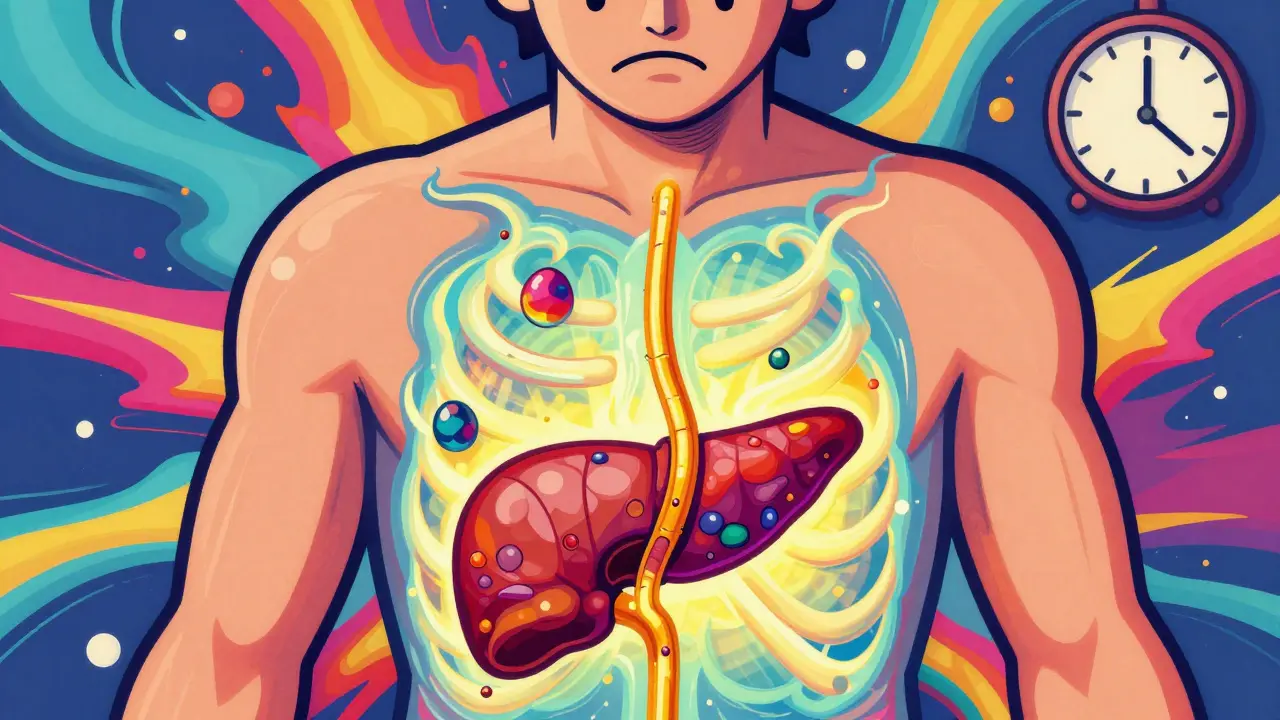
If you’ve ever had sudden, intense pain under your right ribs that came out of nowhere and lasted for hours, you might have experienced biliary colic. It’s not gas. It’s not indigestion. It’s your gallbladder screaming because a stone got stuck. And if that stone doesn’t move, things can get serious-fast.
About 10 to 15% of adults in the U.S. have gallstones. But here’s the twist: 80% of them never feel a thing. They live their whole lives without knowing they’re carrying them. The problem starts when those stones block the ducts that carry bile out of the gallbladder. That’s when pain hits, and complications like cholecystitis or pancreatitis can follow.
What Happens When a Gallstone Gets Stuck?
Biliary colic isn’t a disease-it’s a symptom. It happens when a gallstone temporarily blocks the cystic duct, the pipe that lets bile flow out of the gallbladder. When that happens, the gallbladder contracts hard trying to push bile through, but nothing moves. The result? Sharp, steady pain in the upper right abdomen or just below the breastbone. It usually starts suddenly, peaks within an hour, and lasts 1 to 5 hours. It doesn’t get better with burping, vomiting, or going to the bathroom. And it doesn’t come and go like a stomach virus.
Most stones are made of cholesterol (80% of cases in Western countries). The rest are pigment stones, made from bilirubin. These form when bile doesn’t empty properly, or when your liver dumps too much cholesterol or bilirubin into bile. Obesity, rapid weight loss, pregnancy, and being over 40 all raise your risk. Women are 2 to 3 times more likely to get them than men.
When Biliary Colic Turns Into Cholecystitis
If the stone doesn’t move after several hours, the gallbladder gets inflamed. That’s acute cholecystitis. It’s no longer just pain-it’s infection. Fever, nausea, vomiting, and tenderness when you press on your right side are signs. The gallbladder swells, and bacteria from the gut can creep in. Left untreated, it can rupture. That’s an emergency.
Studies show about 20% of people who have one episode of biliary colic will develop cholecystitis. And if you’ve had one episode, there’s a 90% chance you’ll have another within 10 years. Two out of three will have a second episode within just two years. That’s not luck. That’s a ticking clock.
Complications don’t stop there. Stones can slip into the common bile duct, blocking it and causing jaundice (yellow skin), dark urine, and pale stools. Or they can block the pancreatic duct, triggering pancreatitis-a dangerous inflammation that can be life-threatening. The NHS reports that 20 to 30% of people with untreated symptomatic gallstones end up in the hospital within five years.
How Doctors Diagnose It
It starts with symptoms. But confirmation? That’s usually an ultrasound. It’s quick, safe, and picks up stones in over 95% of cases. If there’s doubt, doctors might order a CT scan or an MRCP (magnetic resonance cholangiopancreatography) to see the bile ducts in detail. Blood tests can show signs of infection or liver stress-elevated liver enzymes, white blood cell count, or bilirubin levels.
But here’s the problem many patients face: diagnostic delays. A 2022 Healthline survey found 41% of people saw three or more doctors before getting the right diagnosis. Pain gets written off as acid reflux. Or blamed on stress. Or dismissed as "just aging." By the time the right test is ordered, the gallbladder is already inflamed.

Can You Dissolve Gallstones Without Surgery?
Yes-but only sometimes.
The drug ursodeoxycholic acid (UDCA) can dissolve small cholesterol stones over 6 to 24 months. But it works in only 30 to 50% of cases. And even if it does, half of those stones come back within five years. It’s not a cure. It’s a temporary fix, usually only offered to people who can’t have surgery.
Shock-wave lithotripsy-breaking stones apart with sound waves-used to be popular in the 1990s. But it required multiple sessions, expensive equipment, and still left fragments that could re-form stones. Today, it’s rarely used. The recurrence rate is too high.
There’s also no proven benefit from herbal remedies, apple cider vinegar, or gallbladder flushes. These aren’t just ineffective-they can be dangerous. Pushing stones around without medical supervision can cause blockages, infection, or even pancreatitis.
The Gold Standard: Laparoscopic Cholecystectomy
For most people with recurrent biliary colic or cholecystitis, surgery is the only real solution. And the standard procedure? Laparoscopic cholecystectomy.
This isn’t open surgery with a big cut. It’s four small incisions. A camera and tools go in. The gallbladder is carefully detached and removed. In the U.S., 90% of gallbladder removals are done this way. Why? Because it works.
- Average hospital stay: 1.2 days (vs. 4.7 days for open surgery)
- Recovery time: 7 days (vs. 30 days)
- Return to work: Often within a week
- Complication rate: Below 2% in experienced hands
According to Dr. David Flum of the University of Washington, laparoscopic cholecystectomy has a 95% patient satisfaction rate. People don’t just stop having pain. They stop worrying about it. They eat normally again. They sleep through the night.
But timing matters. The Society of American Gastrointestinal and Endoscopic Surgeons (SAGES) says if you have acute cholecystitis, surgery should happen within 72 hours. Delaying increases the chance the surgeon will have to switch to open surgery-from 25% down to just 7% when done early.
Who Shouldn’t Have Surgery?
Surgery isn’t for everyone. For healthy people under 75, the risks are very low. But for older adults with multiple health problems-heart disease, diabetes, lung disease-the risk changes.
Dr. Emily Finlayson from UCSF points out that 30-day mortality for cholecystectomy jumps from 0.1% in healthy patients to 2.8% in those with three or more serious conditions. That’s why doctors now assess each person individually. A 78-year-old with diabetes and COPD might be better off with temporary drainage (like a tube placed through the skin into the gallbladder) and later surgery, if they recover enough.
There’s also a new option: endoscopic ultrasound-guided gallbladder drainage. The FDA approved it in 2023. It’s not a cure, but it’s a bridge. It relieves infection without cutting out the gallbladder-useful for people too sick to handle surgery right away.
What Happens After Surgery?
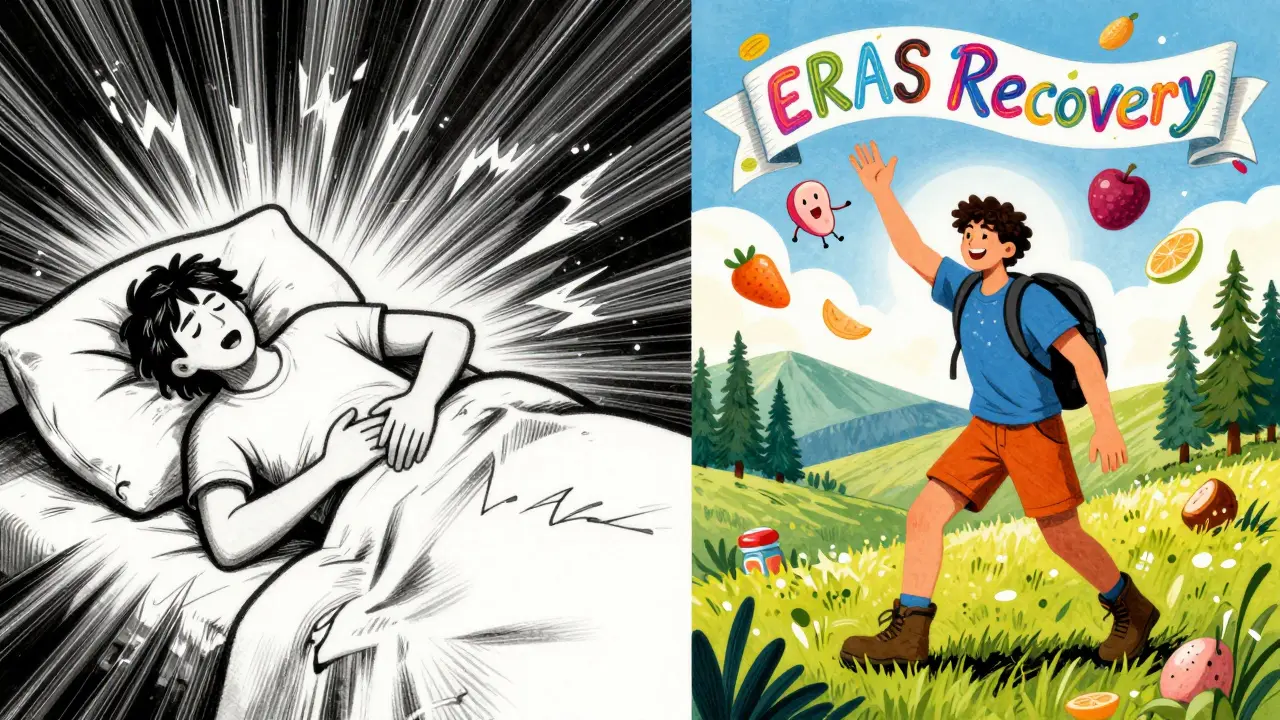
Most people go home the same day or the next morning. You’ll be up and walking within 4 hours. You’ll start sipping water within 6 hours. No IVs. No catheters. No long bed rest.
Some people have loose stools after surgery. About 12% report diarrhea, especially after fatty meals. That’s because bile flows directly into the intestine now, instead of being stored. It usually improves over weeks or months. A few (6%) develop post-cholecystectomy syndrome-ongoing pain, bloating, or nausea. Often, it’s not from the surgery, but from another issue like SIBO or IBS that was masked by the gallstones.
One patient from Cleveland Clinic had 17 episodes of biliary colic over 18 months. After surgery, her pain vanished in 10 days. She was back to hiking and working full-time in two weeks.
The Bigger Picture: Why This Matters
More than 700,000 gallbladder surgeries are done in the U.S. every year. That’s $6.2 billion in costs. And the numbers are rising. Obesity rates are up. People are living longer. And with age comes more gallstones.
Women, especially those who’ve had children, are at highest risk. Hispanic populations have a 45% higher incidence than non-Hispanic whites. That’s not random-it’s tied to diet, genetics, and access to care.
There’s a new trend: single-incision laparoscopic surgery (SILS). It leaves one tiny scar. But it’s harder to do, takes longer, and has a 20% higher complication rate than standard laparoscopy. For now, it’s not the standard.
What’s changing? Recovery protocols. Hospitals are using ERAS (Enhanced Recovery After Surgery) pathways. They get you up faster, feed you sooner, and reduce pain with non-opioid meds. In hospitals using ERAS, hospital stays dropped 30%, and readmissions dropped 25%.
One thing won’t change: surgery remains the best option. Despite advances in pills and drainage, nothing matches the long-term safety and effectiveness of removing the gallbladder when it’s causing problems.
What Should You Do?
- If you’ve had one episode of biliary colic, don’t wait. Talk to a surgeon. The odds of recurrence are high.
- If you have cholecystitis, get surgery within 72 hours. Delaying makes it harder and riskier.
- If you’re over 75 with other health problems, ask about alternatives-but don’t assume surgery is off the table. Many older patients do very well.
- Don’t try home remedies. They don’t work. And they can hurt you.
- If you’re scared of surgery, ask about the procedure. Laparoscopic cholecystectomy is routine. Most people say they wish they’d done it sooner.
Gallstones aren’t a death sentence. But they’re not something you should ignore. The pain is real. The risk is real. And the solution? It’s simple, safe, and life-changing.

February 16, 2026 AT 23:13
Philip Blankenship
Man, I had no idea gallstones were so common. I thought it was just an old-person thing, but 10-15% of adults? Wild. I remember my aunt going through this years ago - thought it was just bad tacos until the ER visit. Now she eats pizza like a champ, no regrets. Surgery was a total game-changer for her. Honestly, if you’ve had one episode, just get it done. No point playing Russian roulette with your insides.
Also, side note: the idea that apple cider vinegar dissolves stones is pure myth. I saw a guy on TikTok try it. He ended up in the hospital. Don’t be that guy.
February 18, 2026 AT 19:37
Oliver Calvert
Cholecystitis needs to be treated fast. Delaying surgery increases the chance of open procedure from 25% to 7% if done within 72 hours. That’s not a small difference. It’s the difference between a week off work and a month in recovery. And yes, laparoscopic is the gold standard. 95% satisfaction rate isn’t hype - it’s data. Skip the supplements. Get the scan. Get the surgery. Simple.
Post-op diarrhea? Yeah, happens. Usually clears up. Bile just flows straight through now. No storage tank. Your gut adapts. Most people don’t even notice after a few months.
February 20, 2026 AT 08:37
Kancharla Pavan
People still believe in gallbladder flushes? Really? You’re going to drink a cup of olive oil and lemon juice and expect your body to magically expel stones like a magic trick? That’s not medicine. That’s a cult. And then you wonder why emergency rooms are packed with people who thought they could outsmart biology.
Obesity. Pregnancy. Over 40. Women. Hispanic populations. These aren’t random stats. They’re consequences of lifestyle, diet, and systemic neglect. We’ve normalized ignoring pain until it’s unbearable. And then we blame the body. Not the system. Not the food industry. Not the lack of preventive care.
Stop romanticizing natural remedies. They’re not alternatives. They’re traps. And if you’re still on the fence about surgery? You’re not being cautious. You’re being stupid.
February 21, 2026 AT 14:37
Dennis Santarinala
So glad this post exists!! I’ve been meaning to write something like this for months. I had my gallbladder out last year after 3 episodes in 8 months - each one worse than the last. The pain? Like someone was twisting a corkscrew in my ribs. No gas. No indigestion. Just pure, unrelenting agony.
And yeah, the recovery? Mind-blowing. I was walking the next day. Ate a burger on day 3. Back to work in 6 days. My surgeon said I was a model patient. I said I was just smart.
Also - the ERAS protocols? YES. I didn’t even need opioids. Just ibuprofen and walking. That’s the future. We’re not stuck in the 90s anymore. Surgery isn’t a horror story. It’s a reset button.
And to anyone saying ‘I’ll wait’ - you’re not waiting. You’re just counting down to the next attack. Trust me. Do it sooner.
February 21, 2026 AT 23:39
Tony Shuman
They say surgery is the gold standard. But what about all the people who just… don’t have symptoms? 80% of people with stones never feel a thing. So why are we pushing surgery like it’s a vaccination?
And let’s talk about the $6.2 billion. Who’s really profiting here? Hospitals? Insurance companies? Surgeons? I’m not saying don’t operate - but why is this so aggressively marketed? Why is every doctor pushing it like it’s the only option?
Also - laparoscopic is great. But I’ve heard horror stories about internal scarring. Adhesions. Long-term digestive issues. They downplay it. It’s not 2% complication rate for everyone. It’s 2% for the healthy ones. What about the rest?
Just saying - don’t let fear drive you into the OR. Do your own research. Don’t trust the hype.
February 22, 2026 AT 17:55
Haley DeWitt
OMG YES. I had my gallbladder out last winter and I’m so glad I did!! 🙌 I thought it was just stress or bad sushi for months. Then one night I couldn’t breathe from the pain. My husband called 911. 😱
Recovery was easier than I thought. I was back to yoga in 10 days. And now I eat cheese like a normal human again. No more holding back. No more panic attacks before meals.
Also - the diarrhea thing? Totally real. I still get a little gurgly after buttery pasta, but it’s SO worth it. I sleep through the night now. 🛌✨
To anyone scared: just talk to your surgeon. They’ll walk you through it. You’re not alone. 💕
February 23, 2026 AT 07:22
Prateek Nalwaya
What fascinates me is how biology doesn’t care about our convenience. The gallbladder isn’t a luxury. It’s a reservoir. A buffer. But we treat it like a disposable filter. And when it fails, we just… remove it. Like replacing a broken battery.
Yet somehow, the body adapts. It’s not perfect - bile just flows constantly - but we learn to live with it. We don’t need the tank. We just need the flow.
It makes me wonder - how many other organs are we removing because we’ve outgrown their function? Tonsils? Appendix? Maybe someday we’ll look back and say, ‘Why did we think we needed a gallbladder?’
Evolution didn’t design us for cheeseburgers and 3 a.m. takeout. But we adapt. We survive. We heal. And that’s the real miracle.
February 23, 2026 AT 20:32
Jonathan Ruth
Ursodeoxycholic acid? That’s a joke. 30-50% success? Half come back? So you’re telling me I spend two years on a pill that doesn’t even work half the time and then I still have to get surgery? Why not just skip the middleman and go straight to the solution?
And don’t even get me started on the ‘herbal flush’ crowd. You think you’re being holistic? You’re just a walking ER visit waiting to happen. I’ve seen it. A guy drank 3 liters of olive oil. Ended up with pancreatitis. Broke his ribs from vomiting. Paid $12K. All for a ‘natural cure.’
Surgery isn’t scary. It’s efficient. It’s clean. It’s over in a day. Stop romanticizing pain. Stop glorifying pseudoscience. Just. Get. It. Done.
February 25, 2026 AT 19:42
PRITAM BIJAPUR
There’s something deeply poetic about the gallbladder - a quiet organ, storing bile, waiting patiently, until one day, it screams. Not with words. With pain. With fire. With a body that’s been whispering for months, ‘Something’s wrong.’ And we ignore it until it explodes.
It’s a metaphor, really. We store things. Emotions. Stress. Trauma. We think we can hold it all. But eventually, the ducts clog. The pressure builds. And we collapse.
Surgery isn’t just about removing a stone. It’s about releasing what’s been clogging us. The pain? It was a message. The surgery? The answer.
And yes - I cried after mine. Not from pain. From relief. Like I’d been holding my breath for years.
February 26, 2026 AT 11:23
John Haberstroh
One thing nobody talks about: the post-op cravings. I used to avoid fatty food like it was poison. Now? I eat buttered toast with glee. It’s weird. My body didn’t ‘miss’ the gallbladder. It just… adapted. And now I don’t have to plan meals around my fear.
Also - the fact that 41% of people see three+ doctors before diagnosis? That’s insane. Pain gets dismissed. Especially in women. ‘It’s just PMS.’ ‘You’re stressed.’ ‘You’re overthinking.’
And then you end up in the ER, doubled over, while someone writes you a prescription for Tums.
Advocate for yourself. Demand an ultrasound. Don’t let bias delay your care. Your gallbladder doesn’t care if you’re ‘too young’ or ‘too healthy.’ It’s just doing its job. Until it can’t.
February 27, 2026 AT 23:26
James Lloyd
Let’s talk about the 6% who get post-cholecystectomy syndrome. It’s real. But here’s the kicker - most of those cases aren’t from the surgery. They’re from SIBO, IBS, or bile acid malabsorption that was masked by the stones. The gallbladder pain was a smokescreen.
So if you’re still hurting after surgery? Don’t assume it’s the operation. Go back. Get tested. There’s probably another root cause. And it’s treatable.
Also - the 700,000 surgeries a year? That’s not over-treatment. That’s recognition. We finally stopped pretending gallstone pain is ‘just gas.’ We’re listening to the body. That’s progress.
February 28, 2026 AT 08:07
Sam Pearlman
Okay but… what if I just… don’t want to get cut open? Like… what if I’m scared? Is that invalid? I’ve had two episodes. I’m 32. Female. Healthy. But the thought of surgery? I freeze.
Is it okay to wait? To try supplements? To just… live with it? I don’t want to be that person who ignores their health. But I also don’t want to feel like I’m being bullied into surgery because the internet says so.
Can someone just… tell me it’s okay to be scared? And that I still deserve to be heard?
March 1, 2026 AT 20:44
Steph Carr
Wow. I love how this post doesn’t just dump facts - it tells a story. The gallbladder as a screaming, silent witness to our bad life choices. The stone as a tiny, stubborn rebel. The surgery as a quiet act of self-respect.
Also - ‘Don’t try home remedies. They don’t work. And they can hurt you.’
That line? That’s the whole damn thesis.
I used to think alternative medicine was about empowerment. Now I think it’s about exploitation. Selling hope to people in pain. While the real solution - simple, safe, effective - sits quietly in the OR.
Do the thing. Get the scan. Get the surgery. Then go eat a taco. You earned it.
March 3, 2026 AT 06:46
Philip Blankenship
Replying to Sam Pearlman - you’re not alone. Being scared is valid. I was terrified too. But I talked to my surgeon for 20 minutes. He didn’t push. He just showed me my ultrasound. Said, ‘This isn’t going away. It’s going to get worse.’
And he was right. My second episode was worse. I was in the ER for 6 hours. They gave me morphine. I cried. I asked, ‘Why didn’t I just do this sooner?’
It’s not about being brave. It’s about being kind to yourself. Surgery isn’t punishment. It’s peace.