

When you're trying to lose weight or keep it off, you might think calories are the only thing that matters. But what if the secret isn’t just eating less-it’s eating differently? One of the most overlooked tools in weight management isn’t a pill, a shake, or a fancy app. It’s fiber. Not just any fiber, but the right kind. And there are two main types: soluble and insoluble. They do very different things in your body-and only one of them truly helps you control your appetite and shed pounds.
What Exactly Is Fiber, Anyway?
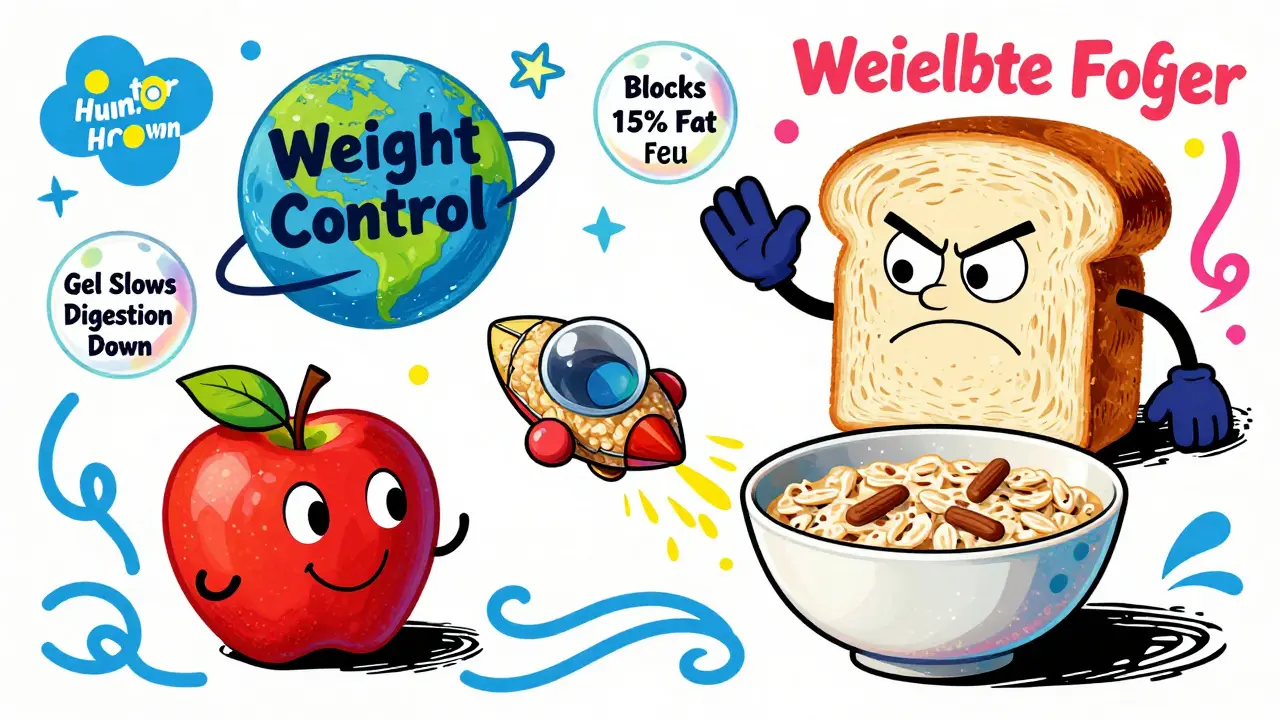
Fiber is the part of plant foods your body can’t fully digest. It passes through your stomach and intestines mostly unchanged. That doesn’t mean it’s useless. On the contrary, fiber plays a huge role in how your body handles food, blood sugar, and hunger. The key is understanding the difference between the two types.Soluble fiber dissolves in water. Think of it like a sponge soaking up liquid. It turns into a thick, gel-like substance that slows digestion. Insoluble fiber? It doesn’t dissolve at all. It’s more like roughage-adding bulk to your stool and helping things move through your system faster. Both are important. But if you’re focused on weight control, soluble fiber is the one you need to pay attention to.
How Soluble Fiber Helps You Lose Weight
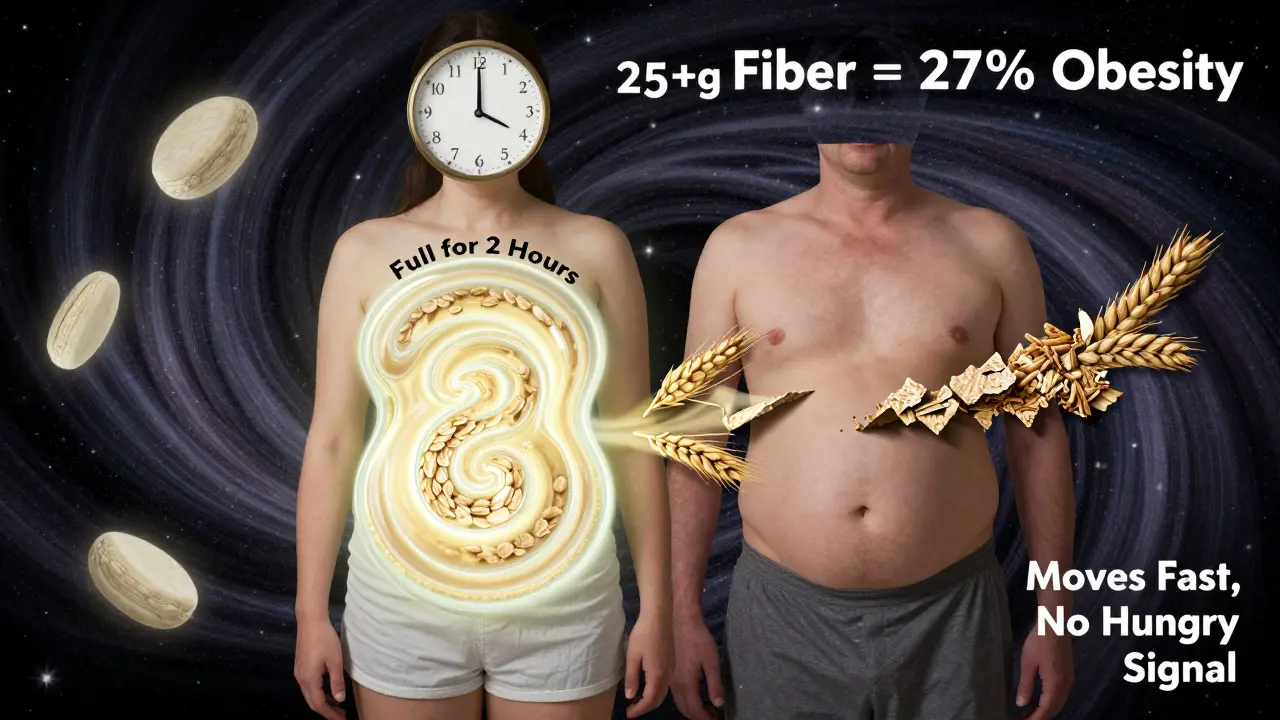
Soluble fiber doesn’t just make you feel full. It changes how your body works. When you eat foods rich in soluble fiber-like oats, beans, apples, or psyllium husk-it forms a gel in your stomach. This gel slows down how fast food leaves your stomach. Studies show this can delay gastric emptying by 25-30%. That means you feel full longer. One meal might keep you satisfied for an extra hour or two.That gel also gets in the way of fat absorption. Research shows soluble fiber can block about 15-20% of dietary fat from being absorbed. That’s not a magic bullet, but over time, those extra calories add up. If you’re eating 2,000 calories a day and 15% of your fat intake gets blocked, that’s roughly 100-150 fewer calories absorbed daily. Over a month? That’s over 3,000 calories-close to a pound of fat.
But the real game-changer is how soluble fiber affects your hunger hormones. Viscous soluble fibers like psyllium, beta-glucans, and glucomannan trigger the release of peptide YY and GLP-1-hormones that tell your brain, “I’m done eating.” At the same time, they reduce ghrelin, the hunger hormone. A 2023 study in PMC10253086 found that people taking psyllium supplements lost 3.2% of their body weight over eight weeks, compared to just 1.1% in the placebo group. That’s not luck. That’s biology.
Insoluble Fiber: The Unsung Hero (But Not for Weight Loss)
Insoluble fiber is essential-but not because it helps you lose weight. It’s essential because it keeps your gut running smoothly. Found in whole wheat, bran, nuts, seeds, and vegetables like celery and broccoli, insoluble fiber adds bulk to stool and speeds up transit time through your intestines. It reduces constipation. It lowers your risk of diverticulitis. It’s vital for long-term health.But here’s the catch: it doesn’t slow digestion. It doesn’t form a gel. It doesn’t affect hunger hormones. It doesn’t block fat. A 2023 analysis from the American Institute for Cancer Research found that insoluble fiber had no measurable effect on appetite, calorie intake, or body weight. Its job is to move things along-not to make you feel full.
That doesn’t mean you should ignore it. You still need it. But if your goal is weight control, soluble fiber is your priority. Think of insoluble fiber as the foundation. Soluble fiber is the upgrade.
Which Soluble Fibers Work Best?
Not all soluble fibers are created equal. Some are more viscous-meaning they form thicker gels-and those are the ones that deliver the biggest weight control benefits.- Psyllium husk: The most researched. Absorbs up to 50 times its weight in water. In clinical trials, it led to the greatest weight loss among fiber supplements.
- Beta-glucans: Found in oats and barley. They don’t just help with weight-they improve blood sugar control, reducing those sugar crashes that lead to cravings.
- Glucomannan: From the konjac root. It’s so effective at expanding in the gut that it’s used in weight-loss supplements. One study showed 1 gram taken before meals reduced calorie intake by 10-15%.
- Pectins: Naturally found in apples and citrus fruits. They’re mild but effective, especially when eaten with whole foods.
- Inulin: Often added to processed foods. It’s good for gut bacteria but doesn’t create the same thick gel as psyllium or glucomannan. Its weight-loss effects are modest.
Psyllium stands out. In the same 2023 study, psyllium users saw a 2.1% drop in BMI and a 4.3% reduction in visceral fat-the dangerous fat around your organs. That’s more than double the effect of placebo.
Whole Foods vs. Supplements
You’ve probably seen fiber supplements on the shelf. Psyllium capsules. Inulin powders. Guar gum sticks. They work. But experts agree: whole foods beat supplements every time.Why? Because fiber doesn’t work alone. When you eat an apple, you get fiber, water, vitamins, antioxidants, and natural sugars-all working together. That food matrix makes the fiber more effective. A 2023 Healthline survey of 1,245 people found that 63% of those who successfully lost weight with fiber did it by eating more whole foods-not supplements.
And here’s something most people miss: supplements can backfire. If you take psyllium without enough water, you risk constipation. Some people report bloating, gas, or even intestinal blockages when they jump into supplements too fast. Reddit users on r/loseit reported that 42% of those who tried fiber supplements had initial stomach discomfort. The fix? Go slow.
How to Actually Use Fiber for Weight Control
You don’t need to take a pill. You need a plan.Start slow. If you’re eating 10 grams of fiber a day, don’t jump to 30. Increase by 5 grams per week. Most side effects come from going too fast.
Drink water. For every 5 grams of supplemental fiber, drink 16-24 ounces of water. No exceptions. Fiber without water = constipation.
Time it right. Take 3-5 grams of viscous soluble fiber (like psyllium or glucomannan) 15-30 minutes before your main meals. This maximizes the gel’s ability to slow digestion and reduce hunger. Studies show this cuts calorie intake by 10-15% per meal.
Focus on whole foods first. Aim for two high-fiber meals a day. For example:
- Breakfast: Oatmeal with chia seeds (8g fiber)
- Dinner: Lentil soup with broccoli (10g fiber)
That’s 18 grams right there. Add an apple or pear as a snack? You’re at 25+ grams. That’s the target.
And here’s a pro tip: aim for a 3:1 ratio of insoluble to soluble fiber. That’s what your gut prefers. Whole foods naturally give you this balance. A medium apple has 2.4 grams of fiber-71% soluble. A slice of whole wheat bread has 2 grams-75% insoluble. Eat a variety, and you’ll hit the right mix.
What the Numbers Say
Let’s cut through the noise. What does real science show?A 2023 analysis of 62 studies by the American Institute for Cancer Research found that people who ate 7 grams of viscous soluble fiber daily lost an average of 0.75 pounds and reduced their waistline by 0.25 inches in just 10 weeks. Sounds small? Multiply that over six months. That’s 4-5 pounds and over an inch off your waist. Not bad for a nutrient that costs pennies.
And the bigger picture? People who eat 25+ grams of fiber daily have 27% lower obesity rates than those eating less than 15 grams. That’s not correlation-it’s cause. Fiber changes how your body stores fat, how your gut bacteria behave, and how hungry you feel.
But here’s the truth: fiber alone won’t make you lose weight. It works best when paired with a balanced diet and some movement. It’s not a magic pill. It’s a powerful tool.
The Bottom Line
If you’re serious about weight control, don’t just add fiber. Add the right kind. Soluble fiber-especially viscous types like psyllium, beta-glucans, and glucomannan-slows digestion, reduces hunger, blocks fat, and helps regulate blood sugar. Insoluble fiber keeps you regular, but it doesn’t touch your appetite.Get your fiber from whole foods first: oats, beans, apples, lentils, chia seeds, and vegetables. Use supplements only if you’re falling short. Go slow. Drink water. Time it before meals. And don’t expect miracles. Expect results-slow, steady, and sustainable ones.
Most people quit because they expect quick fixes. Fiber doesn’t work like that. But if you stick with it, your body will thank you-not just for losing weight, but for feeling better every day.






March 4, 2026 AT 07:10
Siri Elena
Oh wow, finally someone who gets it. Not the ‘eat less, move more’ garbage everyone shoves down your throat. Soluble fiber? Yeah, it’s not sexy, but it’s the only thing that actually works without making you hate life.
Psyllium before meals? Genius. I’ve been doing it for six months. Lost 12 pounds without even trying to diet. My cravings just… vanished. Like my brain got an update.
And no, ‘whole foods’ isn’t just a buzzword. It’s science. That apple you’re ignoring? It’s not fiber. It’s a full-spectrum anti-hunger weapon. Supplements? Sure, they help. But they’re like using a spoon to dig a tunnel. Whole foods are the backhoe.
Also, ‘viscous’ isn’t a weird word. It’s the technical term. If you can’t handle that, maybe don’t read a post about biochemistry.
March 5, 2026 AT 03:46
Divya Mallick
Finally! Someone in the West is speaking truth to power. In India, we’ve known this for centuries - sabzi, dal, oats, chia, psyllium - these are not ‘trends,’ they are ancestral wisdom.
You think Western science discovered this? No. They just slapped a lab coat on it and sold it for $39.99 in Amazon bundles.
My grandmother ate 30g of fiber daily - no supplements, no apps, just roti, lentils, and raw mango pickle. She lived to 98. No diabetes. No belly fat. Just quiet, stubborn health.
Meanwhile, Americans think ‘fiber’ means Fiber One bars. Oh honey, that’s just sugar with a dusting of cellulose. You’re not eating fiber. You’re eating marketing.
And if you’re not drinking water with it? Congrats, you’ve created a digestive time bomb. Your colon is screaming. And no, I don’t care if you ‘hate the taste.’ Your body doesn’t care about your preferences.
March 6, 2026 AT 13:48
Pankaj Gupta
There’s a lot of useful information here, and I appreciate the breakdown of soluble versus insoluble fiber. The data cited from the 2023 meta-analysis is particularly compelling - especially the 0.75-pound-per-10-weeks figure, which is statistically significant when aggregated.
One minor correction: the claim that insoluble fiber has ‘no measurable effect’ on appetite is slightly overstated. A 2021 study in the European Journal of Clinical Nutrition showed a modest but significant reduction in snack intake among high-insoluble-fiber consumers, likely due to increased satiety from prolonged chewing and gastric distension.
That said, the primary mechanism for weight regulation remains the viscous gel formation of soluble fibers, particularly psyllium and glucomannan. The hormonal modulation of GLP-1 and PYY is well-documented and reproducible.
Also, the 3:1 insoluble-to-soluble ratio is empirically sound and aligns with the average composition of traditional whole-food diets. This is not anecdotal - it’s evolutionary.
March 7, 2026 AT 22:53
Levi Viloria
Been eating oats with chia every morning for two years. No magic. No drama. Just… less hungry. Like my body finally stopped throwing tantrums.
Used to snack at 3 p.m. like clockwork. Now? I just drink water. Weirdly, I don’t even think about food. It’s like my stomach got a new boss.
Also, I tried psyllium supplements once. Felt like a balloon filled with sand. Now I just eat flaxseed, apples, and beans. Way more chill.
And yeah, water. Always water. I keep a bottle next to my desk. It’s not a suggestion. It’s a law.
March 9, 2026 AT 08:52
Dean Jones
Let’s not romanticize fiber. It’s not a virtue. It’s a biomechanical tool. The body doesn’t care if your fiber comes from ‘ancestral wisdom’ or a capsule. It cares about viscosity, molecular weight, and transit time.
The 15-20% fat absorption block? That’s not ‘blocking.’ That’s competitive inhibition of pancreatic lipase. The gel physically interferes with enzyme-substrate binding. This isn’t mystical. It’s chemistry.
And the ‘3:1 ratio’? That’s a population average from observational studies. Individual gut microbiomes vary wildly. Some people get 80% of their soluble fiber from apples. Others from inulin-enriched protein bars. The outcome isn’t different - the mechanism is.
Also, the claim that whole foods ‘work better’ than supplements? That’s confounded by lifestyle. People who eat whole foods are more likely to sleep better, exercise, and avoid ultra-processed sugar bombs. Fiber isn’t the hero - the entire dietary pattern is.
Don’t confuse correlation with causation. Fiber is a component, not a cure. And if you think it’s ‘easy,’ you haven’t tried eating 30g of fiber without bloat, gas, or existential dread.
March 10, 2026 AT 04:06
Betsy Silverman
I love how this post doesn’t just say ‘eat more fiber’ - it tells you which kind, how, and why. So many people give up because they’re told to ‘add fiber’ and then eat a bunch of bran flakes and wonder why they feel like a balloon.
I started with one tablespoon of psyllium before dinner. First week? Gas city. Second week? Barely noticed. Third week? I didn’t snack after dinner. At all.
Now I do oatmeal with flax, a pear at lunch, and lentils twice a week. No supplements. No stress. Just food that feels like it belongs in my body.
Also, drinking water with it? Non-negotiable. I keep a giant glass on my nightstand. I drink it before bed. It’s my little ritual. Feels like self-care, not a chore.
March 11, 2026 AT 05:40
Ivan Viktor
So… fiber’s the new protein? Cool. I’ll just keep eating bacon and calling it a day. 😴
March 11, 2026 AT 23:33
Zacharia Reda
That’s a great breakdown - especially the part about timing fiber before meals. I’ve been doing that for 4 months now. Took me 3 weeks to get used to the texture, but now I can’t imagine not doing it.
And Ivan, I feel you. Bacon’s great. But have you ever tried bacon with a side of lentil stew? The fiber doesn’t kill the bacon - it just makes you feel like you didn’t just commit a crime against your arteries.
Also, the 10-15% calorie reduction per meal? That’s like getting a free snack every day. Without the guilt. Or the nap.
One thing I’d add: don’t wait until you’re ‘ready’ to start. Just do 5 grams a day for a week. See what happens. Your gut doesn’t need a permission slip.
March 12, 2026 AT 10:16
Jeff Card
I’ve been eating 30g of fiber a day for over a year now. Lost 18 pounds. Didn’t count calories. Didn’t cut carbs. Just ate more beans, apples, oats, and greens.
My biggest mistake? Starting too fast. First week: bloated, gassy, miserable. Took me three tries to get it right.
Now? I feel like my digestion is a well-tuned machine. No crashes. No cravings. Just steady energy.
And honestly? The biggest change isn’t the weight. It’s how I feel after meals. No sluggishness. No guilt. Just… okay.
It’s not about perfection. It’s about consistency. One apple. One cup of lentils. One tablespoon of chia. Over time, it adds up. Like brushing your teeth.