
Why Dust Mites Are Making You Sick
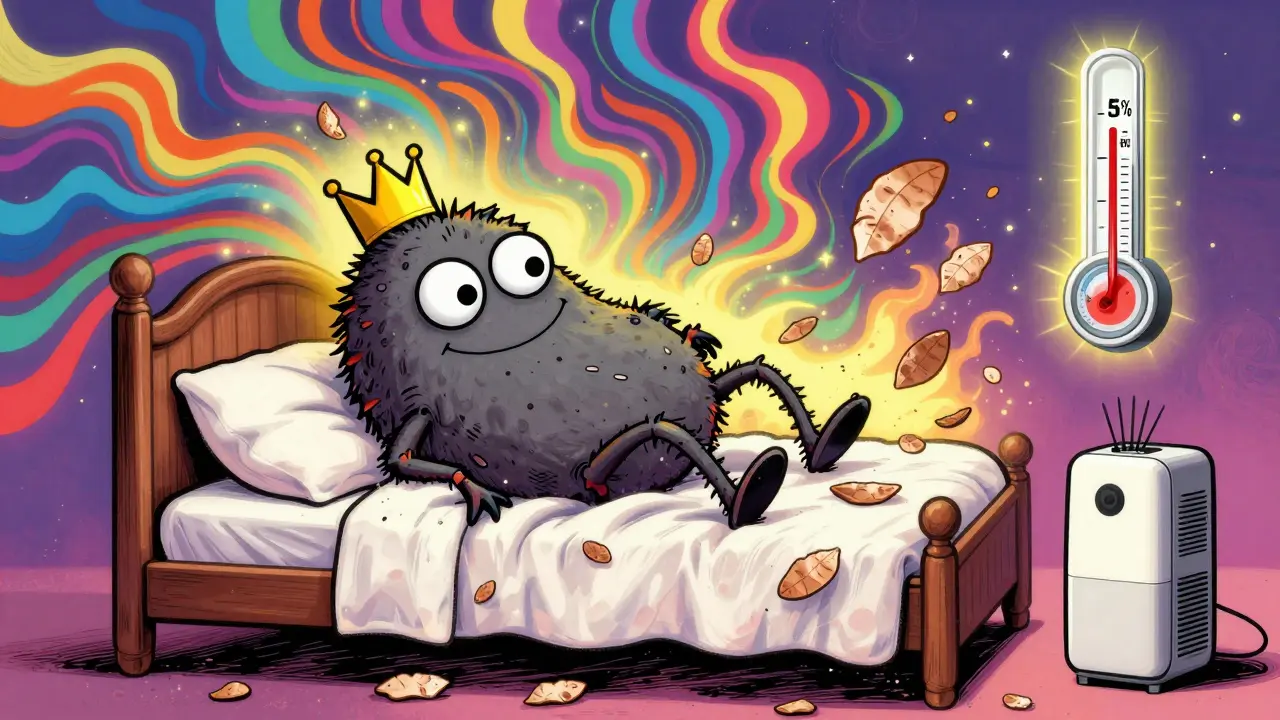
You wake up every morning with a stuffy nose, itchy eyes, or a cough that won’t quit. You’ve tried antihistamines, changed your pillow, even switched to hypoallergenic sheets. But nothing sticks. The real culprit? Dust mites. These tiny bugs - smaller than a grain of sand - live in your mattress, pillows, and blankets, feeding on the skin flakes you shed every night. They don’t bite. They don’t crawl on you. But their waste? That’s what triggers allergies. According to the American College of Allergy, Asthma, and Immunology, dust mite control is the most effective way to cut symptoms for 20 million Americans who suffer year-round.
The Humidity Factor: Your Biggest Ally
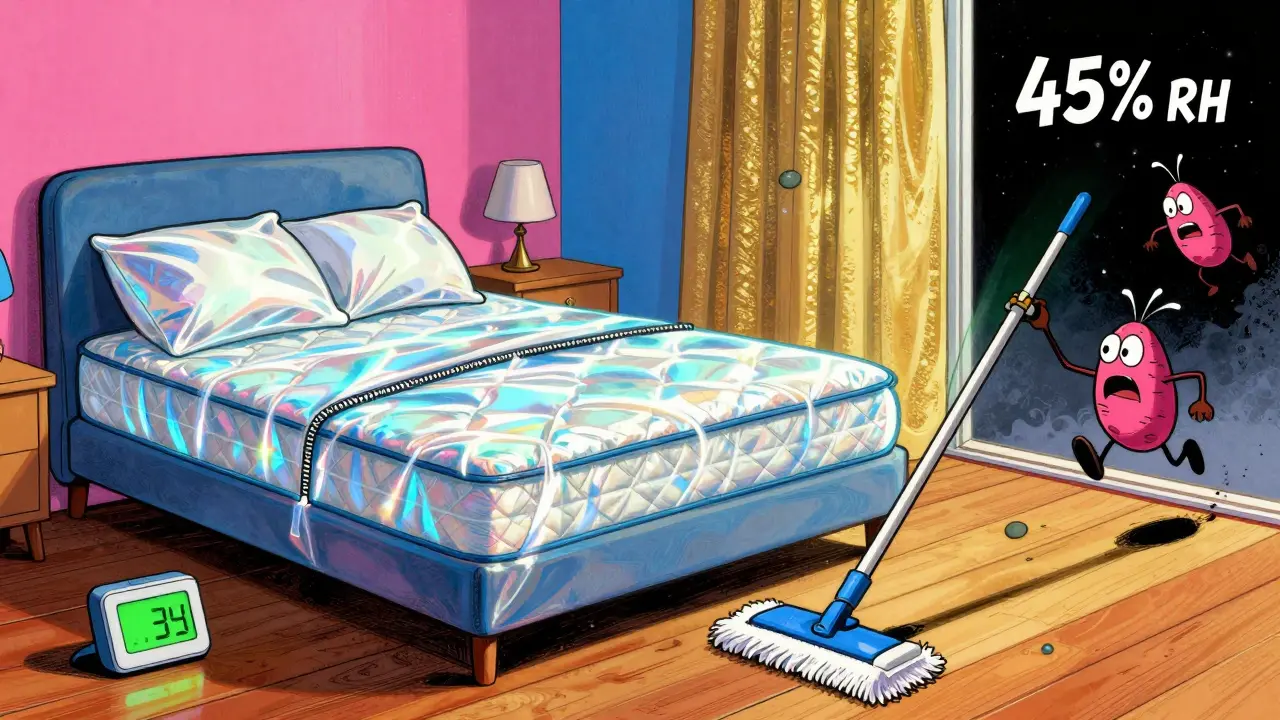
Dust mites need moisture to survive. They don’t drink water - they absorb it from the air. When humidity drops below 50%, they start dying off. At 45% or lower, they can’t reproduce. That’s not a suggestion. It’s a biological fact backed by the National Institute of Allergy and Infectious Diseases and confirmed by multiple peer-reviewed studies.
Most homes sit at 55-65% humidity, especially in bedrooms where people breathe out moisture all night. That’s a paradise for mites. The fix? A digital hygrometer. Not the cheap one from the hardware store. Get one accurate to ±2% RH and place it right next to your bed. If it reads above 50%, you need a dehumidifier. A 30-pint unit in a standard bedroom costs under $150 and can slash mite populations by 90% in two weeks. No chemicals. No sprays. Just dry air.
Some people think turning up the heat will help. It won’t. In fact, heating a room without controlling moisture can make humidity worse. The goal isn’t to make the room hot - it’s to make it dry. Keep your thermostat between 68-72°F and let the dehumidifier do the rest.
Bedding: The Battle Ground
Your bed is ground zero. You spend 6-8 hours a night in direct contact with it. Dust mites multiply there faster than anywhere else. Washing your sheets weekly sounds simple - but most people do it wrong.
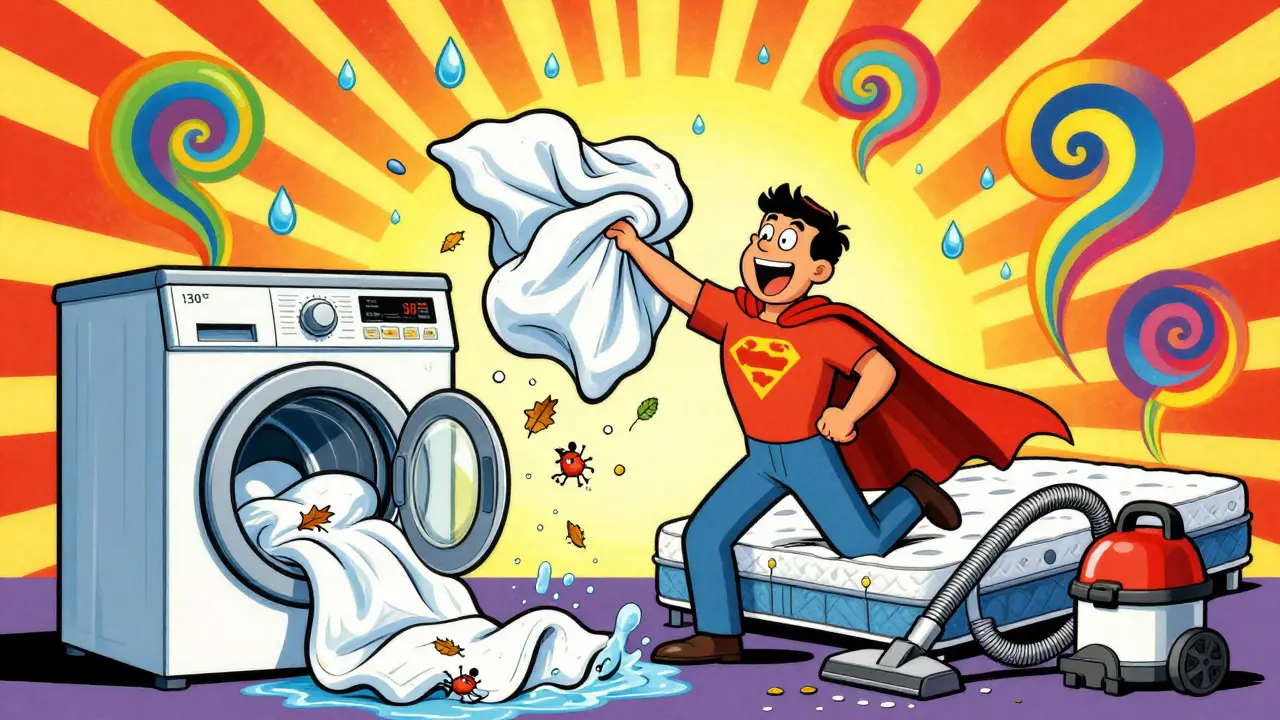
Washing at 90°F? That kills maybe 75% of mites. Washing at exactly 130°F? That kills 100%. Cold water? It does almost nothing. You need heat. You need agitation. You need detergent. The Mayo Clinic says it plainly: 130°F for a full 20-minute cycle with no overcrowding. Don’t stuff the washer. Fill it halfway. Use 30-40ml of regular detergent. Skip the fabric softener - it coats fibers and traps allergens.
After washing, dry everything on high heat for at least 15 minutes. Heat kills mites even if washing didn’t. This is critical for pillows, comforters, and blankets that can’t be washed often. If you can’t wash something (like a stuffed animal), freeze it for 24 hours. That kills mites too. Then vacuum it with a HEPA filter to remove the dead bugs and their waste.
Next, invest in mattress and pillow encasements. Not just any zippered cover. Look for ones certified to block particles 10 micrometers or smaller. Cheap ones tear after a few months. Look for products tested for 10,000 abrasion cycles. These aren’t cheap - $150-$250 for a full set - but they’re the only barrier that stops mites from getting in and allergens from getting out.
Cleaning: What Actually Works
Most people think vacuuming is enough. It’s not. A regular vacuum just kicks dust mite waste back into the air. You need a HEPA vacuum. Not just any model with “HEPA filter” on the box. Look for ones certified by the Asthma and Allergy Foundation of America. These trap 99.97% of particles down to 0.3 microns.
How to vacuum right? Move slowly - one foot per second. Focus on seams, crevices, and under the bed. Vacuum your mattress, too. Do it weekly. Don’t skip weekends. Dust mites rebuild colonies fast.
Hard floors? Damp mop them every week. Dry sweeping spreads allergens. A slightly damp microfiber mop traps them. Avoid carpets entirely if you can. If you have them, replace them with hardwood, tile, or vinyl. Studies show carpet removal cuts allergen levels by 90%. HEPA vacuuming alone only gets you 60-70%.
What about sprays? Tannic acid and essential oils? They’re marketed as miracle cures. They don’t work long-term. Tannic acid breaks down allergens temporarily - but only if you vacuum it up afterward. And it fades in weeks. Plant-based powders like Dr. Killigan’s Dust to Dust last longer, but they still require HEPA vacuuming to remove. They’re supplements, not solutions.
The Real Cost of Getting It Right
Setting up a dust mite-free bedroom costs $350-$500 upfront. That includes:
- Two mattress encasements ($100-$120)
- Two pillow encasements ($50-$70)
- A HEPA vacuum ($180-$300)
- A digital hygrometer ($20-$50)
- A 30-pint dehumidifier ($120-$150)
That’s a lot. But consider this: if you suffer from asthma or chronic allergies, you’re likely spending hundreds more a year on medications, doctor visits, and missed workdays. The investment pays for itself. One Reddit user reported 80% fewer symptoms after spending $300 on a dehumidifier and encasements. Another said their $200 dehumidifier made the difference - not the expensive vacuum.
Don’t try to do it all at once. Start with humidity control. Get the hygrometer. Buy the dehumidifier. Then tackle bedding. Then vacuum. Do it in stages. You’ll see progress within two weeks.
What Doesn’t Work (And Why)
There’s a lot of noise out there. Here’s what science says doesn’t work:
- Washing in cold water - Doesn’t kill mites. Allergens stay active.
- UV light wands - No peer-reviewed study shows they reduce allergen levels in real-world settings.
- Air purifiers alone - They filter airborne particles, but dust mite allergens settle. They don’t float. You need surface cleaning.
- Essential oil diffusers - Might smell nice, but they don’t kill mites or neutralize allergens.
- Buying “hypoallergenic” bedding without encasements - That label means nothing if mites can still live in the mattress underneath.
These products are sold with flashy ads and fake testimonials. Don’t waste your money. Stick to the basics: dry air, hot washing, physical barriers, and HEPA vacuuming.
Long-Term Success: Making It Stick
Dust mite control isn’t a one-time fix. It’s a habit. The first two weeks are the hardest. You’ll forget to wash sheets. You’ll turn off the dehumidifier because it’s “too loud.” You’ll skip vacuuming because you’re tired.
Set reminders. Put your hygrometer where you see it every morning. Keep your HEPA vacuum by the door. Make washing bedding part of your Sunday routine. After four weeks, it’ll feel normal.
And if you still have symptoms? Recheck your humidity. Did the dehumidifier break? Is the filter clogged? Is your encasement torn? One small gap can ruin everything. Test your mattress with a dust mite test kit (available online) if you’re unsure. If Der p 1 allergen levels are above 2 μg/g of dust, you’re still at risk.
The Future of Dust Mite Control
Researchers are working on new tools - CRISPR gene editing to reduce mite populations, advanced tannic acid sprays that last longer, even smart humidity systems that auto-adjust. But none of that matters yet. Right now, the best method is simple, proven, and affordable: lower humidity, wash hot, cover your bed, vacuum with HEPA. It’s not glamorous. But it works.
And it’s getting more important. As global temperatures rise, humidity levels are climbing. The Lancet predicts a 20% increase in dust mite prevalence in temperate regions by 2040. The solution isn’t waiting for a miracle product. It’s doing what science has known for decades.




February 1, 2026 AT 09:44
Melissa Melville
I tried the dehumidifier and it was like night and day. My allergies went from 'can't breathe' to 'meh, whatever'.
February 3, 2026 AT 08:00
vivian papadatu
I was skeptical until I got the hygrometer. Turns out my bedroom was at 62% RH. I didn’t even realize. Now I sleep like a baby. No more sneezing fits at 3 a.m.
Washing sheets at 130°F was a game-changer too. I used to think hot water ruined fabrics-turns out, it’s the only thing that kills the little jerks.
February 3, 2026 AT 15:59
Deep Rank
ok but like... why are we even fighting dust mites? they’re just trying to live. we’re the ones shedding skin like a snake. maybe we should take responsibility? also i tried the encasements and they made my bed feel like a plastic tomb. also the dehumidifier sounds like a dying dragon and i hate it. i just take benadryl and call it a day. 🤷♀️
February 3, 2026 AT 22:00
Naomi Walsh
Honestly, if you’re relying on a 30-pint dehumidifier, you’re already behind. The real solution is a whole-home humidity control system with integrated HEPA filtration and smart sensor feedback loops. The $150 unit you bought? It’s a Band-Aid on a ruptured aorta. Also, your mattress encasement needs to be certified to ISO 17025 standards, not just ‘tested for abrasion cycles’-that’s marketing fluff.
And no, ‘hypoallergenic’ bedding is meaningless without a controlled microenvironment. You’re not cleaning-you’re deluding yourself.
February 5, 2026 AT 12:51
Lu Gao
I swear I tried everything. Cold wash? Nope. New pillow? Nope. Then I just started sleeping with a fan on full blast. Turns out, airflow drops humidity enough to kill mites. No dehumidifier. No $200 encasements. Just a $20 fan. 🤫
February 7, 2026 AT 09:35
Angel Fitzpatrick
They told you it’s dust mites. But have you considered the government is spraying nano-particles through HVAC systems to make us dependent on dehumidifiers? The real allergens are the microchips embedded in your ‘hypoallergenic’ sheets. They’re synced to your phone via Bluetooth. You think you’re allergic? You’re being monitored. Check your WiFi router. It’s probably blinking in Morse code right now.
February 8, 2026 AT 06:28
Jamie Allan Brown
I appreciate how practical this is. I’ve been managing my allergies for over a decade, and honestly? The humidity control tip was the missing piece. I used to think it was just about cleaning. Turns out, it’s about creating the right environment.
One thing I’d add: if you live in a humid climate, don’t open windows at night. That’s when mites thrive. Seal it up, let the dehumidifier do its job. It’s not glamorous, but it’s science.
February 9, 2026 AT 01:18
Nicki Aries
I just want to say-thank you. I’ve been suffering for years. I thought it was mold. Then I thought it was pet dander. Then I thought I was just ‘sensitive.’ I didn’t even know dust mites were the problem until I read this. I bought the hygrometer yesterday. It read 61%. I cried. I didn’t know I was living in a mite spa.
I’m ordering the encasements today. And yes-I’m washing my sheets at 130°F. No more half-measures.
February 10, 2026 AT 05:13
Ed Di Cristofaro
Yo, if you’re spending $500 on this, you’re doing it wrong. I just threw all my pillows in the freezer for 24 hours. Did it. Vacuumed the mattress. Turned the AC up. Done. Saved $450. And I’m not sneezing. Simple ain’t sexy, but it works.
February 11, 2026 AT 02:10
Lilliana Lowe
You mention the American College of Allergy, but you omit the 2021 meta-analysis from the Journal of Allergy and Clinical Immunology that found no statistically significant reduction in Der p 1 levels with dehumidifiers alone when ambient humidity exceeded 55% for more than 12 hours daily. Your conclusion is oversimplified. The real efficacy requires longitudinal environmental modulation-not a single dehumidifier purchase. Also, your cost estimate ignores maintenance costs for HEPA filters, which degrade by 40% after 6 months. You’re selling a fantasy.
February 12, 2026 AT 09:29
Bob Cohen
I love how everyone’s acting like this is some revolutionary breakthrough. My grandma did this in 1978. She boiled her sheets, aired out the mattress every morning, and kept the windows open during the day. No gadgets. No $200 vacuum. Just common sense. We didn’t need a hygrometer. We had a thumb and a sense of smell.
February 14, 2026 AT 00:21
Ishmael brown
I tried the dehumidifier. It made my room feel like a cave. Then I started sleeping with a humidifier. My allergies got better. Maybe the mites don’t like dry air... but I sure as hell don’t like it either. 🤡
February 15, 2026 AT 21:27
Nancy Nino
It is imperative to note, with the utmost scientific rigor, that the efficacy of the proposed methodology is contingent upon the maintenance of a strictly controlled microenvironment, wherein the interplay between thermal regulation, particulate filtration, and relative humidity must be calibrated to within a 1.5% margin of error. Failure to adhere to these parameters renders the entire regimen functionally inert.
February 17, 2026 AT 06:43
June Richards
I read this whole thing. Then I Googled ‘dust mites are fake’ and found a 2018 blog post by a guy who says they’re just ‘urban legends created by Big Vacuum.’ I’m going with that. 😴
February 18, 2026 AT 00:06
Jaden Green
Let’s be real. This entire post is just a marketing funnel disguised as public health advice. The author is probably affiliated with a dehumidifier brand. Look at the product names. Look at the price ranges. Look at how they dismiss tannic acid sprays while never mentioning their own affiliate link to ‘PremiumMiteShield’ encasements. The science is thin, the monetization is thick. You’re being sold a lifestyle, not a solution. And if you fall for it? You’re not allergic-you’re gullible.