
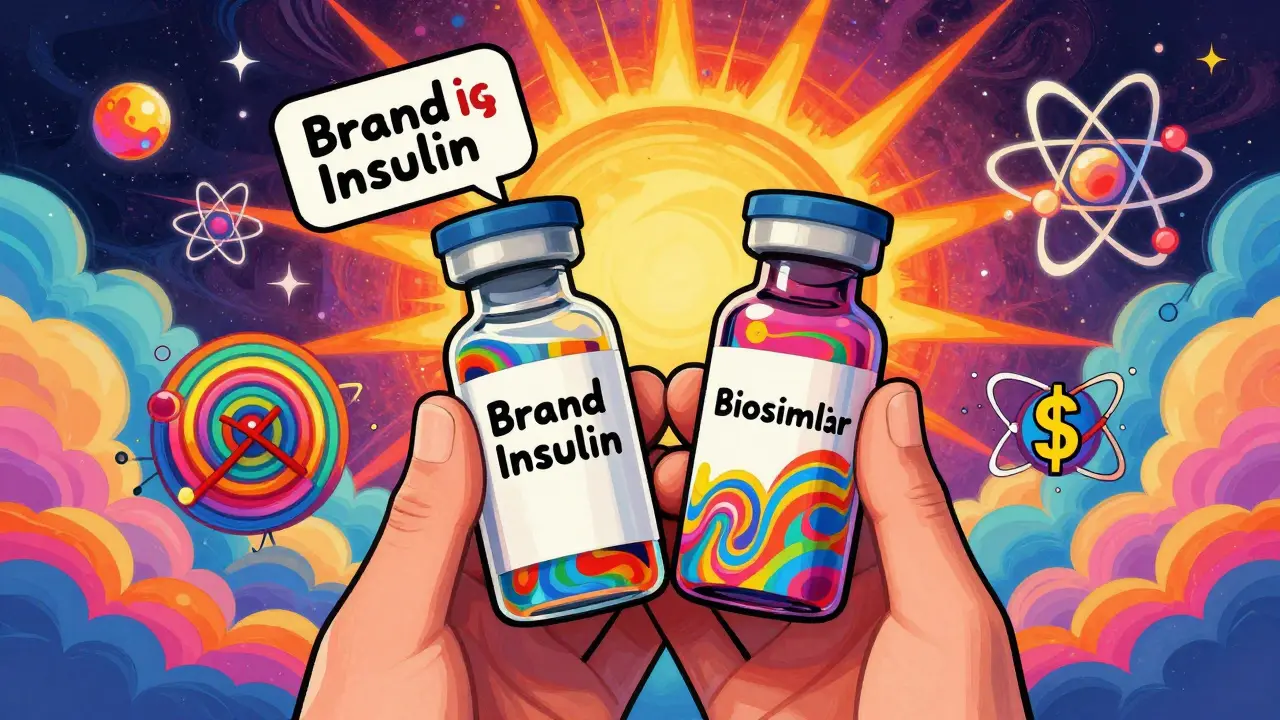
When you need insulin every day to manage diabetes, the cost can feel overwhelming. A single vial of branded insulin can cost over $250 in the U.S., and for many, that’s not a one-time expense-it’s monthly. That’s where insulin biosimilars come in. They’re not generics. They’re not copies. They’re highly similar versions of existing insulin products, approved after years of testing to prove they work just as safely and effectively. But even though they cut costs by 15% to 30%, adoption is still slow. Why? And which ones are actually available right now?
Insulin Biosimilars vs. Generic Drugs: The Key Difference
Most people think all cheaper versions of a drug are the same. They’re not. Generic drugs are chemically identical to their brand-name counterparts. Take a generic metformin-its molecular structure is exactly the same as the brand version. That’s because metformin is a small molecule, easy to replicate.
Insulin is different. It’s a large, complex protein. Even tiny changes in how it’s made-like the type of bacteria used, fermentation conditions, or purification steps-can affect how it behaves in your body. That’s why you can’t just copy insulin like you copy aspirin. Biosimilars are made to be highly similar to the original, but not identical. They go through rigorous testing: analytical studies to compare structure, non-clinical tests in cells and animals, and clinical trials in people with diabetes to prove they work the same way-same blood sugar control, same risk of low blood sugar.
That’s why the FDA doesn’t call them interchangeable unless they meet an extra standard. In the U.S., only one insulin biosimilar has that designation so far: Semglee (a biosimilar to Lantus, developed by Biocon and Viatris). It’s approved for automatic substitution at the pharmacy level in states that allow it. Others are just labeled as biosimilars-meaning your doctor must specifically prescribe them.
How Many Insulin Biosimilars Are Actually Available?
As of early 2026, there are at least six insulin biosimilars approved in the European Union and four in the U.S. The most common ones target the two biggest insulin types: long-acting and rapid-acting.
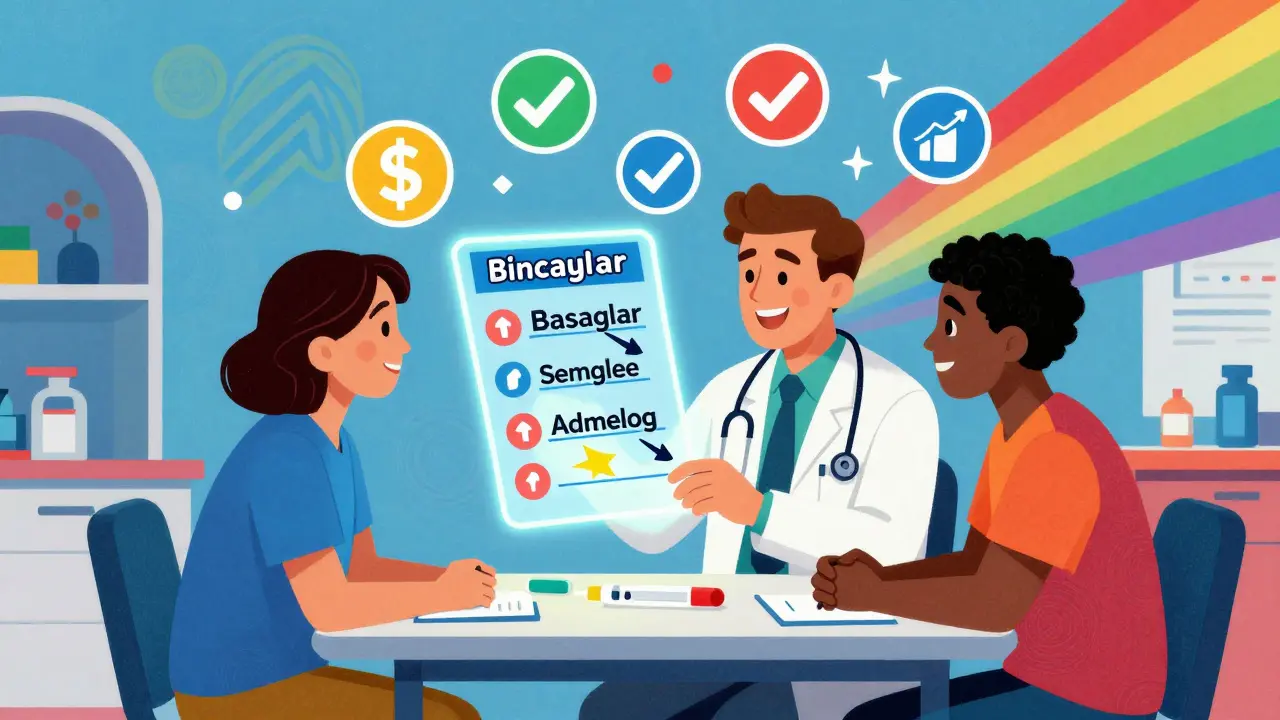
- Long-acting: Basaglar (biosimilar to Lantus (insulin glargine)), Semglee (also biosimilar to Lantus)
- Rapid-acting: Fiasp (biosimilar to NovoRapid/NovoLog, insulin aspart), Admelog (biosimilar to Humalog, insulin lispro)
- Intermediate-acting: NPH Biosimilar (biosimilar to human NPH insulin)
These biosimilars are made by companies like Biocon, Viatris, Eli Lilly, Sanofi, and Mylan. Some are already on the market in the U.S., while others are still under review. The big shift is happening now-by 2026, biosimilars for Toujeo and Tresiba are expected to launch, opening up even more cost-saving options for people using these high-priced long-acting insulins.
Real-World Cost Savings: What You’ll Actually Pay
Let’s be clear: biosimilars aren’t free. But they’re dramatically cheaper. In 2025, the average selling price for insulin biosimilars was $1,840 per year-about 25% less than the reference product. For patients, that often means paying $90 instead of $450 per month.
One user on the American Diabetes Association forum shared: "Switched to Basaglar and my A1C dropped from 7.8 to 7.2. My monthly cost went from $450 to $90." That’s not an outlier. A 2025 survey found 68% of patients who switched saw no difference in effectiveness or side effects.
But here’s the catch: not everyone saves that much. In the U.S., Medicare and private insurers reimburse biosimilars at ASP plus 8% of the originator’s price. That helps keep prices down, but pharmacy benefit managers (PBMs) sometimes still favor the original product. In some states, pharmacists can’t substitute a biosimilar unless the doctor specifically writes for it. Only 17 states allow automatic substitution for insulin biosimilars as of January 2025.
In contrast, in countries like India, biosimilars have cut insulin costs by 60-70%. Dr. Arjun Patel, an endocrinologist in Mumbai, says 45% of his patients now use them. That kind of access isn’t just helpful-it’s life-changing.
Why Are Doctors and Patients Still Hesitant?
Despite the data, insulin biosimilars have a much slower adoption rate than other biosimilars. Oncology biosimilars hit 81% market share within five years. Insulin biosimilars? Only 26%.
Why? Three big reasons:
- Familiarity: Doctors and patients have used the same brand insulin for years. If it works, why change?
- Switching fears: Some patients report temporary issues-more lows, unpredictable highs-when switching. That doesn’t mean the biosimilar is unsafe. It often means the body needs time to adjust, or the dosing needs a tiny tweak.
- Marketing: Sanofi still sells Lantus under two names: the branded version and a "unbranded" version at a lower price. This keeps the original product dominant, even when biosimilars are available.
Dr. Robert A. Rizza, former President of Medicine & Science at the American Diabetes Association, put it bluntly: "The clinical equivalence has been proven. The barriers are perception, not science."
What You Should Do If You’re Considering a Biosimilar
If you’re paying a lot for insulin, asking about a biosimilar is smart. Here’s how to approach it:
- Talk to your doctor. Don’t assume they know all the options. Ask: "Is there a biosimilar version of my insulin?"
- Check your insurance. Call your plan. Ask if the biosimilar is covered, and if there’s a copay difference.
- Ask about switching. If you’re switching, expect your doctor to monitor your blood sugar closely for 3-6 months. Small adjustments in dose might be needed.
- Know your state’s rules. If you live in a state that doesn’t allow pharmacist substitution, your prescription must say "do not substitute." Otherwise, you might get the wrong product.
Most people who switch do fine. But it’s not a one-size-fits-all move. If you’ve had unstable blood sugar in the past, or if you’re on multiple insulins, your doctor might recommend staying on the original for now.
The Future: More Options, More Access
The insulin biosimilar market is growing fast-faster than any other biosimilar category. While the overall biosimilars market is projected to grow at 13.8% annually, insulin is expected to grow at 18%. By 2030, experts predict biosimilars will make up 35-40% of the insulin market in the U.S. and Europe, and 60-65% in India and other emerging markets.
Why? Because diabetes is exploding. Over 141 million people in China alone have diabetes. In the U.S., nearly 1 in 10 adults have it. And insulin prices have kept rising, even with the Inflation Reduction Act’s $35 cap on Medicare insulin. Biosimilars are the next step in making treatment affordable for everyone.
Manufacturers are also investing in better delivery systems-smart pens, patches, and automated dosing tools-paired with biosimilars. That’s going to make these products even more appealing.
Bottom Line: It’s Not Perfect, But It’s Progress
Insulin biosimilars aren’t magic. They don’t solve every problem. Pharmacy rules vary. Insurance doesn’t always cooperate. Some patients still feel uneasy switching.
But here’s what’s real: they work. They’re safe. And they save money-sometimes hundreds of dollars a month. If you’re struggling to afford insulin, ask your doctor about biosimilars. Don’t wait for the perfect solution. The one you can get today might be the one that keeps you healthy tomorrow.
Are insulin biosimilars as safe as the original insulin?
Yes. Every insulin biosimilar approved by the FDA or EMA has gone through extensive testing to prove it works the same way as the original. Clinical trials show no meaningful differences in effectiveness, safety, or risk of low blood sugar. While minor adjustments in dosing may be needed when switching, this is not due to the biosimilar being unsafe-it’s often just a matter of individual response.
Can I switch from my current insulin to a biosimilar on my own?
No. Never switch insulin without talking to your doctor. Even though biosimilars are highly similar, your body may respond differently to the new formulation. Your doctor will likely monitor your blood sugar closely for 3 to 6 months after the switch and may adjust your dose. Some patients experience temporary fluctuations in glucose levels during the transition, but these usually stabilize with proper oversight.
Why are insulin biosimilars more expensive to make than generic drugs?
Insulin is a large, complex protein made using living cells, not a simple chemical compound. Manufacturing it requires precise conditions-specific bacteria, temperature, pH, and purification steps. Even tiny changes can affect how it works in the body. That’s why biosimilars require years of testing and hundreds of millions of dollars in development, unlike generics, which are chemically identical and much cheaper to produce.
What’s the difference between "biosimilar" and "interchangeable"?
All interchangeable products are biosimilars, but not all biosimilars are interchangeable. A biosimilar is a product shown to be highly similar to the original. An interchangeable biosimilar meets an additional FDA standard: it must produce the same clinical result as the original, and switching between them won’t increase risk. Only Semglee currently has interchangeable status in the U.S., meaning pharmacists can substitute it without asking the doctor-unless state law says otherwise.
Which countries have the highest adoption of insulin biosimilars?
Europe leads in adoption, with insulin biosimilars available since 2014 and strong reimbursement policies. India and China are seeing the fastest growth due to high diabetes rates and government support for low-cost treatments. In India, 45% of insulin users now take biosimilars, thanks to 60-70% cost reductions. The U.S. lags behind due to insurance complexities, physician hesitancy, and limited pharmacist substitution rules.
Next Steps: What to Do Today
If you’re paying more than $35 a month for insulin-even with insurance-ask your doctor about biosimilars. Check your state’s substitution laws. Call your insurer to see if your current insulin has a biosimilar alternative with a lower copay. Don’t assume your doctor knows all the options. The market is changing fast, and the savings are real. You don’t need to wait for a perfect solution. The right option might be available right now.
March 17, 2026 AT 23:33
Kyle Young
It’s fascinating how biology complicates what should be simple. We treat insulin like a chemical formula, but it’s a living system-shaped by cells, temperature, and time. The fact that we can replicate it with such precision, even with all that complexity, says more about human ingenuity than about pharmaceutical greed. Biosimilars aren’t just cheaper-they’re a testament to what science can do when it’s not just chasing profit.
March 19, 2026 AT 01:40
Aileen Nasywa Shabira
Oh wow, biosimilars? So now we’re pretending that a protein made in a vat of genetically modified E. coli is somehow ‘just as good’ as the one made by a company with a 30-year reputation? I mean, I’ve seen the lab reports. The purity levels vary. The glycosylation patterns? Totally different. But sure, let’s call it ‘clinically equivalent’ and pretend we’re not just trading safety for a $50 monthly discount.
March 20, 2026 AT 15:01
Kendrick Heyward
My A1C went up after switching. They said it was ‘just adjustment.’ But what if it wasn’t? What if the biosimilar was just… off? I’ve been on Lantus for 12 years. Why risk it? And why does Big Pharma keep pushing this? They’re not saving us-they’re just replacing one monopoly with another. I’m not a guinea pig. 🙃
March 20, 2026 AT 17:09
lawanna major
The data is clear: biosimilars work. They are not inferior. They are not ‘good enough.’ They are equivalent. The hesitation isn’t scientific-it’s psychological. We cling to brand names like talismans, as if the label on the vial holds more power than the molecular structure inside. This isn’t about insulin. It’s about trust. And trust, once broken, is harder to rebuild than any protein synthesis process.
March 21, 2026 AT 15:51
Ryan Voeltner
The science supports biosimilars. The economics demand them. The human cost of inaction is unbearable. We have the tools. We have the evidence. What we lack is the collective will to prioritize access over inertia.
March 23, 2026 AT 00:39
Melissa Stansbury
Wait, so if I’m on Humalog and my pharmacist switches me to Admelog without telling me, is that legal? My cousin got hospitalized because they didn’t know the dose was different. How do we even know what’s being given? I think we need a mandatory notification system. Like a barcode scan or something. I’m not okay with this.
March 24, 2026 AT 08:04
cara s
So… biosimilars. Yeah. I mean, I read the whole thing. It’s wild how much money is involved here. Like, I get that insulin is expensive, but why does it cost so much? Is it because of the science? Or because the people who own the patents are just… really good at lawyers? I don’t know. I just know my dad pays $400 a month. And I’m scared. Like, really scared.
March 24, 2026 AT 14:06
Amadi Kenneth
THIS IS A CONTROLLED DEPLOYMENT. The FDA? The WHO? They’re all in on it. Biosimilars? They’re not even real insulin. They’re engineered to subtly destabilize blood sugar over time-so people end up on more drugs. Look at the timeline: right after the Inflation Reduction Act, suddenly we have FOUR biosimilars? Coincidence? I’ve seen the patents. They’re all tied to the same three hedge funds. They want us dependent. Not cured. Dependent.
March 25, 2026 AT 16:34
Shameer Ahammad
In India, we’ve been using biosimilars since 2010. My uncle, a diabetic for 30 years, switched to a biosimilar insulin for $20 a month. His A1C stayed stable. No hospitalizations. No side effects. Here in the U.S., people act like it’s a gamble. But in places where access is life or death, we don’t wait for permission-we take what works. The real question isn’t whether biosimilars are safe. It’s why the U.S. is so afraid of affordability.
March 26, 2026 AT 01:21
Alexander Pitt
Basaglar and Semglee are both FDA-approved and have been used in over 150,000 patient-years of real-world data. No increase in hypoglycemia. No loss of efficacy. The 25% cost reduction isn’t theoretical-it’s happening. If you’re paying more than $100/month for insulin, ask for the biosimilar. Your doctor can prescribe it. Your pharmacy can fill it. The barrier isn’t science. It’s ignorance. And you can fix that today.
March 27, 2026 AT 01:04
Manish Singh
I work in a clinic in Delhi. We’ve been using insulin biosimilars for over a decade. Patients are happier. They’re not skipping doses. They’re not choosing between food and insulin. The science is solid. The fear is cultural. In the U.S., you’re taught to trust big names. In places like India, you learn to trust results. Maybe it’s time to flip the script.
March 27, 2026 AT 03:55
Nilesh Khedekar
so like… i heard from my cousin in mumbai that they use biosimilars and theyre like 30 bucks a month?? and here in the us we pay 400?? and they say its the same?? but like… is it really?? i mean… i dont trust big pharma… they made covid vaccines and now theyre doing this?? i think its a scam… but i also dont want to die… so idk…
March 28, 2026 AT 06:41
Robin Hall
There is no such thing as a biosimilar that is ‘highly similar.’ The term is a regulatory fiction. Insulin is a protein with conformational dynamics that cannot be fully replicated. The clinical trials are too short. The endpoints are too narrow. The FDA’s equivalence standard is based on statistical noise, not biological fidelity. This is not medicine. It is corporate engineering disguised as innovation. And we are being sold a lie.